Following the proton without losing charge
By UK A Level Chemistry · independent study · myAudience
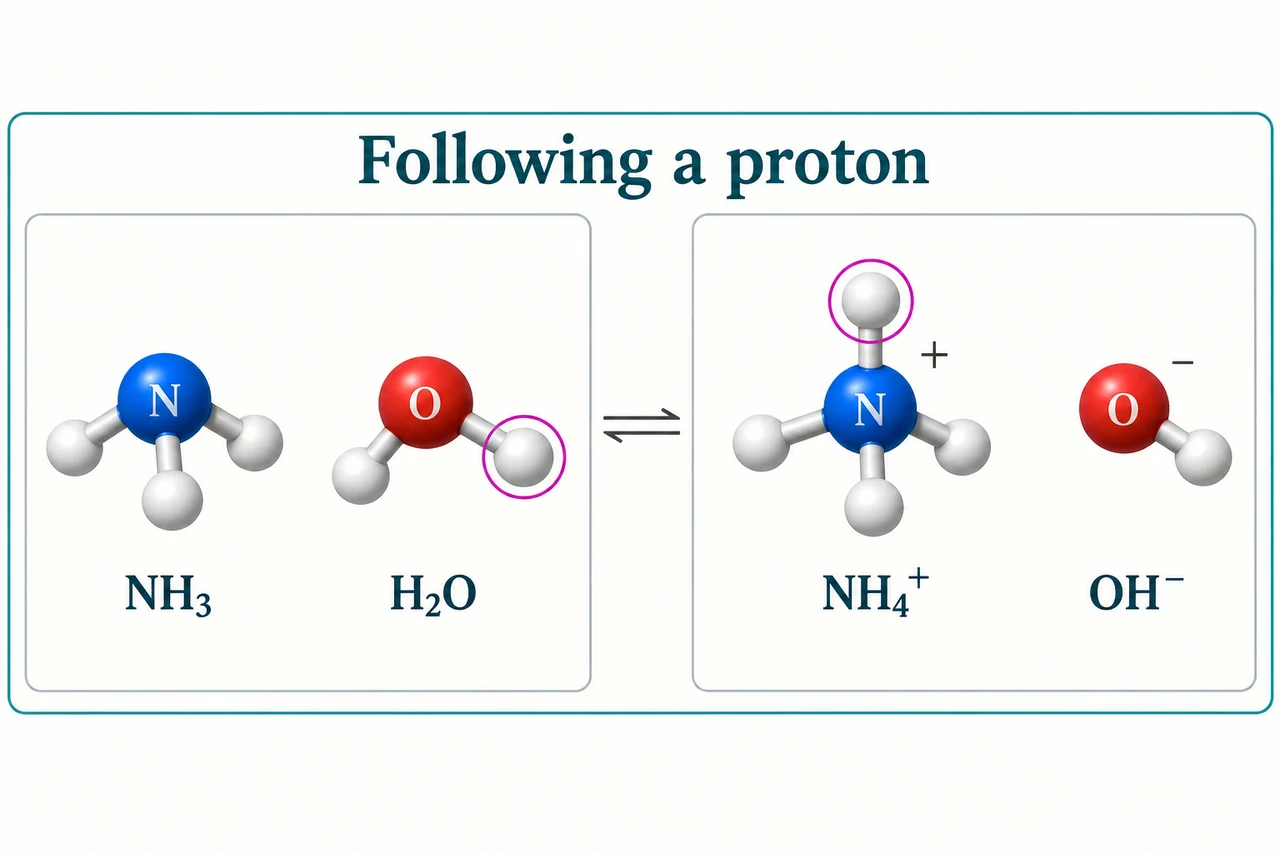
Image: illustration, not a documentary photograph. One proton-transfer event conserves N1 H5 O1 and net charge; the highlighted hydrogen is a correspondence marker. Particle positions are schematic, not measured bond angles; solvent water and equilibrium composition are not represented. · Original AI-generated illustration; independently reviewed scientific teaching model.
Following the proton without losing charge
Calling a substance an acid tells us what it does in a particular reaction. In the Brønsted–Lowry model, an acid donates a proton and a base accepts it. A proton here is the hydrogen nucleus, represented by H+. This model lets us explain reactions involving ammonia, water and many dissolved ions without requiring every base to contain hydroxide. Begin with a balanced reaction and ask which participant loses one hydrogen nucleus and which gains it. The answer depends on the reaction partners: a substance can have different roles in different equilibria.
Consider NH3 + H2O ⇌ NH4+ + OH−. Ammonia gains a proton, so it acts as the base; water loses that proton, so it acts as the acid. The products make sense when both atoms and charge are counted. Before the event there are one nitrogen, one oxygen and five hydrogens; afterwards there are the same totals. The reactants have total charge zero, and the products have charges +1 and −1, again summing to zero. Proton transfer changes the identities and charges of the species without creating another nucleus or losing matter.
The reversible arrow asks us to read the reaction in both directions. NH4+ can donate a proton back to OH−, regenerating NH3 and H2O. Each species and its partner after proton loss form a conjugate acid–base pair: NH4+/NH3 and H2O/OH−. Members of a pair differ by one H+ and therefore by one unit of charge. They do not differ by an electron alone or by an entire water molecule. Writing the pairs separately is a useful check when an unfamiliar equation contains several hydrogen-bearing ions and the acid is not obvious.
In aqueous chemistry H+ is convenient notation for a solvated proton, rather than a lone nucleus drifting through the solution. H3O+ makes one water-associated representation explicit, although liquid water supports a more complicated changing network of interactions. For example, HA + H2O ⇌ H3O+ + A− expresses the same proton-donation idea as the shorter HA ⇌ H+ + A− used in concentration calculations. Keep the convention consistent when balancing an equation. Do not insert H3O+ into the shorter equation without also supplying the water needed to conserve oxygen and hydrogen.
An acid–base reaction and a redox reaction answer different accounting questions. In the ammonia example the defining event is transfer of a proton; it does not represent electron transfer between an oxidising and a reducing agent. Water becoming OH− does not mean that a negative oxygen particle was manufactured. Removing positively charged H+ from a neutral species leaves a species with charge −1. Ammonia accepting H+ becomes NH4+ because adding a positively charged proton changes its net charge. The formal charges help account for this process; they do not show measured partial charges on individual bonds.
Some species can donate or accept a proton. Hydrogen carbonate illustrates this flexibility: HCO3− + H2O ⇌ CO3²− + H3O+ shows hydrogen carbonate donating, whereas HCO3− + H2O ⇌ H2CO3 + OH− shows it accepting. Such a species is amphiprotic. The two equations do not promise equal extents or a solution at pH 7: those conclusions would require equilibrium information. The general lesson is to assign the acid and base from a specified proton transfer, then use equilibrium constants and concentrations when deciding how much reaction occurs.
The illustration follows one displayed transfer event, not the full composition of a beaker. The magenta outline identifies the corresponding hydrogen before and after; it is not another atom. Count three hydrogens on NH3 and two on H2O before, then four on NH4+ and one on OH− afterwards. The shaded positions make counting clear but should not be used to measure molecular bond angles. Most solvent water is omitted, and the particle counts do not imply complete ammonia ionisation. These limits separate the useful conservation model from claims that this particular drawing cannot establish.
Worked example: For NH3 + H2O ⇌ NH4+ + OH−, identify the acid, base and both conjugate pairs, then verify atom and charge conservation. Explain the acid and base on the reverse reading.
NH3 gains H+: it is the forward base. H2O loses H+: it is the forward acid.
Pairs are NH4+/NH3 and H2O/OH−; each pair differs by one proton and one charge unit.
Before: N1 H(3+2)=5 O1 and net charge 0. After: N1 H(4+1)=5 O1 and net charge (+1)+(−1)=0.
On reversing the reaction NH4+ donates H+ and OH− accepts it, regenerating neutral NH3 and H2O.
Answer: Ammonia is the forward base and water the forward acid. Both conjugate pairs, all N1 H5 O1 atom totals and zero total charge are conserved. The reverse acid/base roles belong to NH4+ and OH− respectively; the reversible arrow alone does not quantify the extent.
Check your understanding: Read HCO3− + H2O ⇌ CO3²− + H3O+. Identify both conjugate pairs and check charge and atoms. Then write the alternative reaction in which HCO3− accepts a proton from water. Does having both possibilities guarantee neutral pH?
Answer: In the first reaction HCO3− donates H+ and H2O accepts it. The pairs are HCO3−/CO3²− and H3O+/H2O. Each side contains C1 H3 O4, with charge −1 before and (−2)+(+1)=−1 after. The accepting branch is HCO3− + H2O ⇌ H2CO3 + OH−: again C1 H3 O4 and net charge −1 are conserved. Here hydrogen carbonate is the base and water the acid. Having both roles establishes amphiprotic behaviour, not equal equilibrium extents; without appropriate equilibrium and concentration data we cannot infer pH 7.
Why: Original independently checked transfer reasoning under stated concentration, temperature and finite-inventory limits. Editorial review is not assessed mastery, observed practical performance or a completed practical endorsement.