Reading a logarithmic acidity scale
By UK A Level Chemistry · independent study · myAudience
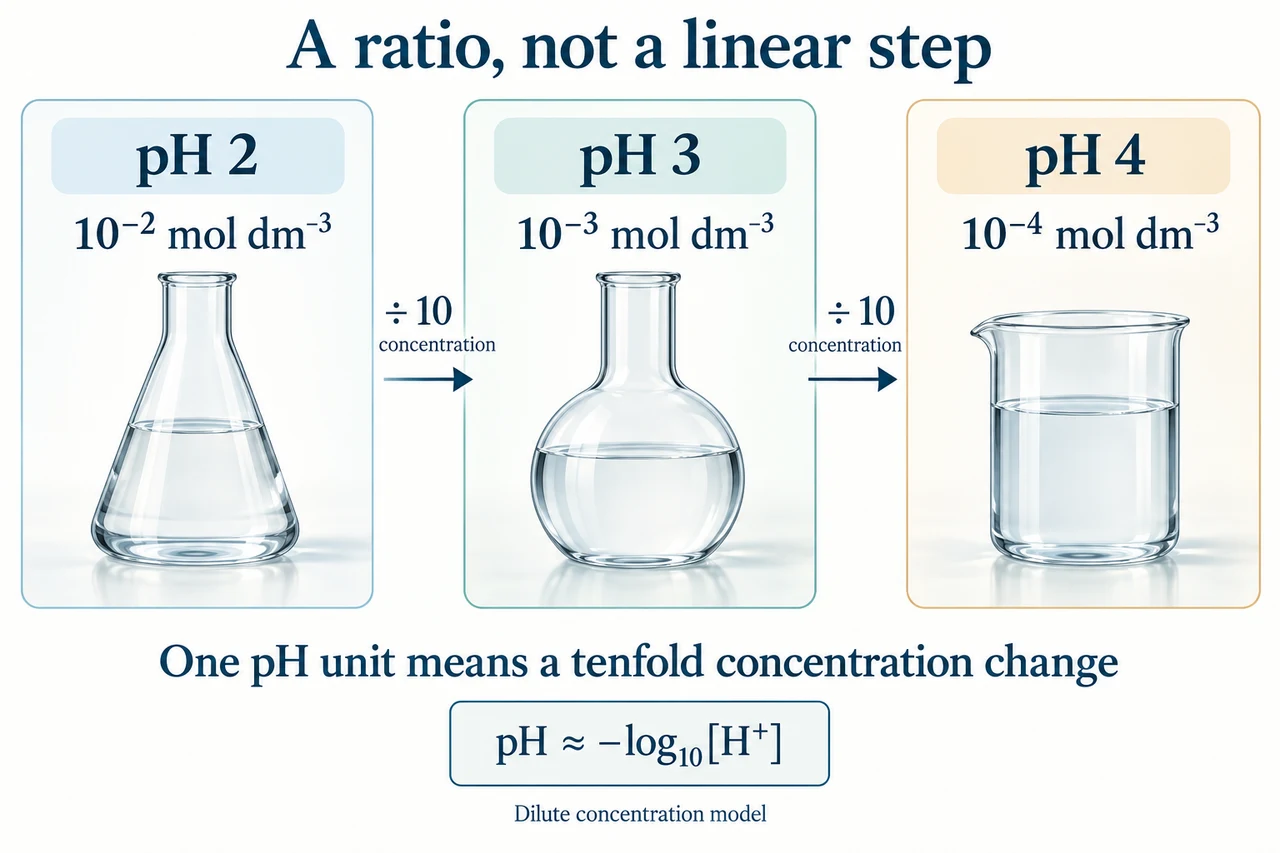
Image: illustration, not a documentary photograph. Equal pH intervals encode tenfold differences in the numerical hydrogen-ion concentration; symbolic marks and accent colours are explanatory, not measured particles or intrinsic solution colours. · Original AI-generated illustration; independently reviewed scientific teaching model.
Reading a logarithmic acidity scale
A concentration scale has to span very different quantities: a solution containing 0.01 mol dm−3 hydrogen ions has a million times the concentration of one containing 0.00000001 mol dm−3. The pH scale makes such ratios easier to compare by using a base-ten logarithm. In the A Level concentration approximation, pH = −log10[H+], with the bracket interpreted as the numerical concentration in mol dm−3. A smaller pH therefore means a larger hydrogen-ion concentration. A decrease of one pH unit corresponds to a tenfold increase, rather than an increase by one mole per cubic decimetre.
There is an important convention behind the compact equation. IUPAC defines pH in terms of hydrogen-ion activity, using a molality-based standard state in its formal definition. A single-ion activity cannot be measured independently, so operational pH standards and measurement conventions also matter. concentration calculation treats the numerical [H+] in mol dm−3 as the logarithm's input for dilute idealised classroom problems; dividing concentration by 1 mol dm−3 makes that numerical ratio dimensionless. This useful approximation does not replace the formal metrological definition or establish exact equivalence between concentration and molality. pH has no unit, and appreciable non-ideal interactions require more care than this model provides.
A strong monoprotic acid supplies approximately one hydrogen ion per acid formula unit when dissociation is effectively complete and the acid contribution greatly exceeds that from water. For 0.00500 mol dm−3 such an acid, use [H+] ≈ 0.00500 mol dm−3 and obtain pH = 2.30103, or 2.301 when three decimal places reflect the three-significant-figure concentration. An exercise may instead specify a two-decimal reporting convention. The word monoprotic is doing work: it prevents us from silently treating all acids as supplying exactly one proton per formula unit. Strong describes dissociation, whereas concentrated describes the amount per volume; neither word can substitute for the other.
Dilution calculations start with matter conservation, not with an average of two pH values. If 20.0 cm³ of 0.0250 mol dm−3 strong monoprotic acid is made up to 100.0 cm³, the acid amount is 0.0200 dm³ × 0.0250 mol dm−3 = 0.000500 mol. The final concentration is 0.000500 mol divided by 0.1000 dm³, giving 0.00500 mol dm−3. Only after obtaining that concentration should we take the logarithm. Volumes must share a consistent unit, and making up to 100.0 cm³ is different from adding 100.0 cm³ of water.
The inverse calculation is just as useful. A supplied pH of 3.40 corresponds to a numerical concentration 10^(−3.40) = 3.98107 × 10⁻⁴, hence [H+] ≈ 3.98 × 10⁻⁴ mol dm−3 within the stated approximation. If a strong-acid solution is diluted to four times its initial volume, this concentration falls by a factor of four and the pH increases by log10(4), approximately 0.60206. It becomes about 4.00, not 13.60. Averaging or multiplying pH values treats a logarithmic description as a linear concentration and therefore loses the underlying matter balance.
Reporting pH requires care because decimal places in a logarithm carry information about precision. For example, 0.00500 has three significant figures, and the corresponding pH is appropriately expressed to roughly three decimal places if those are the only uncertainty constraints; an educational result may round to 2.30 when a two-decimal convention is stated. Keep extra calculator digits during intermediate work and state the final reporting convention. A pH measurement and a concentration inferred from it also depend on calibration, temperature and the activity approximation, not simply on how many digits fit on the screen.
Water sets a limit on the shortcut [H+] ≈ acid concentration. An extremely dilute strong acid cannot be assigned [H+] below the water contribution by pretending that the solvent supplies none. Near that regime we must combine charge balance with water's equilibrium product, which the next unit introduces. Likewise, 0–14 is a familiar classroom range rather than an absolute physical boundary: sufficiently concentrated or unusual conditions can produce values outside it. The diagram's equal pH steps should be read as equal concentration ratios, and its schematic colour must not imply that acid solutions inherently change colour without an indicator.
Worked example: Make 20.0 cm³ of a 0.0250 mol dm−3 fully dissociated monoprotic strong acid up to 100.0 cm³. Find the acid amount, concentration and approximate pH. For this exercise report pH to two decimal places.
Convert aliquot volume: 20.0 cm³ = 0.0200 dm³. The final volume is 0.1000 dm³.
Conserved acid amount n = cV = 0.0250 × 0.0200 = 0.000500 mol.
Final concentration = 0.000500/0.1000 = 0.00500 mol dm−3. Complete monoprotic dissociation and dominant acid contribution give [H+] ≈ 0.00500 mol dm−3.
pH = −log10(0.00500) = 2.301029996; under the requested reporting convention this is 2.30.
Answer: The acid amount remains 0.000500 mol, final concentration is 0.00500 mol dm−3 and the concentration-approximation pH is 2.30 to two decimal places. The calculation uses the final total volume and assumes complete monoprotic dissociation with negligible water contribution.
Check your understanding: A dilute ideal strong monoprotic acid has supplied pH 3.40. Calculate its hydrogen-ion concentration, then predict the pH when its volume is made four times larger with water. Explain why multiplying 3.40 by four fails.
Answer: Invert the logarithm: [H+] ≈ 10^(−3.40) = 3.98107 × 10⁻⁴ mol dm−3. Conserving acid amount while quadrupling volume gives 9.95268 × 10⁻⁵ mol dm−3. The new pH is −log10(9.95268 × 10⁻⁵) = 4.00206, or 4.00 to two decimal places. The change is log10(4) = 0.60206 because concentration falls by a factor of four; multiplying pH by four would multiply a logarithm rather than apply the matter balance. These concentrations remain far above the usual water contribution under the stated dilute-ideal, monoprotic conditions.
Why: Original independently checked transfer reasoning under stated concentration, temperature and finite-inventory limits. Editorial review is not assessed mastery, observed practical performance or a completed practical endorsement.