Water sets the temperature-dependent neutral point
By UK A Level Chemistry · independent study · myAudience
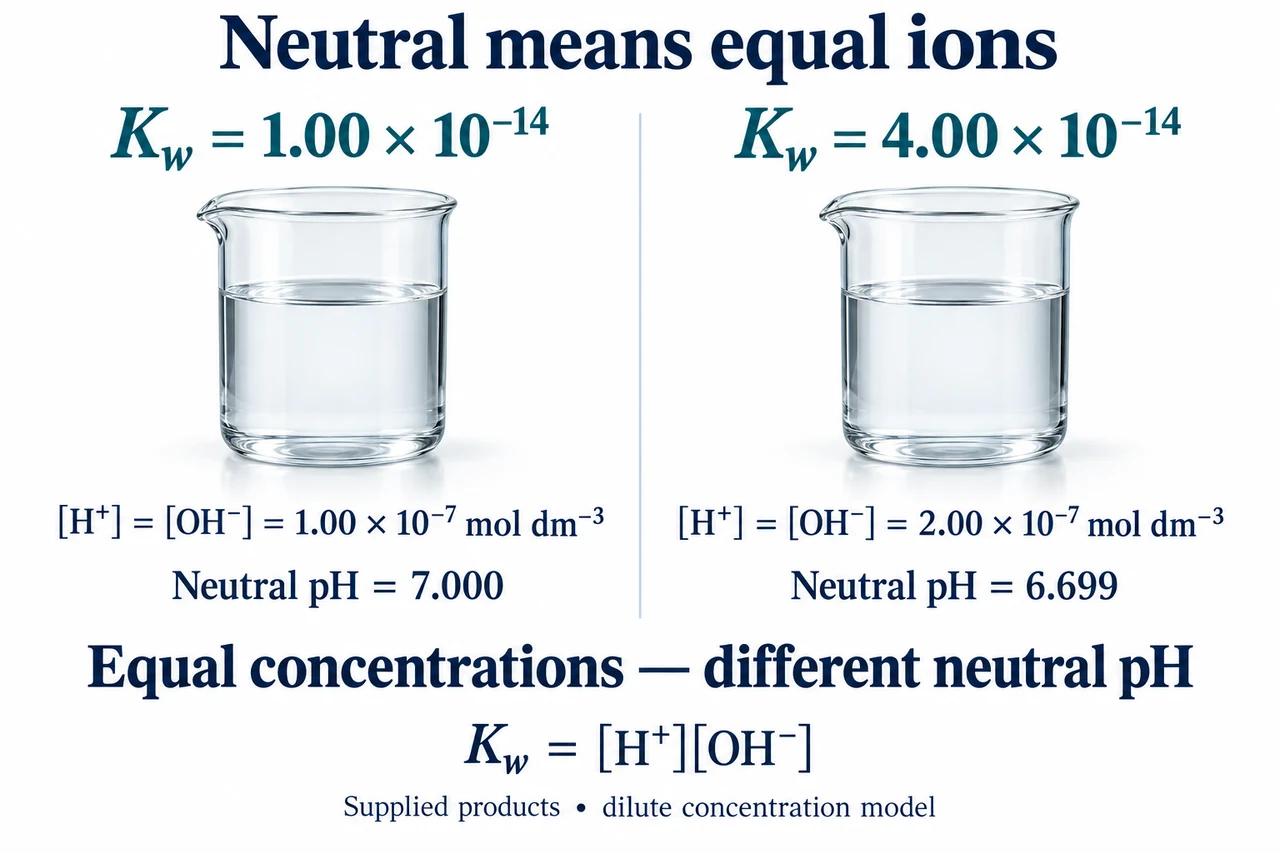
Image: illustration, not a documentary photograph. Two supplied Kw values give different neutral pH values while hydrogen-ion and hydroxide concentrations remain equal; the panels do not establish a quantitative temperature law. · Original AI-generated illustration; independently reviewed scientific teaching model.
Water sets the temperature-dependent neutral point
Even pure water is not an inventory containing only H2O. A small fraction participates in proton transfer, represented explicitly as 2H2O ⇌ H3O+ + OH−. The activity-based equilibrium ratio for that equation is a(H3O+)a(OH−)/a(H2O)². In dilute aqueous solutions the solvent activity is treated as approximately constant, so its denominator is absorbed when defining the ionic product. Classroom concentration notation then uses H+ for the solvated proton and writes Kw = [H+][OH−], commonly supplied in (mol dm−3)². This concentration-form constant must be distinguished from a dimensionless thermodynamic equilibrium constant with specified standard states. The ions form and recombine at equilibrium; the equation does not describe a one-time process which steadily uses up all the solvent.
Water's equilibrium product constrains the hydrogen-ion and hydroxide concentrations together. At a stated temperature, increasing one concentration generally requires the other to fall if the equilibrium product is to remain constant. This relationship does not say that hydrogen ions and hydroxide ions are always equal. Equality defines neutral conditions in this concentration approximation. In an acidic solution [H+] exceeds [OH−]; in an alkaline solution the ordering is reversed. Before labelling a solution, compare these quantities or use the neutral pH appropriate to the supplied Kw and temperature.
For a supplied Kw = 1.00 × 10⁻¹⁴ (mol dm−3)², neutral water has equal concentrations x satisfying x² = Kw. Thus x = 1.00 × 10⁻⁷ mol dm−3 and pH = 7.00. The familiar value is tied to these conditions; it is not the definition of neutrality at every temperature. The positive root is required because a concentration cannot be negative. Checking the product after calculating x is a quick safeguard against confusing Kw with its square root or accidentally using a sum of the ion concentrations.
A dilute strong base can often be handled in two steps. If 0.00250 mol dm−3 NaOH dissociates effectively completely, it supplies approximately the same hydroxide concentration. With the supplied Kw above, [H+] = Kw/[OH−] = 4.00 × 10⁻¹² mol dm−3. The pH is therefore 11.39794, reported as 11.40 under a two-decimal exercise convention. The denominator is hydroxide concentration, not the base volume or the amount in moles. NaOH supplies one OH− per formula unit; another hydroxide's stoichiometry must be checked rather than assumed identical.
A different temperature means a potentially different Kw. If an exercise supplies 4.00 × 10⁻¹⁴ (mol dm−3)² at an elevated temperature, neutrality gives equal ion concentrations of 2.00 × 10⁻⁷ mol dm−3 and pH = 6.69897. The neutral water has pH about 6.70 without becoming acidic relative to its own equilibrium. Calling every pH below 7 acidic would misclassify it. The pH remains a logarithmic hydrogen-ion description; it is the neutral comparison value, determined by the water equilibrium, which has changed.
Some textbooks introduce pOH = −log10[OH−] and pKw = −log10 of the numerical Kw. Taking logarithms of the concentration-form product gives pH + pOH = pKw. This route is convenient, provided the correct temperature-specific pKw is used. The frequently memorised pH + pOH = 14 is only the case where the supplied numerical Kw equals 10−14. It is safer to keep Kw visible in unfamiliar questions: calculate the missing ion concentration, verify the product and then take the appropriate logarithm.
These base calculations assume that the supplied base contributes far more hydroxide than water would on its own and that the solution is dilute enough for the activity approximation. Near neutral conditions, replacing [OH−] by the analytical base concentration can fail because water contributes additional ions. A more complete solution then combines the product equation with charge balance. The illustration compares two supplied equilibrium products without claiming a universal temperature curve. Equal ion labels establish neutrality; symbolic vessel colours are design aids, and the panels are not measurements of how every real solution changes when heated.
Worked example: At a temperature where Kw = 1.00 × 10⁻¹⁴ (mol dm−3)², a dilute 0.00250 mol dm−3 NaOH solution dissociates fully. Find [OH−], [H+] and pH, stating the water-contribution approximation.
NaOH supplies one OH− per formula unit; its dominant contribution gives [OH−] ≈ 0.00250 mol dm−3.
Use [H+] = Kw/[OH−] = (1.00 × 10⁻¹⁴)/0.00250 = 4.00 × 10⁻¹² mol dm−3.
Verify the product: 0.00250 × 4.00 × 10−12 = 1.00 × 10⁻¹⁴.
pH = −log10(4.00 × 10⁻¹²) = 11.39794001, or 11.40 to two decimal places.
Answer: [OH−] is approximately 0.00250 mol dm−3, [H+] is 4.00 × 10⁻¹² mol dm−3 and pH is 11.40 under the stated concentration and rounding approximations. The strong-base hydroxide contribution dominates water dissociation.
Check your understanding: At another supplied temperature Kw is 4.00 × 10⁻¹⁴ (mol dm−3)². Find neutral pH and the pH of a dilute strong-base solution with [OH−] = 0.00500 mol dm−3. Is the neutral water acidic because its pH is below 7?
Answer: Neutrality requires [H+] = [OH−] = sqrt(Kw) = 2.00 × 10⁻⁷ mol dm−3, so neutral pH is 6.69897, or 6.70. For the supplied base, [H+] = (4.00 × 10⁻¹⁴)/0.00500 = 8.00 × 10⁻¹² mol dm−3 and pH = 11.09691, or 11.10. The neutral water is not acidic relative to its own conditions: the two ion concentrations are equal. A fixed comparison with 7 would incorrectly ignore the temperature dependence of Kw; the base lies above the correct neutral pH and has much more OH− than H+.
Why: Original independently checked transfer reasoning under stated concentration, temperature and finite-inventory limits. Editorial review is not assessed mastery, observed practical performance or a completed practical endorsement.