Weak-acid strength needs an equilibrium inventory
By UK A Level Chemistry · independent study · myAudience
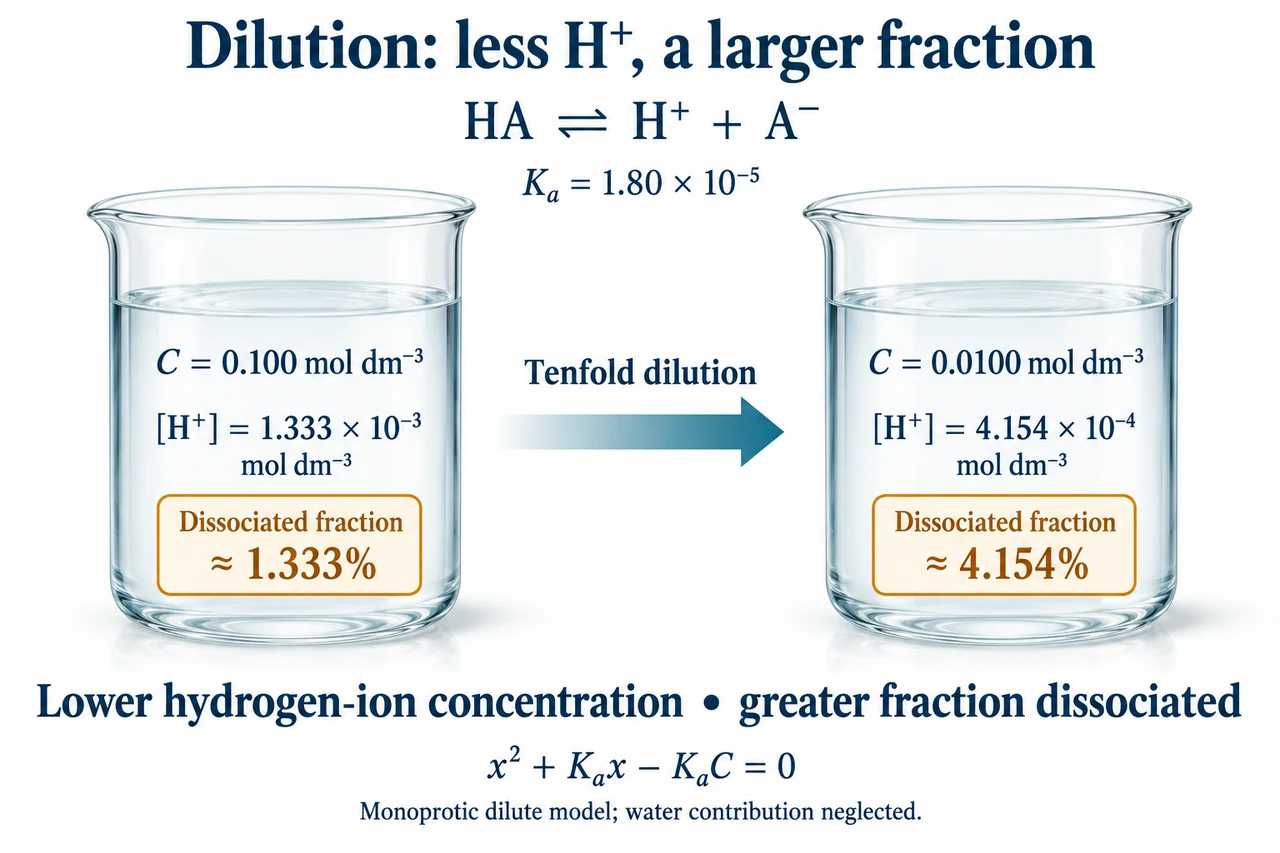
Image: illustration, not a documentary photograph. Supplied analytical concentrations and calculated weak-acid results distinguish concentration from dissociated fraction. The equal decorative sample vessels do not depict total batch volumes; water and non-ideal activities are neglected in the stated model. · Original AI-generated illustration; independently reviewed scientific teaching model.
Weak-acid strength needs an equilibrium inventory
A weak acid does not dissociate completely in water. For a monoprotic acid HA, the concentration model writes HA ⇌ H+ + A− and Ka = [H+][A−]/[HA]. The bracketed values are equilibrium concentrations, not automatically the amounts originally poured into the container. A small Ka means the equilibrium favours undissociated HA under the relevant standard conventions and temperature. Strength is therefore an equilibrium property. Dilution changes concentrations and the dissociated fraction, but it does not by itself turn the acid into a different substance with an arbitrarily different Ka at the same temperature.
Begin with an analytical concentration C of HA and no deliberately added A−. If water's contribution is negligible, let x mol dm−3 of acid dissociate. The equilibrium inventory becomes [H+] = x, [A−] = x and [HA] = C − x. It follows that Ka = x²/(C − x). This ledger conserves the total acid family: undissociated HA plus A− equals C. It also gives a physical range, 0 < x < C. A computed negative concentration or more dissociation than the available acid amount is a rejected mathematical result, not an unusual chemical discovery.
The familiar shortcut assumes x is small compared with C, replacing C − x by C and obtaining x ≈ sqrt(KaC). It is a conditional approximation which needs checking afterwards. For supplied C = 0.100 mol dm−3 and Ka = 1.80 × 10⁻⁵ mol dm−3, the shortcut gives 0.00134164 mol dm−3. This is about 1.34% of C, suggesting that depletion is small. However, the exact quadratic solution is available and lets us quantify the difference rather than rely solely on an informal rule that every weak acid must be only slightly dissociated at every concentration.
Rearranging gives x² + Kax − KaC = 0. Select the positive root x = (sqrt(Ka² + 4KaC) − Ka)/2; the negative root cannot represent concentration. For the supplied example x = 0.001332670973 mol dm−3 and pH = 2.875277. Substituting x into x²/(C − x) recovers Ka. The equilibrium acid concentration is approximately 0.0986673 mol dm−3, and the dissociated fraction is 1.33267%. On a computer, an algebraically equivalent expression, 2KaC/(sqrt(Ka² + 4KaC) + Ka), avoids subtracting nearly equal numbers in more extreme cases.
Diluting the same hypothetical acid to C = 0.0100 mol dm−3 gives exact x = 0.0004153595174 mol dm−3 and pH = 3.381576. The hydrogen-ion concentration falls, so the pH rises, but the dissociated percentage increases to about 4.15360%. There is no contradiction: a greater fraction of a smaller analytical inventory can still produce fewer ions per volume. The numerical Ka stays the supplied constant at the same temperature. Comparing C, x and x/C separately prevents us from confusing acid amount, acidity and the fraction that has dissociated.
pKa compresses the equilibrium constant into a logarithmic description: pKa = −log10 of the numerical concentration-form Ka, with the corresponding standard-concentration convention understood. For Ka = 1.80 × 10⁻⁵ the pKa is 4.744727. Reverse the operation with Ka = 10^(−pKa) under that convention. A smaller pKa corresponds to a larger Ka, usually indicating stronger proton donation within a comparable setting. Weak bases also react only partially with water, but they accept rather than donate protons. This unit does not pretend that a weak-base pH can be found by inserting its concentration into the strong-base shortcut.
Our simple HA inventory has boundaries. Added common ion, another acid, appreciable water dissociation or significant non-ideal activity changes can make [H+] and [A−] differ from the chosen x or make the concentration formula an imperfect description. Those situations require an appropriate charge and material balance, not repeated use of an invalid square root. The illustration contrasts the supplied analytical concentration, calculated free-ion concentration and dissociated fraction. Its equal decorative sample vessels do not represent the total batch volume before and after dilution. Printed results belong to this supplied model, not measured liquids or a claim that all weak acids share its constant.
Worked example: A hypothetical monoprotic weak acid has C = 0.100 mol dm−3 and concentration-form Ka = 1.80 × 10⁻⁵ mol dm−3 at a stated temperature. Neglect water and non-ideal activities. Calculate the exact [H+], pH and dissociation fraction, then test the small-depletion approximation.
Let x = [H+] = [A−]; [HA] = C − x. Thus Ka = x²/(C − x) and x² + Kax − KaC = 0.
The physical positive root is (sqrt(Ka² + 4KaC) − Ka)/2 = 0.001332670973 mol dm−3; reject the negative root.
The acid inventory gives [HA] = 0.09866732903 mol dm−3; x²/[HA] recovers 1.80 × 10⁻⁵ mol dm−3.
pH = −log10(x) = 2.875277062, or 2.88 under a two-decimal convention; 100x/C = 1.332670973%.
sqrt(KaC) = 0.001341640786 mol dm−3, approximately 0.67307% above the exact x. Depletion is small but the approximation is not identical to the exact root.
Answer: The exact free hydrogen-ion concentration is 0.001332670973 mol dm−3, pH is 2.875277062 and 1.33267% of the acid dissociates under the stated idealised inventory. The square-root approximation slightly overestimates [H+]; the positive root, conserved acid family and recovered Ka provide independent physical checks.
Check your understanding: Dilute the same acid to C = 0.0100 mol dm−3 at unchanged temperature. Find the exact [H+], pH and dissociation percentage. Explain why weaker acidity and a larger dissociation fraction can occur together, and reconstruct Ka from the result.
Answer: Using the physical root of x² + Kax − KaC = 0 gives x = 0.0004153595174 mol dm−3. Then pH = 3.381575834 and 100x/C = 4.153595174%. The residual undissociated acid is C − x = 0.009584640483 mol dm−3, so x²/(C − x) = 1.80 × 10⁻⁵ mol dm−3, recovering the unchanged constant. Hydrogen-ion concentration is lower than before dilution while the percentage dissociated is higher because the total acid inventory per volume has decreased. The larger percentage does not imply a larger absolute concentration or a new Ka; added common ion, appreciable water or non-ideal effects would require a different ledger.
Why: Original independently checked transfer reasoning under stated concentration, temperature and finite-inventory limits. Editorial review is not assessed mastery, observed practical performance or a completed practical endorsement.