Why a buffer resists a small addition
By UK A Level Chemistry · independent study · myAudience
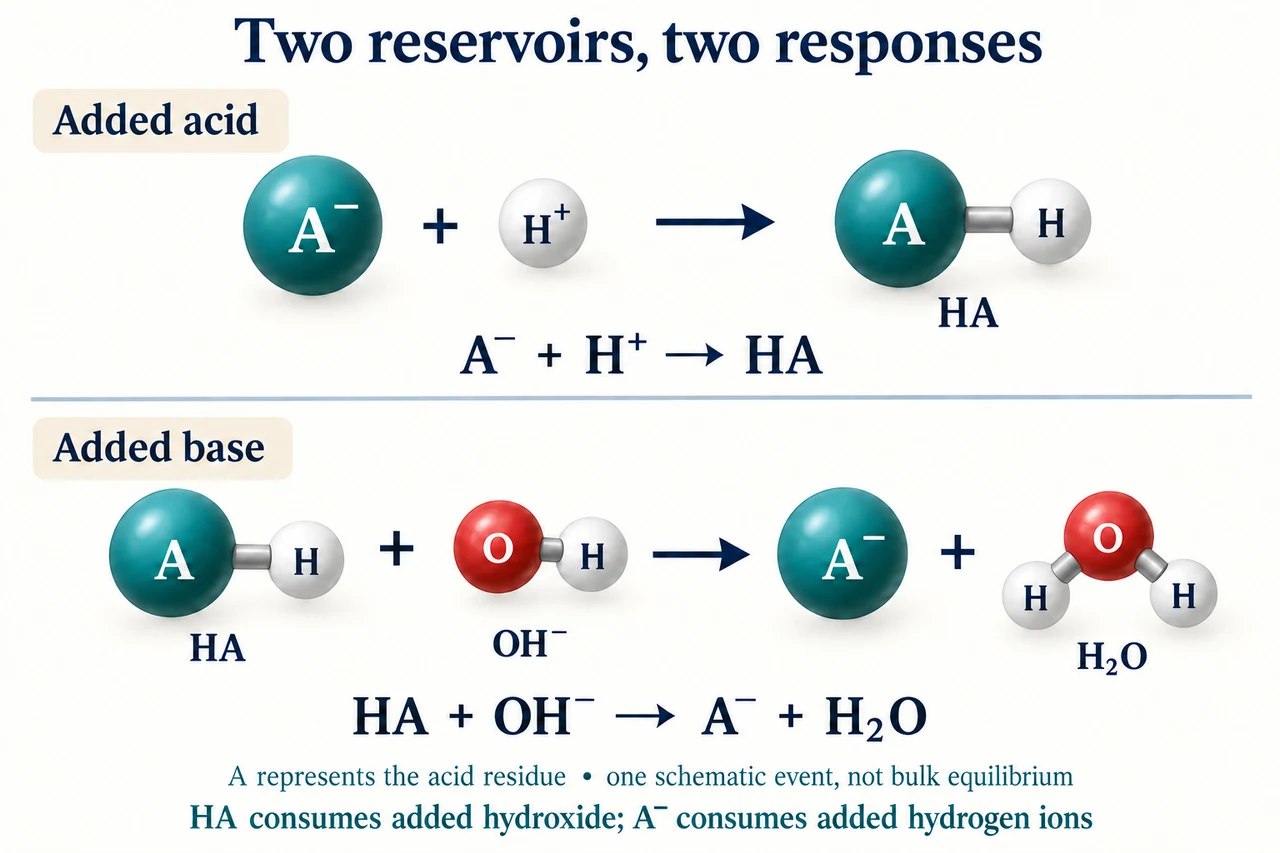
Image: illustration, not a documentary photograph. Two acidic-buffer proton-consumption events preserve the generic acid residue and transferred hydrogen/oxygen inventory. A denotes a whole residue, not a chemical element; charges refer to whole species. Counts are not bulk equilibrium fractions or measured bond angles. · Original AI-generated illustration; independently reviewed scientific teaching model.
Why a buffer resists a small addition
A buffer resists a change in pH when small amounts of acid or base are added; it does not hold pH perfectly constant under every condition. An acidic buffer contains appreciable amounts of a weak acid HA and its conjugate base A−. A basic buffer contains a weak base B and its conjugate acid BH+. The paired species provide different routes for consuming an added proton or hydroxide ion. Their presence, equilibrium relationships and finite amounts explain the response. A weak acid alone is not automatically an effective buffer against both kinds of addition merely because it dissociates incompletely.
For an acidic buffer, added hydrogen ions are mainly consumed by A− through A− + H+ → HA. Added hydroxide is mainly consumed by HA through HA + OH− → A− + H2O. In each equation the proton-bearing identity changes while atoms and total charge remain balanced. Removing most of the substantial added hydrogen or hydroxide contribution reduces its direct effect on pH, but it changes the HA/A− inventory and therefore shifts the equilibrium pH. The arrows here describe the dominant neutralisation step before the equilibrium calculation, rather than asserting that every species in the buffer has disappeared.
The corresponding basic pair works in both directions too. B + H+ → BH+ consumes added acid, while BH+ + OH− → B + H2O consumes added base. A familiar example is ammonia and ammonium, but the letters B and BH+ deliberately avoid pretending that every basic buffer has the same equilibrium constant. In the first generic equation both sides have total charge +1; in the second both sides have total charge zero. Describing a buffer as basic does not mean it contains no acid species: its conjugate acid is essential to the response to added hydroxide.
For the acidic pair, Ka = [H+][A−]/[HA] can be rearranged to [H+] = Ka[HA]/[A−]. Taking base-ten logarithms gives pH ≈ pKa + log10([A−]/[HA]) under the concentration and equilibrium approximations. If the concentrations share the same final solution volume, their ratio can be replaced by the ratio of the corresponding amounts. Analytical amounts approximate the equilibrium pair inventories when dissociation, water and other reactions do not substantially alter them. This distinction matters: a convenient ratio formula is not an exact description of every mixture called a buffer, especially after one component becomes scarce.
Diluting a buffer proportionately leaves its analytical pair ratio unchanged, so the simple ratio model predicts little pH change. Nevertheless, the concentration of each reservoir falls. Each unit volume then contains less material able to consume another addition, and sufficiently strong dilution makes water and the neglected dissociation changes more important. Distinguish the total amounts in the entire diluted batch from amounts per sampled volume: dilution does not itself destroy the original HA or A−, but a fixed-volume sample from the larger batch has less capacity. The claim of unchanged approximate pH must not be stretched into a claim of unchanged practical resistance in every sampling situation.
At half-neutralisation of a weak monoprotic acid with strong base, the analytical amounts of HA and A− are equal. Within the buffer approximation, their ratio is one and pH ≈ pKa. An observed pH of 4.80 at that point would therefore suggest pKa ≈ 4.80 and a concentration-based Ka of about 1.58489 × 10⁻⁵ under the stated conditions. This interpretation requires the correct stoichiometric half-point, suitable measurement and validity of the model; it is not a rule that any solution measuring pH 4.80 has that acid constant. Measurement uncertainty and temperature still belong to the conclusion.
Buffer behaviour is useful wherever a process is sensitive to changing acidity, including controlled laboratory media and many biological settings. Real biological fluids commonly contain several coupled equilibria and regulated processes, so a two-species beaker model is an introduction to the mechanism rather than a medical model or treatment recipe. The illustration shows conservation in one proton-consumption event and distinguishes that event from an entire equilibrium mixture. A large addition can exhaust the required reservoir; once that happens, identify the remaining excess and solve an appropriate equilibrium and water balance rather than putting a negative amount into the ratio formula.
Worked example: Write the acid-addition and base-addition responses for both HA/A− and B/BH+ buffers. Check charge conservation and explain why resistance does not imply exactly unchanged pH.
Acidic pair plus acid: A− + H+ → HA; charge −1 +1 =0 becomes 0.
Acidic pair plus base: HA + OH− → A− + H2O; charge −1 remains −1.
Basic pair plus acid: B + H+ → BH+; charge +1 remains +1. Basic pair plus base: BH+ + OH− → B + H2O; charge +1 −1 =0 becomes 0.
In each case the added proton or hydroxide changes the pair inventories. Their equilibrium ratio therefore changes; finite reservoirs limit the amount that can be consumed.
Answer: Both buffer families contain a proton-accepting and a proton-donating reservoir. The four equations preserve charge and the transferred hydrogen/oxygen ledger; changing reservoir ratios explains small residual pH changes, and exhausting either component invalidates the usual ratio shortcut.
Check your understanding: A weak monoprotic acid has measured pH 4.80 at its correctly identified half-neutralisation point. Infer pKa and Ka within the buffer model. If the same batch is diluted to twice its volume, what is approximately retained and what capacity changes?
Answer: Equal analytical HA and A− amounts give pH ≈ pKa, so pKa ≈4.80 and Ka ≈ 10^(−4.80)=1.58489319 ×10⁻⁵ in the stated concentration convention. Doubling volume halves both analytical concentrations and retains their ratio, so the simple model predicts approximately the same pH. Total reservoir amounts in the whole batch are unchanged, but their concentrations and the capacity in a fixed-volume sample are halved. Extreme dilution, appreciable dissociation changes or water effects require a fuller calculation; the approximate ratio result is not an exact metrological guarantee.
Why: Original independently checked transfer reasoning under stated concentration, temperature and finite-inventory limits. Editorial review is not assessed mastery, observed practical performance or a completed practical endorsement.