Calculate the buffer after the reaction
By UK A Level Chemistry · independent study · myAudience
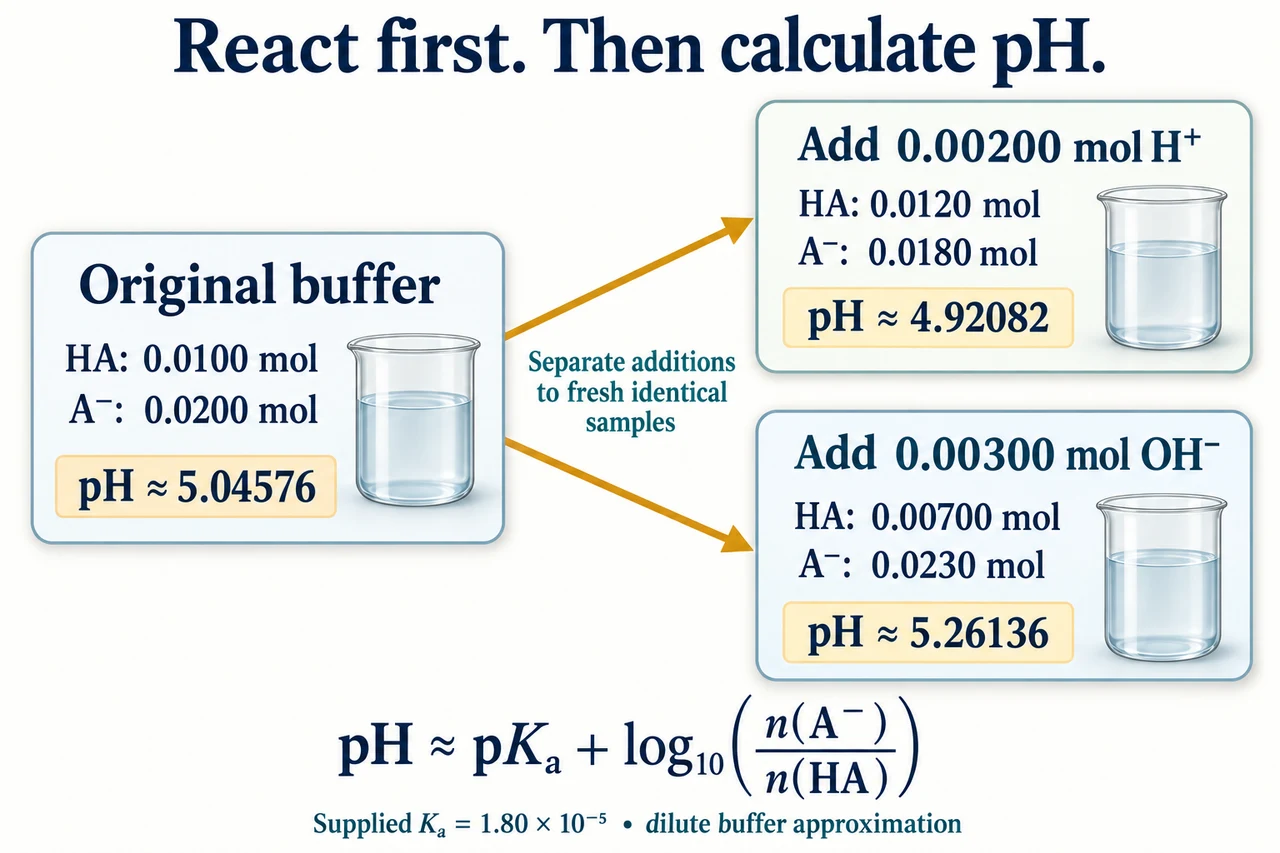
Image: illustration, not a documentary photograph. Labelled original and changed mole inventories are separate branches, not measured equilibrium particle populations. The numerical pH values assume the stated dilute pair model; volume cancellation does not waive its concentration limits. · Original AI-generated illustration; independently reviewed scientific teaching model.
Calculate the buffer after the reaction
A buffer calculation involving added strong acid or base has two stages. First perform the stoichiometric inventory change caused by the added reagent. Then use the equilibrium relationship for the pair that remains. Skipping the first stage means calculating the pH of the original buffer instead of the changed mixture. For an acidic HA/A− buffer, acid converts A− into HA, while hydroxide converts HA into A− and water. Count amounts in moles, verify that the reservoir being consumed is sufficient, and keep the two additions as separate experiments unless the question explicitly describes a sequence.
Begin with an original mixture containing 0.0100 mol HA and 0.0200 mol A−, with supplied Ka = 1.80 × 10⁻⁵. Under the dilute concentration approximation, with both pair concentrations substantial and water effects negligible, pH ≈ pKa + log10(n(A−)/n(HA)). Here pKa = 4.74472749 and the ratio is two, so the initial pH is approximately 5.04575749. A common final volume cancels in the ratio, but that cancellation does not mean volume has no chemical importance: concentrations control whether the approximations behind the formula are justified in the first place.
Add 0.00200 mol fully dissociated strong monoprotic acid to that original buffer. The neutralisation A− + H+ → HA consumes 0.00200 mol A− and produces the same amount of HA. The new analytical amounts are therefore 0.0180 mol A− and 0.0120 mol HA. Their sum remains 0.0300 mol, because the acid-derived pair has changed identity rather than vanished. The ratio becomes 1.5; pH ≈ 4.74472749 + log10(1.5) = 4.92081875. The fall of about 0.12494 pH units is small compared with an unbuffered response under comparable conditions, but is plainly not zero.
Now use a fresh identical original buffer and add 0.00300 mol hydroxide instead. HA + OH− → A− + H2O changes the pair amounts to 0.00700 mol HA and 0.0230 mol A−. Their total again remains 0.0300 mol. The new ratio is 23/7, approximately 3.28571429, so pH ≈ 5.26135729. The increase of about 0.21560 pH units follows the larger conjugate-base fraction. It would be wrong to subtract this hydroxide from the acid-modified inventory unless both additions were made sequentially to the same sample; here they are explicitly separate tests.
If either changed mixture is diluted proportionately, both pair concentrations share the same volume factor and the simple formula preserves its ratio. Even so, lower concentrations reduce the reservoir in a fixed-volume aliquot and may bring the neglected effects into play. Always state that the numerical results assume sufficient pair concentrations and negligible depletion from their own dissociation and from water. A check on positive analytical amounts is necessary but not sufficient: an almost exhausted reservoir can be positive while the approximation is still poor. Activity corrections and any other acid–base species would need separate treatment in a real complex mixture.
A deliberately excessive addition exposes the limit. If 0.0250 mol acid were added to the original mixture, only 0.0200 mol A− would be available for its principal neutralisation. That inventory step leaves 0.0050 mol excess acid and converts the available A− into HA. Substituting a negative A− amount into a logarithm is both chemically and mathematically invalid. Find the final total volume, consider the dominant excess and the remaining weak-acid equilibrium, and include water where needed. Without that volume we cannot provide a unique excess-concentration pH merely from the supplied amounts.
The diagram keeps the acid-addition and base-addition branches separate and displays the original and changed mole inventories rather than decorative particle ratios masquerading as exact equilibrium populations. Its labels and pH results refer to the supplied mathematical model, not measured fluids. The important transferable routine is inventory, domain check, equilibrium relationship and reasonableness check. Added acid should move this acidic buffer toward a smaller A−/HA ratio and lower pH; added base should do the reverse while HA remains available. A result that violates those directions should trigger a review of the balanced reaction and arithmetic before being accepted.
Worked example: For a dilute idealised acidic buffer with 0.0100 mol HA, 0.0200 mol A− and Ka = 1.80 ×10⁻⁵, find its initial approximate pH. Find the changed pH after adding 0.00200 mol strong monoprotic acid, treating neutralisation first.
pKa = −log10(1.80 ×10⁻⁵)=4.7447274949. Initial ratio = 0.0200/0.0100=2, so pH ≈ 5.0457574906.
The reaction A− + H+ → HA consumes 0.00200 mol A− and forms 0.00200 mol HA.
Updated amounts: n(A−)=0.0180 mol and n(HA)=0.0120 mol, both positive; their sum remains 0.0300 mol.
Updated ratio = 1.5, so pH ≈ 4.7447274949+log10(1.5)=4.9208187540. The change is −0.1249387366.
Answer: The initial approximate pH is 5.04576 and the acid-modified result is 4.92082. Neutralisation changes the ratio before the equilibrium calculation; the pair amount sum is conserved and the downward pH direction is consistent with acid addition.
Check your understanding: Use a fresh identical original buffer. Add 0.00300 mol hydroxide, calculate its approximate pH and assess doubling its volume. Explain why adding 0.0250 mol acid to another original sample cannot be handled by the same ratio shortcut.
Answer: Hydroxide consumes HA and makes A−: amounts become 0.00700 and 0.0230 mol respectively, retaining the 0.0300 mol sum. Their ratio is 23/7, giving pH ≈ 4.7447274949+log10(23/7)=5.2613572909. Doubling volume preserves that ratio and therefore the approximate model pH, while halving concentrations and fixed-volume-sample capacity. In a separate acid-excess experiment,0.0250 mol acid exceeds the 0.0200 mol A− reservoir by 0.0050 mol. The reservoir is exhausted; a negative ratio is invalid. A final volume and an appropriate excess/equilibrium calculation are needed for a numerical pH, rather than extending the buffer formula beyond its domain.
Why: Original independently checked transfer reasoning under stated concentration, temperature and finite-inventory limits. Editorial review is not assessed mastery, observed practical performance or a completed practical endorsement.