Articles, agreement and what a description actually means
By UK A Level French · independent study · myAudience
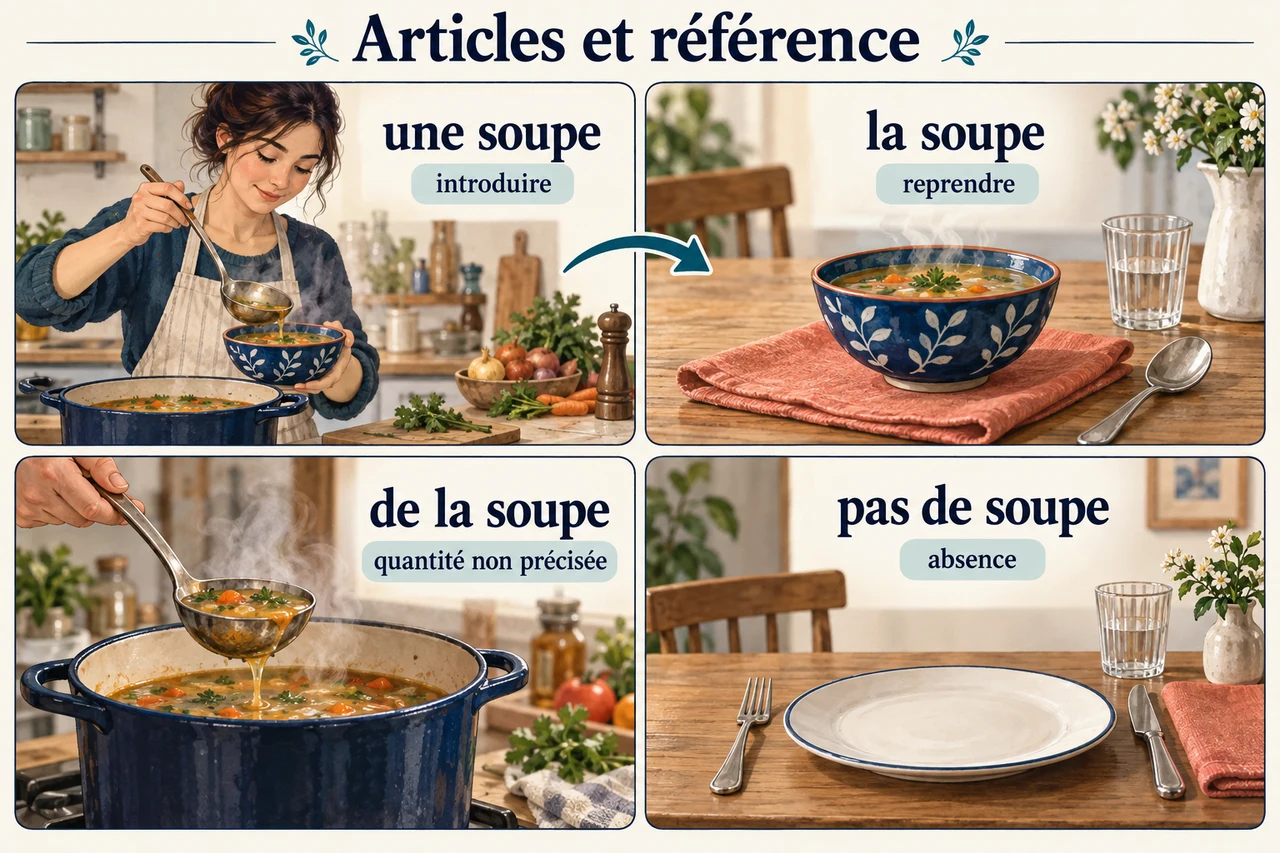
Image: illustration, not a documentary photograph. All people, services, schedules and task data in these examples are fictional teaching contexts, not researched claims about a country or organisation. Selected productive decisions only; broader noun/adjective/negative demands remain OPEN. No oral or assessment completion. Illustrated fictional kitchen: noun-phrase labels compare introducing a soup, referring back to it, serving an unspecified quantity, and ordinary absence. Labels are fragments; construction exceptions, être attributes and ne…que restriction remain in full lesson. The image does not claim all definite references require a previously mentioned noun. · Original operator-generated conceptual illustration; no institutional photograph, edition illustration or modern critical text copied.
Articles, agreement and what a description actually means
An article helps a reader identify what a noun refers to; it is not an English word that can be swapped mechanically. In a fictional community kitchen, « Nous préparons une soupe » introduces one soup, while « La soupe est prête » refers back to the identified dish. « Nous servons de la soupe » treats soup as an unspecified quantity, and « J’aime la soupe » expresses a general preference. The same noun therefore takes different determiners because the speaker makes different claims. Start with reference and quantity, then check the noun’s gender and number rather than selecting an article from the English wording alone.
Partitive forms include du, de la, de l’ and des; the last form can also function as the plural indefinite article, so context matters. « Nous achetons du pain, de la farine et de l’huile » does not specify amounts. A measured quantity changes the construction: « deux litres d’huile » and « beaucoup de farine » use de or d’. A definite reference remains possible after de through contraction, as in « la qualité du pain »: du here combines de and le and does not mean an unspecified quantity. Explaining which structure is present prevents an apparent exception from becoming an arbitrary list to memorise.
In a negative clause, indefinite and partitive determiners before a direct object are normally reduced to de or d’: « Nous préparons une soupe » becomes « Nous ne préparons pas de soupe ». This denies the presence of soup in the preparation rather than selecting a different soup. The definite article usually remains when an identified item is denied: « Nous ne servons pas la soupe prévue ». That sentence refers to a particular planned soup. The reduction is a construction-specific rule, not an instruction to replace every article whenever pas appears somewhere in the sentence; identify the direct object and the intended claim first.
Two important contrasts preserve the regular indefinite or partitive form. An attribute after être identifies or classifies the subject: « Ce n’est pas une cantine » denies that classification, rather than using the direct-object pattern. An explicit correction can preserve the distinction between alternatives: « Nous ne servons pas du riz, mais des pâtes ». In addition, ne… que expresses restriction: « Nous ne servons que du riz » means that rice is the only food being served, not that no rice is served. The placement of que determines what is restricted; changing it can change the meaning even when every article is correctly formed.
Agreement follows the noun described, regardless of the adjective’s position. « Une soupe chaude » becomes « des soupes chaudes »; « un plat végétarien » becomes « des plats végétariens ». These endings carry grammatical information even when some are not heard. Before a plural noun, the indefinite des often becomes de when an adjective is placed before the noun in careful writing: « de petites portions ». This is another de construction, separate from negation. Fixed expressions and special adjective classes need their own checks, so the decision method here is to identify noun, gender, number and construction, not assume that all adjectives follow one spelling pattern.
Position can contribute to meaning as well as style. « Une ancienne école » can be a building that formerly functioned as a school; « une école ancienne » draws attention to the school’s age. Likewise, an adjective describing colour normally follows the noun, while many common short adjectives often precede it. These are tendencies with lexical and contextual constraints, not a licence to move any adjective freely. When revising a description of a converted school, the relevant question is whether the writer means former use or age. A grammatically possible relocation that silently changes that claim is still a poor revision.
A useful editing sequence is to underline each noun phrase, state its intended reference in ordinary words, and then inspect the determiner and every agreement link. Next classify ne… pas, ne… que and an explicit contrast separately; finally ask whether adjective position adds an intended meaning. This makes a response explainable and transferable to an unfamiliar sentence. It also separates grammatical correctness from factual truth: a perfectly agreed sentence can still describe a fictional building inaccurately. This lesson develops selected article, agreement and position decisions; the full range of adjective categories, noun patterns and negative constructions remains further work.
All people, services, schedules and task data in these examples are fictional teaching contexts, not researched claims about a country or organisation.
Selected productive decisions only; broader noun/adjective/negative demands remain OPEN. No oral or assessment completion.
Illustrated fictional kitchen: noun-phrase labels compare introducing a soup, referring back to it, serving an unspecified quantity, and ordinary absence. Labels are fragments; construction exceptions, être attributes and ne…que restriction remain in full lesson. The image does not claim all definite references require a previously mentioned noun.
Worked example: Complete this fictional notice, choosing une, la, de la, de, du, une or ancienne as appropriate, and explain the meanings. « Nous préparons ___ soupe chaude. ___ soupe sera servie à midi. Nous ne préparons pas ___ viande. Nous ne servons que ___ pain et de la soupe. Ce n’est pas ___ cantine. Le repas a lieu dans une ___ école, transformée en centre de quartier. » Then put « une petite portion chaude » in the plural in careful written French.
Une introduces the dish; la retrieves that identified soup. De replaces an indefinite/partitive direct-object determiner under ne… pas. Du remains under restrictive ne… que, which limits the menu without denying the bread. Une remains after être because cantine classifies the subject.
Ancienne precedes école here because the conversion makes former use the relevant meaning. In the plural, portions is feminine plural: petites and chaudes both agree; de precedes the front-position adjective petites in careful writing. The exercise’s choices are constrained by the supplied context, not universal article substitutions.
Answer: « Nous préparons une soupe chaude. La soupe sera servie à midi. Nous ne préparons pas de viande. Nous ne servons que du pain et de la soupe. Ce n’est pas une cantine. Le repas a lieu dans une ancienne école, transformée en centre de quartier. »
Plural: « de petites portions chaudes ».
Check your understanding: A different fictional kitchen serves pasta rather than rice, serves no meat, and occupies a school building that is very old but still functions as a school. Write complete French sentences for those three facts, then write a sentence saying it serves only pasta. Explain why the rice/pasta contrast and the no-meat statement use different determiners.
Answer: « Nous ne servons pas du riz, mais des pâtes. Nous ne servons pas de viande. Le repas a lieu dans une école très ancienne qui fonctionne toujours comme école. Nous ne servons que des pâtes. »
Why: The explicit corrective contrast preserves du and des. The ordinary denial of meat as a direct object uses de. Très ancienne follows the noun and describes age; the continuing school function rules out a former-school reading here. Ne… que restricts what is served and retains des. The final restrictive sentence is a separate scenario statement rather than a claim that a negation of rice also denied pasta.