Keeping the right people and objects in a pronoun chain
By UK A Level French · independent study · myAudience
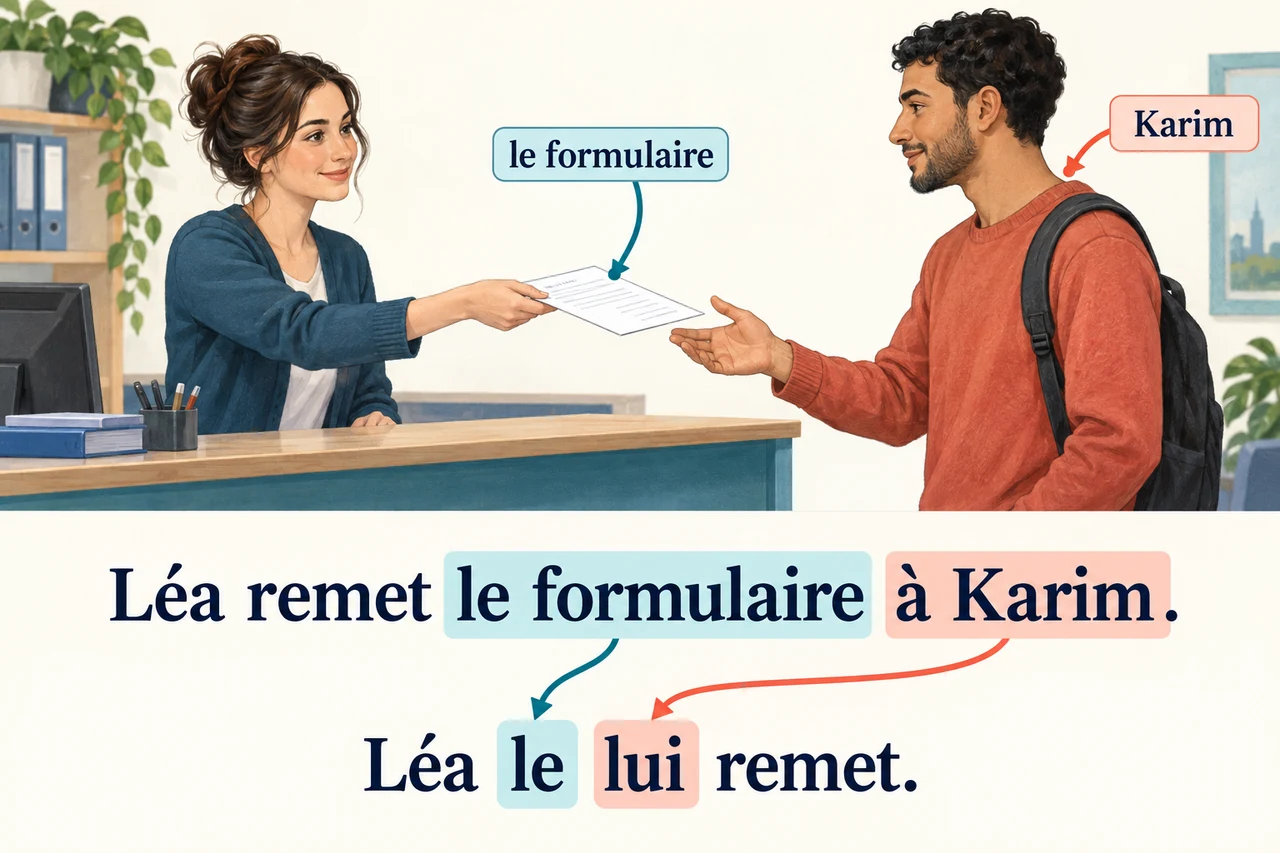
Image: illustration, not a documentary photograph. All people, services, schedules and task data in these examples are fictional teaching contexts, not researched claims about a country or organisation. Selected compatible clitic chains only; no full personal-pronoun or whole 72-row completion; oral/assessment OPEN. Fictional lending desk: le replaces the masculine singular form, lui the recipient à Karim in remettre. This selected finite-verb example does not claim every person is an indirect object; y/en, imperative polarity and governing infinitives remain in full lesson. · Original operator-generated conceptual illustration; no institutional photograph, edition illustration or modern critical text copied.
Keeping the right people and objects in a pronoun chain
A pronoun is useful only if its reference stays recoverable. In a fictional lending desk, « Léa remet le formulaire à Karim » contains an item handed over and a person receiving it. Replacing the item gives « Léa le remet à Karim »; replacing the recipient gives « Léa lui remet le formulaire »; replacing both gives « Léa le lui remet ». The le represents formulaire, while lui represents à Karim. French object patterns depend on the verb’s construction, not just on whether the English translation mentions a person. A person can be a direct object, as in voir Karim, or an indirect recipient, as in répondre à Karim.
Before an ordinary finite verb, the common clitic sequence is me/te/se/nous/vous, then le/la/les, then lui/leur, then y, then en. This is an ordering guide for compatible combinations, not a suggestion that every slot can be filled at once. « Tu me le prêtes » puts the first-person recipient before the direct object; « Tu le lui prêtes » puts the direct object before the third-person recipient. With a compound tense the pronouns precede the auxiliary: « Tu le lui as prêté ». The spelling and role of the pronoun must remain distinct from the later past-participle agreement decision.
With two verbs, identify which verb governs the object before positioning its pronoun. « Je vais envoyer le formulaire à Karim » becomes « Je vais le lui envoyer » because both objects belong to envoyer. The chain belongs before the infinitive, rather than before vais. In « Je lui demande de lire le formulaire », however, lui belongs to demande: Karim is the person being asked. The form « Je lui demande de le lire » preserves that division. This governing-verb check is more reliable than a slogan that pronouns always stand directly before the first verb or that all pronouns move together when an infinitive is present.
Y commonly replaces a location or a non-person complement introduced by à in the constructions practised here: « Nous allons à la médiathèque » becomes « Nous y allons », and « Nous pensons à ce projet » becomes « Nous y pensons ». En can retrieve a de-complement or an indefinite quantity: « Nous parlons de ce projet » becomes « Nous en parlons », and « Nous avons trois formulaires » becomes « Nous en avons trois ». The number three remains because en alone does not preserve it. Neither pronoun translates one fixed English preposition; its function depends on the original phrase. Uses involving people and idioms require contextual checking, so an absolute ban on en representing people would also be misleading.
The affirmative imperative changes placement and sometimes forms. For a direct object and recipient, « Remets le formulaire à Karim » becomes « Remets-le-lui »; « Donne le formulaire à moi » is naturally « Donne-le-moi ». These pronouns follow the imperative and are joined with hyphens. En follows other attached pronouns, while me and te elide before en or y: « Donne-m’en deux ». A first-group singular imperative immediately followed by en or y may acquire a written s, as in « Donnes-en deux ». That s is on the verb; it does not authorise an invented linking z between two pronouns.
A negative imperative returns the clitics before the verb, with no imperative hyphens: « Ne le lui remets pas » and « Ne m’en donne pas ». The negative form of an instruction therefore requires more than adding ne and pas around an unchanged affirmative chain. Also distinguish pronouns governed by a following infinitive: « Viens me le montrer » does not attach me and le to viens, since they belong to montrer. These examples show why pronoun position, hyphenation and governing verb should be checked together. Spoken variants are not treated as interchangeable with the careful written forms used for these practice answers.
To verify a rewritten passage, expand every pronoun back into its original phrase and inspect who gives, receives, sees or uses each item. Check that any quantity and location remain recoverable, then inspect the verbal group and polarity. If two possible antecedents share the same gender and number, repeating a noun may be clearer than compressing the passage further. Pronouns are a tool for coherent communication, not a competition to remove all nouns. This unit works on selected personal-object chains and y/en decisions; relatives, demonstratives, possessives, indefinite pronouns and the complete range of discourse uses remain separate open teaching demands.
All people, services, schedules and task data in these examples are fictional teaching contexts, not researched claims about a country or organisation.
Selected compatible clitic chains only; no full personal-pronoun or whole 72-row completion; oral/assessment OPEN.
Fictional lending desk: le replaces the masculine singular form, lui the recipient à Karim in remettre. This selected finite-verb example does not claim every person is an indirect object; y/en, imperative polarity and governing infinitives remain in full lesson.
Worked example: At a fictional desk, replace the repeated phrases while preserving the supplied references. (1) « Léa remet le formulaire à Karim. » Replace both objects. (2) « Léa va envoyer le formulaire à Karim. » Replace both objects. (3) « Nous avons trois formulaires. » Replace the noun but retain the number. (4) Give a tu-command handing that form to Karim, then prohibit the same action. (5) Ask someone to give you two forms using en.
Le retrieves the masculine singular form; lui retrieves the recipient à Karim. In2 the chain belongs to envoyer and stands immediately before that infinitive. En retrieves the indefinite noun quantity in3, but trois must remain.
The affirmative imperative puts le then lui after remets with hyphens; the negative places them before remets without hyphens. Donne-m’en uses elided me before en, followed by the retained quantity deux; no invented z-link or moi-en spelling is needed.
Answer: 1. « Léa le lui remet. »
2. « Léa va le lui envoyer. »
3. « Nous en avons trois. »
4. « Remets-le-lui. » / « Ne le lui remets pas. »
5. « Donne-m’en deux. »
Check your understanding: Change the scenario: there are four brochures, and two children are the recipients. Rewrite « Je vais donner quatre brochures aux enfants » with pronouns while retaining four. Then instruct a friend to give the children two of those brochures, prohibit that instruction, and replace the location in « Nous allons à la bibliothèque ». Give full sentences and explain every reference.
Answer: « Je vais leur en donner quatre. »
« Donne-leur-en deux. »
« Ne leur en donne pas deux. »
« Nous y allons. »
Why: Leur stands for aux enfants and en for the indefinite brochures; both belong to donner, so they precede its infinitive, and quatre retains the stated quantity. In the affirmative command leur precedes en with hyphens; the negative restores the chain before donne without hyphens.
The negative sentence specifically prohibits giving two; it does not necessarily prohibit every possible quantity. A broader ban would be « Ne leur en donne pas ». Y replaces the location à la bibliothèque, not the children. These choices preserve the changed scenario rather than reusing the earlier singular-recipient answer.