Narrating the past without losing the timeline
By UK A Level French · independent study · myAudience
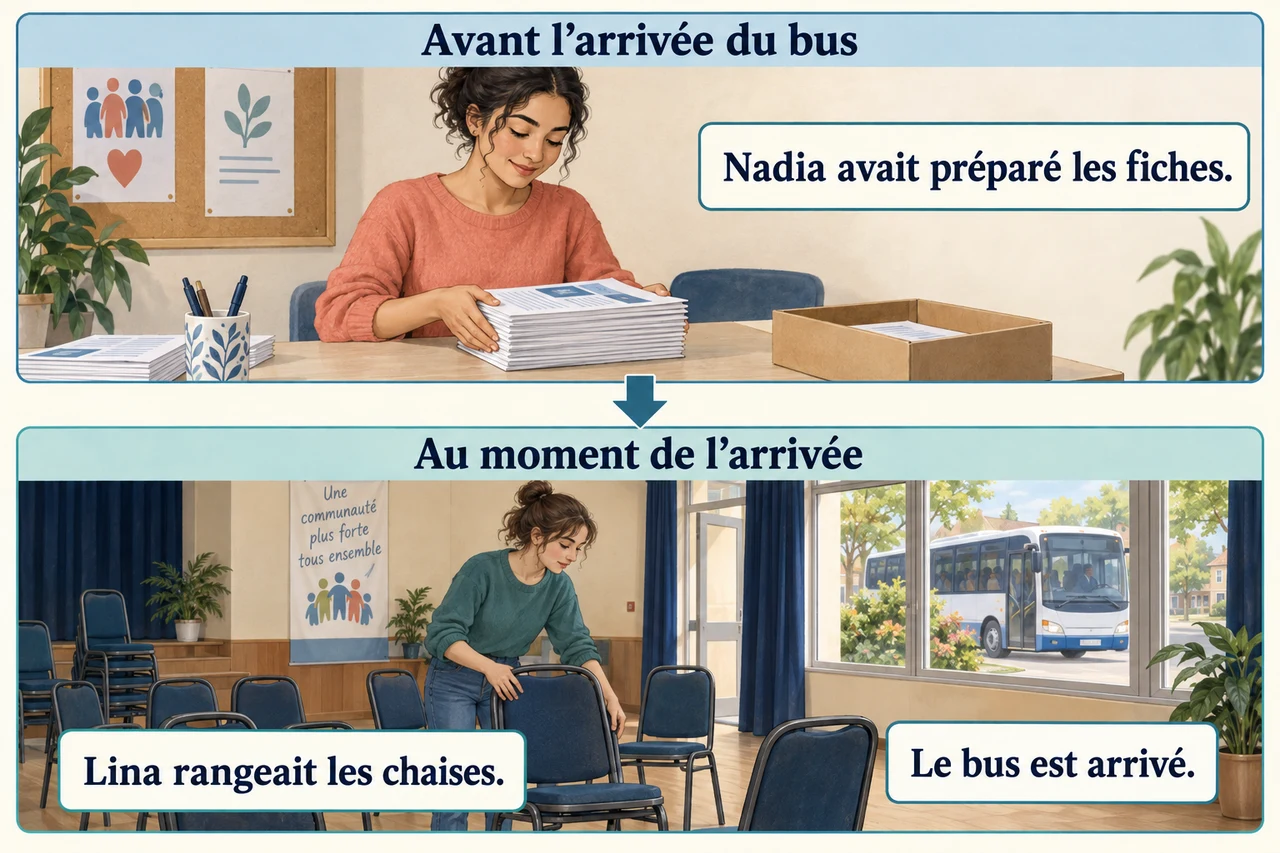
Image: illustration, not a documentary photograph. All people, services, schedules and task data in these examples are fictional teaching contexts, not researched claims about a country or organisation. Past historic remains receptive R. No exhaustive verb/pronominal agreement, oral or assessment claim. Fictional chronology: preparing the sheets is earlier than arrival; arranging chairs is shown in progress at arrival. Panel heights/arrows do not measure durations or imply imparfait always means long-lasting. The poster/background is decorative; selected main captions are teaching evidence. · Original operator-generated conceptual illustration; no institutional photograph, edition illustration or modern critical text copied.
Narrating the past without losing the timeline
The difference between passé composé and imparfait is a choice of viewpoint, not a stopwatch. « Pendant dix ans, elle a travaillé dans ce centre » can present a long period as a bounded whole; « Elle ouvrait la porte quand le téléphone a sonné » can present a brief action as in progress. In a fictional community event, « Il pleuvait » establishes the circumstances, while « Le bus est arrivé » advances the narrated sequence with a completed event. Ask whether the speaker looks inside a situation or presents an event as a whole at that point in the story. Duration alone cannot answer that question.
The imparfait is built from the nous present stem without -ons, followed by -ais, -ais, -ait, -ions, -iez or -aient; être has the stem ét-. Thus nous préparons gives je préparais, while être gives j’étais. It can express background, a repeated practice or simultaneity: « Chaque samedi, nous préparions la salle » frames a habit. A narrator can also choose other specialised uses, including the historical imparfait, so the familiar background/event contrast is a useful starting method rather than a law covering all literary contexts. A reader must connect the verb to the passage’s time markers and narrative purpose.
The passé composé combines a present auxiliary and a participle: « elle a installé les chaises » or « elle est arrivée ». Most verbs use avoir; a selected set of intransitive verbs and pronominal constructions use être. Do not generalise that every movement verb takes être: marcher uses avoir. A verb’s construction may change its auxiliary: « elle est sortie » describes her departure, whereas « elle a sorti les chaises » has a direct object. The auxiliary must therefore be selected from the verb and its actual use, not guessed from whether the event involves motion. Pronominal agreement has additional object-role rules and is not exhausted by this unit.
The plus-que-parfait supplies a past reference point before another past reference point: « Quand le bus est arrivé, nous avions déjà installé les chaises ». Avions is the imperfect of avoir; installé is the participle. The installation is earlier than the bus’s arrival, even though the sentence mentions the bus first. With an être verb, the corresponding form is « elles étaient déjà arrivées ». A useful timeline has three separate anchors: the telling now, the narrated event, and an event already complete before it. A compound form expresses this relation; it is not a decoration that makes a narrative sound more advanced.
Agreement must be checked independently of tense selection. With non-pronominal être constructions here, « les bénévoles sont arrivées » agrees if the group referred to is female. With ordinary avoir constructions, a following direct object does not trigger agreement: « Lina a préparé les fiches ». A preceding direct-object pronoun does: « Les fiches, Lina les a préparées ». An indirect object is not that agreement controller: « Lina leur a parlé ». When checking a relative phrase, « les fiches qu’elle avait préparées » uses que as the preceding direct object. Special cases such as fait followed immediately by an infinitive need their own rule rather than automatic application of this pattern.
Changing viewpoint can change what the reader understands. « Elle lisait le message quand le bus est arrivé » locates reading in progress at arrival; « Elle a lu le message quand le bus est arrivé » presents reading as a bounded event linked to that arrival. The latter need not mean that every conceivable detail happened in a rigid instant, but it no longer supplies the same background relation. A responsible revision preserves the intended relation or explains the change. Time words such as déjà, pendant and chaque help interpretation, yet none dictates one tense in every sentence regardless of context. Grammar and interpretation work together.
The A Level specification also requires receptive recognition of the past historic, normally called passé simple in French. In an original literary-style sentence, « Il ouvrit la porte, entra et aperçut la salle vide », those forms advance completed narrative events much as a contemporary spoken account might use il a ouvert, il est entré and il a aperçu. Recognition includes locating events and noticing register; it does not turn this receptive demand into a requirement to write every passé simple paradigm. The practical goal is to understand an unfamiliar narrative and justify selected forms. Full verb paradigms, specialised literary viewpoints and broader pronominal agreement remain further work.
All people, services, schedules and task data in these examples are fictional teaching contexts, not researched claims about a country or organisation.
Past historic remains receptive R. No exhaustive verb/pronominal agreement, oral or assessment claim.
Fictional chronology: preparing the sheets is earlier than arrival; arranging chairs is shown in progress at arrival. Panel heights/arrows do not measure durations or imply imparfait always means long-lasting. The poster/background is decorative; selected main captions are teaching evidence.
Worked example: Use these fictional facts to write four linked sentences: rain was falling; Lina was arranging chairs at that moment; Nadia had prepared the information sheets before the bus arrived; the bus then arrived; two female volunteers arrived after it. Include a separate sentence replacing « Nadia a préparé les fiches » with an initial « Les fiches ». Explain the timeline and agreements.
Pleuvait and rangeait present simultaneous circumstances; est arrivé presents the bus arrival as a completed narrative event. Avait préparé places preparation before that arrival. Ensuite fixes the two volunteers’ arrival later; the supplied female reference produces arrivées.
Les in the last sentence is the preceding feminine-plural direct object of préparer, so préparées agrees. In Nadia avait préparé les fiches, the object follows the verb and préparé stays unchanged. Nadia’s gender alone does not control an avoir participle.
Answer: « Il pleuvait et Lina rangeait les chaises. Quand le bus est arrivé, Nadia avait déjà préparé les fiches. Deux bénévoles sont ensuite arrivées. Les fiches, Nadia les a préparées. »
Check your understanding: Now the facts change. The bus arrived before preparation began. Lina then prepared the sheets and read the whole message; the rain lasted all morning, treated as a completed period in the retrospective account. Write the account with passé composé, then add « Lina lisait le message quand Nadia est arrivée » for a different scene. Explain why the preparation cannot now be a plus-que-parfait referring to the bus arrival and how the reading viewpoints differ.
Answer: « Le bus est arrivé. Ensuite, Lina a préparé les fiches et a lu le message en entier. Il a plu toute la matinée. Dans une autre scène, Lina lisait le message quand Nadia est arrivée. »
Why: Preparation is later than the bus arrival, so describing it as avait déjà préparé at that arrival would contradict the supplied facts. A préparé and a lu present subsequent completed actions; plu with avoir presents the whole morning as a bounded rainy period despite its duration.
The separate scene’s lisait locates reading in progress when Nadia arrived, whereas a lu le message en entier explicitly presents the completed reading. Nadia est arrivée agrees with its feminine singular subject; the sheets follow a préparé and therefore do not trigger agreement there.