Conditions, future completion and questions introduced by si
By UK A Level French · independent study · myAudience
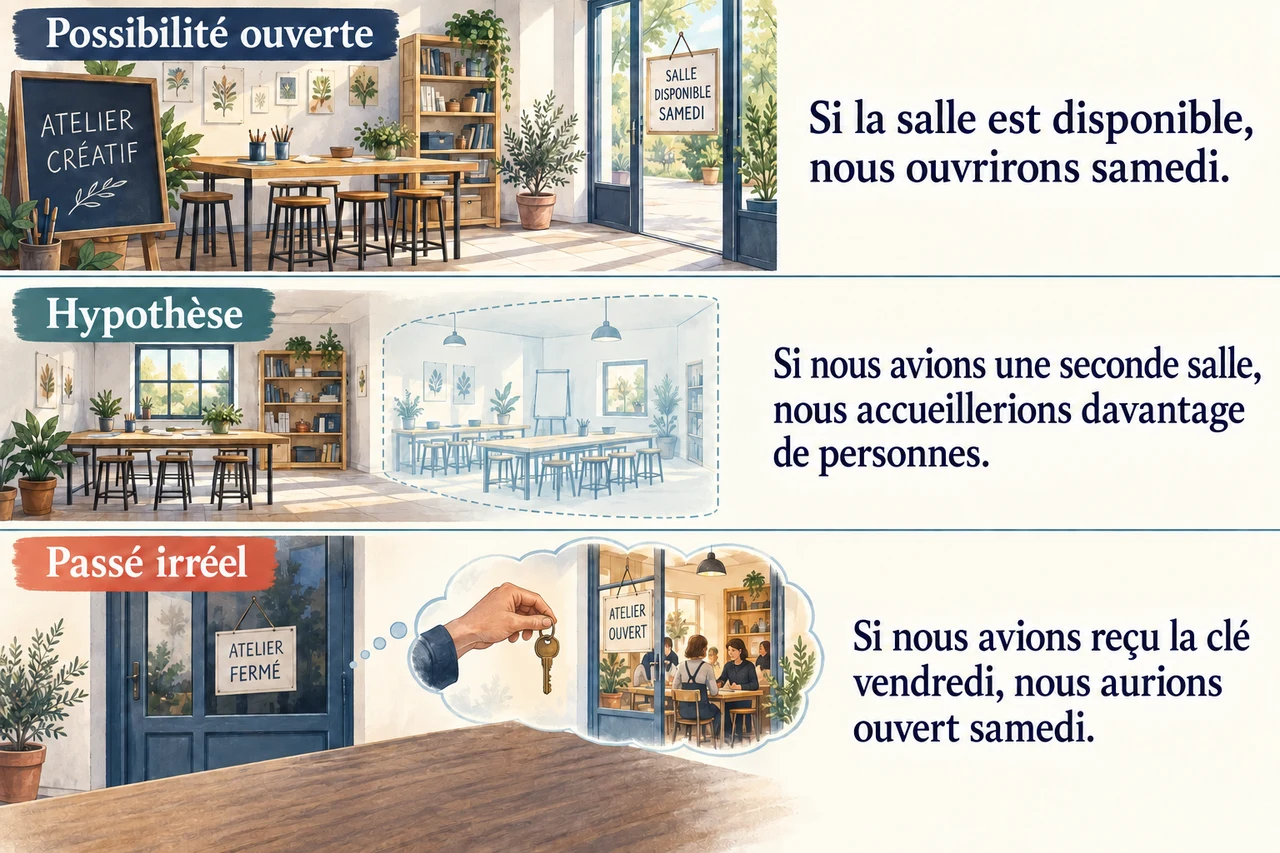
Image: illustration, not a documentary photograph. All people, services, schedules and task data in these examples are fictional teaching contexts, not researched claims about a country or organisation. Selected ordinary hypotheses and future-completion decisions; conditional-si is not all si uses; oral/assessment and exhaustive tense scope OPEN. Illustration contrasts three supplied fictional scenarios, not numerical probabilities or all uses of conditional/si. The imagined second room is hypothetical, not automatically impossible. Thought bubble depicts the alternative past, not an actual received key or actual opening. Indirect-question si, mixed-time and future perfect stay in full lesson. · Original operator-generated conceptual illustration; no institutional photograph, edition illustration or modern critical text copied.
Conditions, future completion and questions introduced by si
A future plan and a hypothetical alternative are different communicative choices. In a fictional repair workshop, « Nous ouvrirons samedi » states a future plan, while « Nous ouvririons samedi si nous avions assez de bénévoles » makes the opening dependent on an imagined condition. The conditional does not merely make a future sound more sophisticated; it changes how the commitment is presented. Future and conditional often share a stem, but use different endings: ouvrirons is future, ouvririons conditional. Read the whole sentence before deciding which form communicates the intended level of commitment and its relation to any condition.
For an ordinary open condition about the present or future, si introduces a present form and the consequence can be future: « Si la salle est disponible, nous ouvrirons samedi ». The future consequence does not require a future form after conditional si. Present and imperative consequences are also possible when their meanings fit, so the lesson’s present/future pattern is a focused example rather than the only permitted construction. Separate the condition clause from the consequence before checking the forms. In « Nous ouvrirons samedi si la salle est disponible », the reversed clause order changes neither the roles nor the ordinary conditional-si pattern.
An imagined present or future condition commonly uses imparfait plus conditionnel présent: « Si nous avions une seconde salle, nous accueillerions davantage de personnes ». The imperfect here need not locate the imagined extra room in the past; its hypothetical function matters. Calling the event impossible solely because an imperfect appears would also overstate the grammar: context determines whether the alternative is remote, unreal or a tentative possibility. The relevant contrast is with a directly open condition such as si nous avons. The correct written form accueillerions combines the future stem accueiller- with the imperfect-type ending -ions; recognising the stem and ending helps distinguish it from the future accueillerons.
An unreal past condition uses a plus-que-parfait condition and commonly a conditionnel passé consequence: « Si nous avions reçu la clé vendredi, nous aurions ouvert samedi ». Aurions is the conditional of avoir; ouvert is the participle. In that counterfactual reading, the intended opening did not occur because the stated past condition was not met. Mixed-time sentences are possible: « Si nous avions reçu la clé hier, nous serions prêts maintenant » links an unreal earlier condition to a present consequence. Check the time of each clause instead of mechanically making every hypothetical consequence a compound tense.
The future perfect, futur antérieur, identifies completion before a future reference point: « À midi, nous aurons installé les tables ». The claim is that installation will already be complete by noon, not merely that it will begin then. Conditional perfect can likewise mark completion viewed from a past forecast or a counterfactual frame, so its meaning must be read in context. Compound forms inherit auxiliary and agreement rules: « elles seront arrivées » uses être and feminine-plural agreement, while « nous aurons installé les tables » leaves installé unchanged with its following direct object. More auxiliary forms do not justify ignoring the object’s position.
A rule about conditional si is not a rule about every occurrence of si. « Je me demande si la salle sera disponible » is an indirect question meaning whether the room will be available; it permits a future. « Je voudrais savoir si vous accepteriez cette proposition » reports a question about someone’s possible willingness and can use a conditional. Neither sentence sets out a condition-consequence pair. Si can also have concessive uses, which require separate analysis. A reliable diagnostic is to ask whether si means if under a stated condition or whether it introduces the content of a question; a blanket ban hides that distinction.
When revising a plan, write a small timeline and label each proposition as asserted, open-conditioned, imagined, counterfactual or questioned. Then choose tense and check the conditional-si clause independently from its consequence. Finally expand any compound tense into auxiliary and participle and verify agreement. This sequence prevents a form that looks advanced from contradicting the supplied chronology. It also keeps a language task from becoming a prediction about real-world certainty: the same conditional construction can serve politeness or a future-in-the-past use in other contexts. The worked answers below concern their explicitly supplied fictional conditions, not every meaning of the conditional.
All people, services, schedules and task data in these examples are fictional teaching contexts, not researched claims about a country or organisation.
Selected ordinary hypotheses and future-completion decisions; conditional-si is not all si uses; oral/assessment and exhaustive tense scope OPEN.
Illustration contrasts three supplied fictional scenarios, not numerical probabilities or all uses of conditional/si. The imagined second room is hypothetical, not automatically impossible. Thought bubble depicts the alternative past, not an actual received key or actual opening. Indirect-question si, mixed-time and future perfect stay in full lesson.
Worked example: For a fictional workshop, write complete French sentences for: (1) if the room is available, we will open on Saturday; (2) if we had a second room, we would welcome more people; (3) if we had received the key on Friday, we would have opened on Saturday, but neither happened; (4) by noon tomorrow we will have installed the tables; (5) I wonder whether the room will be available. Explain si and completion in each.
1 uses an open present condition with a future consequence.2 uses a hypothetical imparfait condition and conditional consequence; avions does not here assert a past possession.3 places the unreal condition in the earlier past with avions reçu and the unreal completed consequence with aurions ouvert.
4 uses futur antérieur to assert completion by a future reference point.5 uses si as whether in an indirect question, so sera is appropriate rather than forbidden by a conditional-si rule. Installé has a following direct object and remains unchanged.
Answer: 1. « Si la salle est disponible, nous ouvrirons samedi. »
2. « Si nous avions une seconde salle, nous accueillerions davantage de personnes. »
3. « Si nous avions reçu la clé vendredi, nous aurions ouvert samedi. »
4. « Demain, à midi, nous aurons installé les tables. »
5. « Je me demande si la salle sera disponible. »
Check your understanding: The changed workshop’s mixed group of organisers did not receive the key yesterday and is not ready now. Write the mixed-time counterfactual. Then ask indirectly whether the organisers would be willing to open next month. Finally state that two female volunteers will have arrived by nine tomorrow. Explain why the last sentence is not passive and why its participle agrees.
Answer: « Si nous avions reçu la clé hier, nous serions prêts maintenant. »
« Je voudrais savoir si les organisateurs seraient disposés à ouvrir le mois prochain. »
« Demain, à neuf heures, les deux bénévoles seront arrivées. »
Why: The key’s receipt is a hypothetical completed past condition, but readiness is a hypothetical present state, so serions prêts—not necessarily aurions été prêts—matches maintenant. The second si introduces the content of an indirect question about willingness, allowing seraient.
Seront arrivées is the future perfect of the active intransitive verb arriver with être. The female-plural subject controls arrivées; there is no active direct-object transformation or patient receiving an action that would make this sentence passive. Prêts describes a group represented by nous under the default masculine/mixed reference in this exercise; a specifically all-female group would require prêtes.