Subjunctive mood: the construction first, the timeline second
By UK A Level French · independent study · myAudience
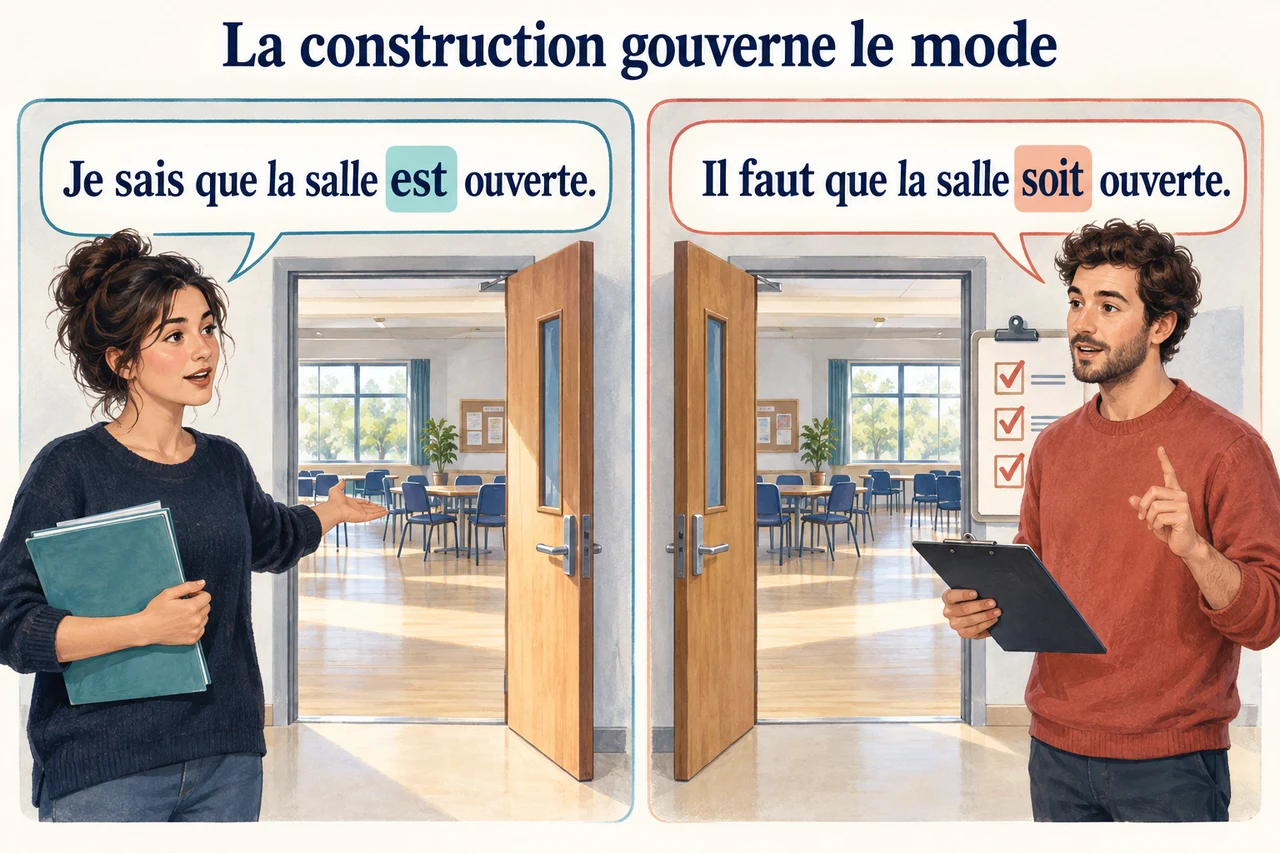
Image: illustration, not a documentary photograph. All people, services, schedules and task data in these examples are fictional teaching contexts, not researched claims about a country or organisation. Imperfect subjunctive and past historic remain receptive R; broader mood-trigger variability, oral and assessment competence OPEN. Knowledge and obligation introduce the same possibly factual room state differently. The subjunctive image does not mean false or unreal; checklist motif illustrates requirements. Completion/auxiliaries/receptive imperfect subjunctive remain taught in full text. · Original operator-generated conceptual illustration; no institutional photograph, edition illustration or modern critical text copied.
Subjunctive mood: the construction first, the timeline second
Que does not by itself require a subjunctive. « Je sais que la salle est ouverte » states knowledge with an indicative, while « Il faut que la salle soit ouverte » presents an obligation using a subjunctive construction. The fictional room might genuinely be open in both contexts; the distinction concerns how the proposition is introduced, not a mechanical division between true events and false events. Start by identifying the governing expression and its communicative function: knowledge, necessity, possibility, purpose or concession. Only then choose the appropriate verb form. A familiar word after que is not enough evidence to make that choice correctly.
For many verbs, the present subjunctive endings are -e, -es, -e, -ions, -iez and -ent, but irregular stems and the auxiliaries require attention. « Il faut que nous finissions » uses finiss-, whereas « Il faut qu’elle puisse venir » uses puisse. Avoir gives aie, aies, ait, ayons, ayez, aient; être gives sois, sois, soit, soyons, soyez, soient. These forms can look or sound close to indicative forms, so a written answer needs an explicit mood check. « Je vois » and « que je voie » illustrate how a similar pronunciation does not make the spellings interchangeable.
The present subjunctive can refer to a present or future action relative to its governing clause: « Je souhaite qu’elle termine aujourd’hui ». It is not restricted to this instant merely because it is called present. The passé du subjonctif marks a completed action with an auxiliary in the present subjunctive and a participle: « Je regrette qu’elle ait oublié le dossier ». Here the forgetting precedes the regret. « Je souhaite qu’elle ait terminé avant midi demain » can look forward to completion by a deadline, so completion and context—not an assumption that passé always means yesterday—govern the interpretation. Distinguish when an action is envisaged from whether it is envisaged as complete.
Auxiliary selection and agreement remain active inside the subjunctive. « Il est possible qu’elles soient parties » uses être because partir takes that auxiliary here and parties agrees with the female-plural subject. « Il est possible qu’elles aient préparé les affiches » uses avoir, leaving préparé unchanged because the direct object follows. For the previously identified posters, « Je regrette qu’elles les aient préparées trop tard » supplies a complete regret construction: les is the preceding feminine-plural direct object and controls préparées. Naming the mood cannot replace a complete analysis of the verb and its object.
Subordinating expressions have distinct conventions. In the careful written French practised here, bien que normally takes the subjunctive: « Bien que la salle soit petite, elle accueille le groupe ». The speaker can accept that the room is small while conceding that it does not prevent the welcome. Après que is followed by the indicative in the standard convention taught here, while pour que introduces a purpose with the subjunctive. Some authorities describe register variation or disputed uses after concessive expressions. That variation is recorded as context, not converted into an instruction that every conjunction ending in que selects the same mood.
In modern usage a past governing verb does not force a learner to produce an imperfect subjunctive in every dependent clause: « La responsable voulait que nous soyons prêts » is an ordinary contemporary construction. The A Level list separately requires receptive recognition of the imperfect subjunctive. In a deliberately literary original sentence, « Elle souhaitait qu’il fût prêt », fût is an imperfect subjunctive of être; « il fut prêt » without that circumflex can instead be a past historic indicative form in a suitable narrative. Recognition involves reading the clause and spelling in context, not treating an isolated accent as a complete interpretation. Productive full paradigms of the imperfect subjunctive are not claimed here.
A sound checking sequence asks four questions: what expression governs the dependent clause, what relationship the speaker establishes, whether its action is complete relative to the relevant reference point, and which auxiliary or agreement is needed. This avoids two misleading shortcuts: subjunctive equals unreal, and past governing verb always demands a literary tense. The worked examples use explicitly supplied situations so a full answer can explain both form and meaning. More verbs of opinion, negated belief, relative-clause interpretations and specialised tense relations need further contextual teaching. Reading these explanations also does not demonstrate that a learner can spontaneously use the forms in conversation.
All people, services, schedules and task data in these examples are fictional teaching contexts, not researched claims about a country or organisation.
Imperfect subjunctive and past historic remain receptive R; broader mood-trigger variability, oral and assessment competence OPEN.
Knowledge and obligation introduce the same possibly factual room state differently. The subjunctive image does not mean false or unreal; checklist motif illustrates requirements. Completion/auxiliaries/receptive imperfect subjunctive remain taught in full text.
Worked example: Complete these fictional sentences and justify mood, timing and agreement: (1) « Je sais que la salle ___ ouverte » (être, present); (2) « Il faut que la salle ___ ouverte » (être); (3) « Je regrette que Nadia ___ le dossier hier » (oublier, completed); (4) « Il est possible que les deux bénévoles ___ avant notre arrivée » (partir, female group, completed); (5) « Bien que nous ___ peu de temps, nous continuons » (avoir). Then explain the meaning of fût in the original literary sentence « Elle souhaitait qu’il fût prêt ».
Sais introduces asserted knowledge with indicative est; il faut que selects subjunctive soit. Regret governs a subjunctive here and hier supplies a completed earlier action, hence ait oublié. Partir uses être and the supplied female-plural subject gives parties; soient supplies the subjunctive auxiliary.
Bien que concedes a fact without cancelling it, and ayons is the appropriate contemporary subjunctive form. The literary fût relates to a past wishing context; a modern paraphrase may use qu’il soit prêt. Recognising fût does not require productive use of the imperfect subjunctive or imply that ready was an invented fact.
Answer: 1. « Je sais que la salle est ouverte. »
2. « Il faut que la salle soit ouverte. »
3. « Je regrette que Nadia ait oublié le dossier hier. »
4. « Il est possible que les deux bénévoles soient parties avant notre arrivée. »
5. « Bien que nous ayons peu de temps, nous continuons. »
Fût is imperfect subjunctive of être, interpreted receptively in a literary clause of wishing.
Check your understanding: Change the facts: you wish that a female-plural group has finished preparing by noon tomorrow; you acknowledge that the room is already open; and you state after a completed arrival that the discussion began. Write a complete French sentence for each, using terminer, savoir and après que respectively. Explain why the first can use a past subjunctive for future completion and the third uses an indicative in the standard convention.
Answer: « Je souhaite qu’elles aient terminé la préparation avant midi demain. »
« Je sais que la salle est déjà ouverte. »
« Après que Nadia est arrivée, la discussion a commencé. »
Why: Aient terminé presents preparation as complete before the future deadline; the completion is future in context even though the form is called passé du subjonctif. Terminer takes avoir, with the object following, so terminé has no feminine-plural ending.
Sais takes indicative est for the acknowledged state. The standard après que construction uses indicative est arrivée for the completed arrival, not soit arrivée; arrivée agrees with Nadia under être. A different narrator could use a different appropriate indicative past relation, but no unsupported replacement is made in this answer.