Passive, causative and responsibility for an action
By UK A Level French · independent study · myAudience
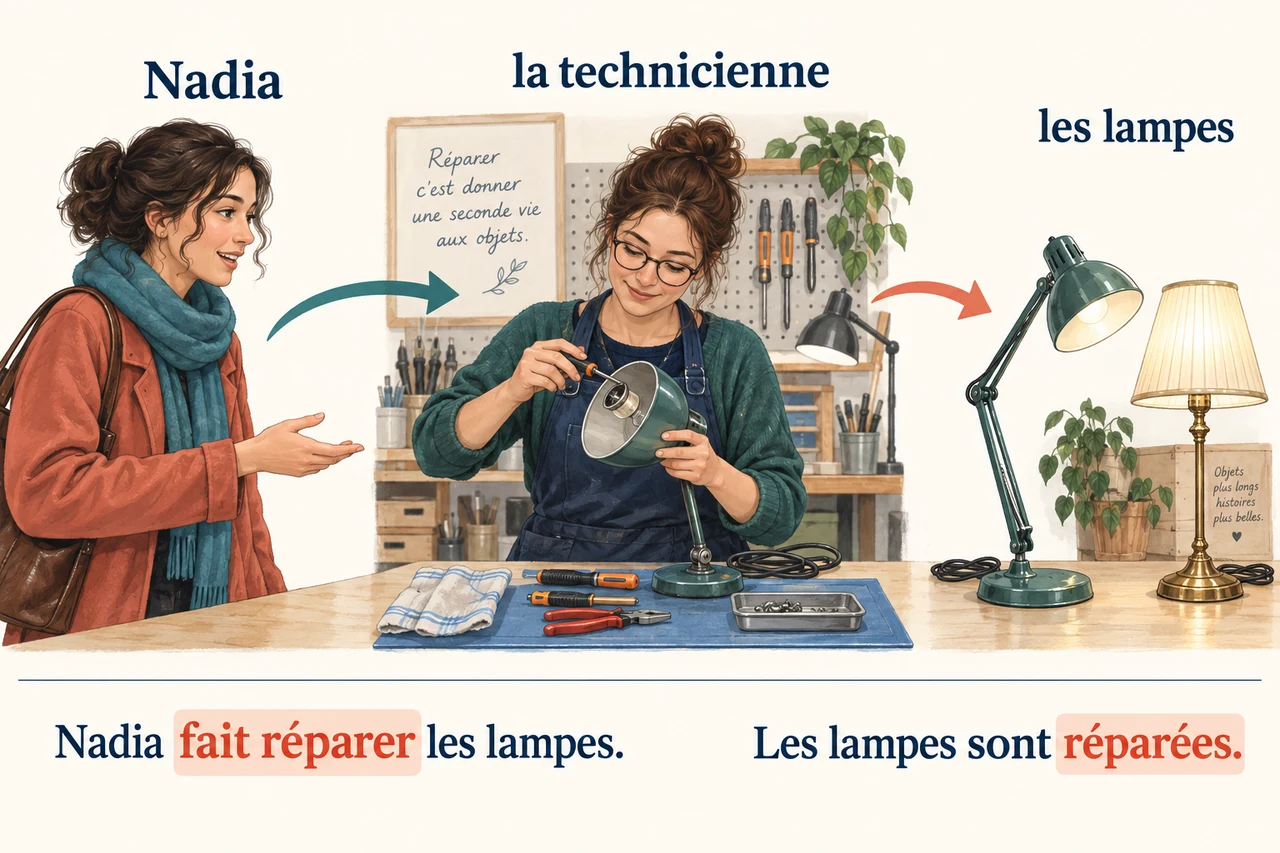
Image: illustration, not a documentary photograph. All people, services, schedules and task data in these examples are fictional teaching contexts, not researched claims about a country or organisation. Explicit AS-receptive→AL productive passive/dependent-infinitive transitions; past historic remains receptive. Full tense coverage and performed oral/assessment remain OPEN. Selected arranger/doer/patient distinction and passive agreement; repair illustration is a schematic role aid, not a technical electrical procedure or all passive tenses. Result lamps and working technician are juxtaposed explanatory frames. All eight passive forms and invariable fait-before-infinitive remain in corrected full lesson. · Original operator-generated conceptual illustration; no institutional photograph, edition illustration or modern critical text copied.
Passive, causative and responsibility for an action
An active sentence and its passive counterpart organise attention differently while preserving the action’s participants. In a fictional community workshop, « L’équipe répare les lampes » makes the team the grammatical subject and the lamps its direct object. « Les lampes sont réparées par l’équipe » makes the lamps the subject receiving that action, with par l’équipe naming the agent. The passive can omit the agent when the result matters or the agent is unknown, but that omission does not prove that nobody acted. Before transforming a sentence, identify the verb’s direct object; a phrase introduced by a preposition is not automatically a candidate for becoming a passive subject.
A straightforward passive transformation is available for direct-transitive constructions such as réparer les lampes. It is not achieved by inserting être before any verb: « L’équipe parle aux visiteurs » cannot become an ordinary passive « les visiteurs sont parlés ». Likewise, « Nadia est arrivée » remains an active intransitive arrival despite its auxiliary être. In a passive, the subject is the patient of an action expressed by the participle; in the arrival sentence, Nadia is the person arriving. Meaning and the original verb construction therefore distinguish forms that share an auxiliary. They are not classified solely by counting how many words the verbal group contains.
To retain tense in a passive, conjugate être at the corresponding tense and keep the lexical participle agreed with the patient subject. With feminine-plural lampes: present « sont réparées »; imperfect « étaient réparées »; future « seront réparées »; conditional present « seraient réparées »; passé composé « ont été réparées »; plus-que-parfait « avaient été réparées »; future perfect « auront été réparées »; conditional perfect « auraient été réparées ». In compound forms, the tense belongs to the full être auxiliary group. Réparées remains feminine plural throughout; été stays unchanged. Each form still needs a context explaining whether the repair is habitual, complete, predicted, imagined or earlier than another event.
Mood can change without abandoning that structure. « Il faut que les lampes soient réparées » is a present subjunctive passive obligation; « Je regrette qu’elles aient été réparées trop tard » uses a completed subjunctive passive action. A literary narrative might contain « La lampe fut réparée » with a past historic form of être, which this learner should recognise receptively. The A Level grammar list extends passive productivity beyond the inherited receptive treatment of other passive tenses, but the past-historic recognition boundary should not be silently recast as an independent demand for every literary paradigm. Full tense practice also remains distinct from assessed spontaneous speaking.
Faire followed by an infinitive introduces a different participant structure: « Nadia fait réparer les lampes » says she causes or arranges the repair. It does not, by itself, say that Nadia personally repairs them. Compare « Nadia répare les lampes », where Nadia is the repairer, and « Les lampes sont réparées », where attention rests on the objects receiving repair. A sentence can name the separate repairer: « Nadia fait réparer les lampes par une technicienne ». The faire construction is not merely a passive with new words. It adds a causing or arranging participant whose exact intention or relationship must be interpreted from context, not assumed to be coercion in every example.
The participle fait remains invariable when immediately followed by an infinitive, including after an earlier direct object: « Les lampes que Nadia a fait réparer fonctionnent maintenant ». Writing faites in that construction would incorrectly apply an ordinary preceding-object agreement rule without recognising the special structure. Compare « les lampes que Nadia a réparées », where the simple lexical participle does agree with its earlier feminine-plural direct object. The same invariability applies in an appropriate pronominal causative, « Elles se sont fait aider ». Do not extend it to every occurrence of the word fait when no following infinitive is present; the syntactic condition is part of the rule.
A useful role check names three possible participants: the arranger, the person carrying out the infinitive’s action, and the thing or person affected by that action. A passive typically promotes that affected participant into subject position; a causative can preserve an arranger as the subject while leaving the actual actor unnamed. After that role analysis, check chronology, auxiliary form, agreement and whether the statement entails the intended responsibility. These steps prevent a superficially elegant rewrite from changing who did the work or suggesting a completed repair where only an obligation exists. The tasks below test selected productive passive and causative decisions with full answers, while wider construction and assessment demands remain open.
All people, services, schedules and task data in these examples are fictional teaching contexts, not researched claims about a country or organisation.
Explicit AS-receptive→AL productive passive/dependent-infinitive transitions; past historic remains receptive. Full tense coverage and performed oral/assessment remain OPEN.
Selected arranger/doer/patient distinction and passive agreement; repair illustration is a schematic role aid, not a technical electrical procedure or all passive tenses. Result lamps and working technician are juxtaposed explanatory frames. All eight passive forms and invariable fait-before-infinitive remain in corrected full lesson.
Worked example: At a fictional workshop, the team repairs the lamps. Transform the active sentence into passive present, future and passé composé forms, preserving the named agent. Then say that Nadia arranged for a technician to repair the lamps yesterday, using faire, and embed the lamps as an earlier relative direct object. Explain the difference between Nadia repairing and arranging repair.
The direct object les lampes becomes passive subject; réparer becomes être plus participle with the selected tense. Réparées agrees feminine plural with lampes, while été is unchanged in ont été réparées. Par l’équipe retains the repairer.
Nadia is the arranger in a fait réparer; une technicienne is the repairer. The immediately following infinitive requires fait to stay invariable even after que representing lampes. The causative does not entail Nadia carried out the repair personally.
Answer: Present: « Les lampes sont réparées par l’équipe. »
Future: « Les lampes seront réparées par l’équipe. »
Passé composé: « Les lampes ont été réparées par l’équipe. »
Causative: « Hier, Nadia a fait réparer les lampes par une technicienne. »
Earlier relative object: « Les lampes que Nadia a fait réparer par une technicienne fonctionnent maintenant. »
Check your understanding: The changed facts concern two female volunteers who personally repaired two doors before the visitors arrived. Write an active plus-que-parfait sentence and its passive counterpart, preserving the repairers. Separately state that Nadia would have arranged for the doors to be repaired if she had received permission. Finally explain why « Nadia est arrivée » is not passive and why « les portes qu’elle a réparées » differs from « les portes qu’elle a fait réparer ».
Answer: Active: « Les deux bénévoles avaient réparé les portes avant l’arrivée des visiteurs. »
Passive: « Les portes avaient été réparées par les deux bénévoles avant l’arrivée des visiteurs. »
Counterfactual causative: « Si Nadia avait reçu l’autorisation, elle aurait fait réparer les portes. »
« Nadia est arrivée » describes Nadia’s active intransitive arrival. In « les portes qu’elle a réparées », repaired doors are an earlier direct object of réparer, so réparées agrees. In « les portes qu’elle a fait réparer », fait is immediately followed by réparer and remains invariable.
Why: The active plus-que-parfait marks repair already complete before visitor arrival; réparé has its direct object after it. The passive keeps that prior chronology in avaient été and agrees réparées with the female-plural doors, not the repairers.
The conditional perfect aurait fait presents an unreal completed arrangement dependent on the supplied plus-que-parfait condition; it does not claim an actual repair. Être in est arrivée is an auxiliary choice for arriver, not evidence of a passive patient. The two relative constructions distinguish personal repair from arranging it and have different agreement rules.