Reporting somebody’s words without changing the question
By UK A Level French · independent study · myAudience
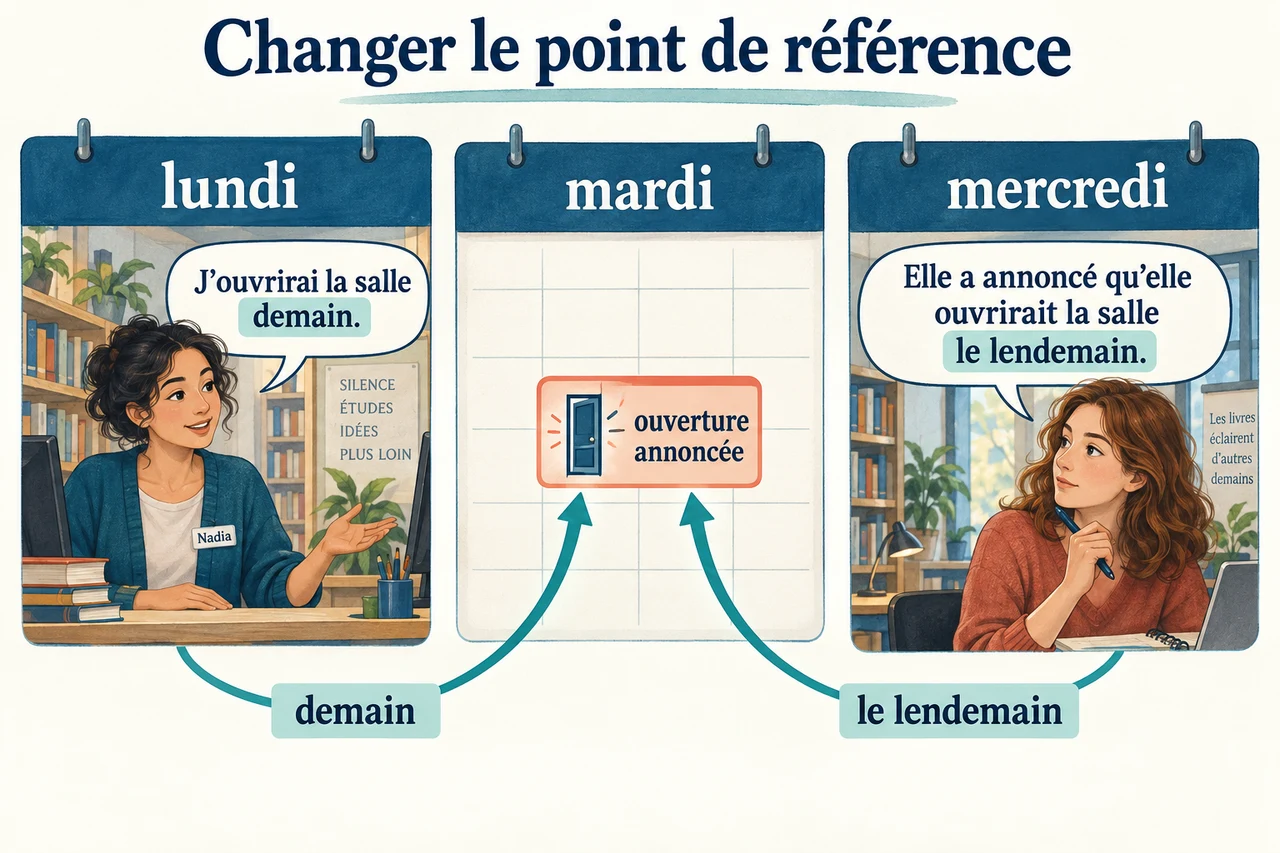
Image: illustration, not a documentary photograph. All people, services, schedules and task data in these examples are fictional teaching contexts, not researched claims about a country or organisation. Selected reported-speech and formal inversion constructions only; oral fluency/full question and preposition coverage OPEN. The library announcement is fictional and reported plan does not establish that opening happened. Arrows track reference to Tuesday, not a later day after Wednesday. Indirect questions, inversion and broader reference point cases remain in full text. · Original operator-generated conceptual illustration; no institutional photograph, edition illustration or modern critical text copied.
Reporting somebody’s words without changing the question
Direct quotation preserves the speaker’s words within an identified speaking situation. In a fictional library, Nadia says on Monday, « J’ouvrirai la salle demain ». An indirect report written on Wednesday can be « Lundi, Nadia a annoncé qu’elle ouvrirait la salle le lendemain ». Je becomes elle because the reporter now refers to Nadia; demain becomes le lendemain because Tuesday is the day after the original Monday; ouvrirait presents an event future relative to that past announcement. This report describes what Nadia announced. It does not, by itself, establish that the promised opening actually happened, and an accurate account must keep those claims separate.
Reported speech needs a reference-point check, not a blanket substitution list. If a present-tense reporter says « Nadia annonce qu’elle ouvrira demain », future ouvrira remains natural. If the report is anchored in the past, conditional can represent the future of that past, as in ouvrirait. A still-valid state can sometimes retain a present depending on how the reporter frames it; context determines whether a tense shift changes or preserves the intended claim. First locate the original speaking time, reporting time and event time. Then replace person, possessives, location and relative time words only where the shift in speaker or reference actually requires it.
A direct question and an indirect question use different constructions. « Qu’est-ce que vous préparez ? » can become « Elle demande ce que nous préparons ». The requested object is introduced by ce que; the indirect version does not carry est-ce que into the dependent clause. If the direct question asks about the subject, « Qu’est-ce qui manque ? », the report uses « Elle demande ce qui manque ». The distinction between ce que and ce qui depends on grammatical role, not on whether the answer will describe a thing. In a normal statement containing an indirect question, the final punctuation is a full stop, rather than a question mark borrowed from the original words.
A yes/no question becomes an indirect question introduced by si: « Ouvrirez-vous samedi ? » can become « Elle demande si nous ouvrirons samedi ». If the asking is reported from a past viewpoint, « Elle a demandé si nous ouvririons le samedi suivant » can preserve the original future relationship under a supplied changed reference. Si here means whether; it does not create a condition that must be satisfied before a consequence. This is why future or conditional may legitimately follow it. Direct quotation remains another option, using quotation marks and the original question structure; it should not be confused with an indirect report that silently retains fragments of that structure.
Formal inversion offers another way to form a direct question: « Quand viendra-t-elle ? » or « Nadia viendra-t-elle ? ». The t between a vowel-ending verb and elle is a written linking element, attached with hyphens, not the final consonant of Nadia’s name. It is not added after an already suitable final t or d, as in « Est-elle prête ? ». In an ordinary indirect question, the ordering returns to subject then verb: « Je demande quand elle viendra ». Choosing a more formal direct form does not authorise keeping its inversion after every reporting verb. Syntax and punctuation should be checked as a connected construction.
Some clause-initial adverbs permit or invite a formal inversion pattern: « Peut-être Nadia arrivera-t-elle à midi ». If peut-être que is used instead, the clause does not use that inversion: « Peut-être que Nadia arrivera à midi ». Initial aussi used to present a consequence can also produce a formal inversion, as in « Il pleuvait; aussi avons-nous fermé la terrasse ». That use differs from an ordinary additive aussi meaning also within a clause. Other adverbs and registers have their own constraints, so no general rule says every fronted adverb requires inversion. An accurate revision identifies both the adverb’s meaning and the construction selected for the intended register.
For a reliable report, preserve the proposition and who said or asked it, then check every deictic expression against its new reference point. Keep an open question open rather than transforming it into a statement of fact: asking whether the room will open is not confirming its opening. Check whether the reported interrogative asks for an object, a subject, a time or a yes/no answer, and choose ce que, ce qui, quand or si accordingly. Finally inspect agreement, inversion and punctuation. These written comparisons develop selected reporting and formal-order decisions; they do not demonstrate spontaneous conversational performance or exhaust the grammar’s broader preposition and question demands.
All people, services, schedules and task data in these examples are fictional teaching contexts, not researched claims about a country or organisation.
Selected reported-speech and formal inversion constructions only; oral fluency/full question and preposition coverage OPEN.
The library announcement is fictional and reported plan does not establish that opening happened. Arrows track reference to Tuesday, not a later day after Wednesday. Indirect questions, inversion and broader reference point cases remain in full text.
Worked example: In a fictional library, on Monday Nadia says to a group that includes the reporter: « J’ouvrirai la salle demain. Qu’est-ce que vous préparez ? Qu’est-ce qui manque ? Ouvrirez-vous le stand samedi ? » Write a report on Wednesday, preserving all four statements/questions and treating samedi as the Saturday following that Monday. Then write two equivalent possibilities for Nadia’s arrival at noon, one with initial peut-être and formal inversion, one with peut-être que.
Elle refers to Nadia; nous includes the original addressees and this reporter. Le lendemain retains Tuesday relative to the Monday announcement, while le samedi suivant retains the supplied Saturday. Ouvrirait and ouvririons express future from that past viewpoint; préparions and manquait report the original present activities or state in the past asking context.
Ce que asks for the object prepared, ce qui for the missing subject, and si for whether the stand will open. The report does not confirm either opening. With initial peut-être, the noun subject is resumed by inverted elle; arrivera-t-elle uses the linking t. Peut-être que instead takes ordinary order without the resumed inverted pronoun.
Answer: « Lundi, Nadia a annoncé qu’elle ouvrirait la salle le lendemain. Elle a demandé ce que nous préparions, ce qui manquait et si nous ouvririons le stand le samedi suivant. »
« Peut-être Nadia arrivera-t-elle à midi. »
« Peut-être que Nadia arrivera à midi. »
Check your understanding: Change the reference point to a present live report. Nadia now asks « Qu’est-ce qui fonctionne ? Quand pourrez-vous revenir ? Seriez-vous disposés à aider ? » Report all three questions with « Nadia demande… », keeping nous as the addressee group. Then turn « Il neige. Nous annulons la sortie en conséquence » into one formal sentence using initial consequential aussi in the second clause. Explain why the conditional after si is legitimate.
Answer: « Nadia demande ce qui fonctionne, quand nous pourrons revenir et si nous serions disposés à aider. »
« Il neige; aussi annulons-nous la sortie. »
Why: Ce qui introduces the subject of fonctionne. The present report preserves future pourrons for future ability to return. The direct conditional Seriez-vous disposés becomes an indirect question about willingness with si nous serions disposés; si means whether, not a condition-consequence relation.
The second sentence connects snowfall with the cancellation through consequential aussi and formal annulons-nous. An additive clause such as nous annulons aussi la sortie would instead say cancellation is an additional action and would not necessarily express the same causal connection. All examples remain fictional; the report contains requests for information, not proof of attendance or agreement to help.