Making an argument that stays faithful to its evidence
By UK A Level French · independent study · myAudience
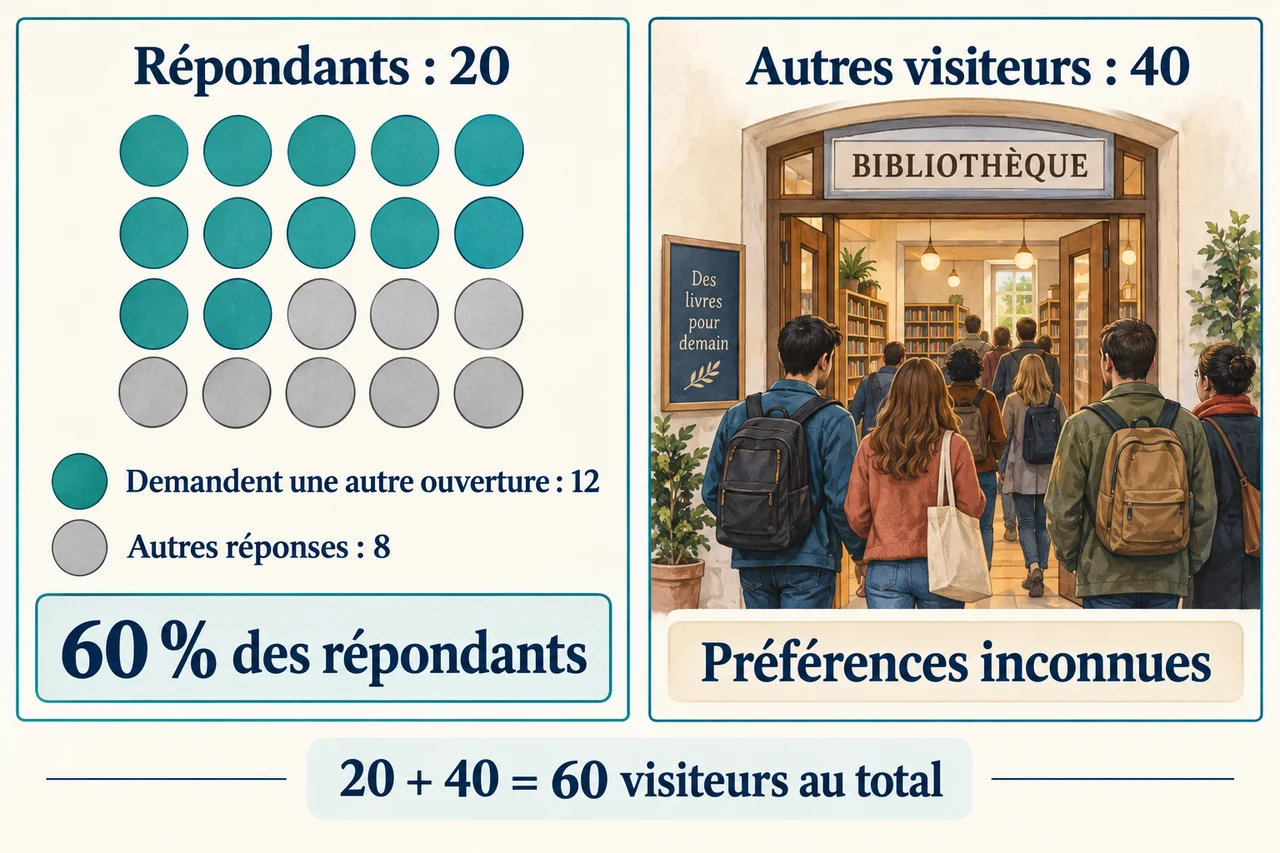
Image: illustration, not a documentary photograph. All people, services, schedules and task data in these examples are fictional teaching contexts, not researched claims about a country or organisation. Fictional data/evidence reasoning; no country-survey claim. Full listening/oral/summary assessment and remaining grammar rows OPEN. Fictional voluntary survey, not actual demographic findings. Dot grid is 20 respondents only; legend dots are keys and right-side library people are decorative, not literal 40 person headcount. Remaining eight responses are unspecified, not necessarily negative. 60 percent applies only to respondents and does not establish a majority of all 60 visitors. · Original operator-generated conceptual illustration; no institutional photograph, edition illustration or modern critical text copied.
Making an argument that stays faithful to its evidence
A convincing argument separates a claim, supporting evidence and an inference connecting the two. In a fictional library trial, sixty visitors attend an evening event and twenty complete a voluntary questionnaire. If twelve respondents ask for another evening opening, « Douze répondants sur vingt souhaitent une nouvelle ouverture en soirée » describes the available evidence. « La plupart des visiteurs souhaitent une nouvelle ouverture » would silently move from respondents to all visitors, which the facts do not justify. French quantifiers and connectors therefore do more than decorate a paragraph: they can strengthen, weaken or distort a claim. State the population and the evidence before choosing words that generalise.
Coordination links propositions without making one grammatically dependent on the other: « Le projet est utile, mais son coût reste élevé ». Subordination can introduce a reason, purpose, condition or concession: « Nous proposons un essai parce que les réponses sont encourageantes ». The connector should express the relationship actually supported by the passage. Donc or par conséquent suggests an inference, yet it does not manufacture one merely by appearing. If a voluntary survey has a selection limitation, that limitation survives every elegant transition. An accurate argument can recommend an additional trial while admitting that the existing information is insufficient for a permanent decision.
Concession is especially useful for weighing competing considerations: « Bien que l’échantillon soit limité, les réponses méritent d’être examinées ». The small sample and its usefulness can both be accepted; bien que does not require the speaker to regard the limitation as false. Même si offers another construction, ordinarily using an indicative in the factual concession practised here: « Même si l’échantillon est limité, nous pouvons organiser un second essai ». A learner must choose the connector and its verbal construction together rather than replace words while leaving a mismatched mood. Selected examples support careful written argument; broader register variation remains a separate topic.
Quantifiers such as plusieurs, certains, la plupart and tous should retain their logical differences. Twelve of twenty respondents is a majority of respondents; it is not evidence that all sixty visitors agree, nor proof about residents who did not attend. Comparisons likewise need a common basis: « plus de réponses favorables que défavorables » compares counts within this questionnaire, while « un service plus utile » evaluates usefulness and needs a stated criterion. The intensifier très describes degree rather than a precise proportion. Replacing a number with beaucoup can lose useful information, and replacing plusieurs with tous can make an otherwise well-formed sentence false.
Time expressions also affect what a reader is asked to believe. « La bibliothèque ouvre en soirée depuis septembre » presents a practice that began then and continues in the relevant present. « La bibliothèque a ouvert en soirée il y a deux semaines » locates an opening event two weeks before the telling. « Elle a testé cet horaire pendant deux semaines » treats the trial as a duration, here a completed period in the selected account. Depuis does not universally force a present: « Elle n’a pas rouvert depuis septembre » uses a compound past appropriately. Explain the continuing state, event location or duration rather than choosing a tense from one time word alone.
An own-word summary should preserve the passage’s essential content and its uncertainty, not merely change a few nouns into synonyms. First identify the proposal, the evidence, the limitation and the next step; then compose complete French sentences without importing personal opinions. marks summary content and language separately, with a specified natural-break treatment of lengthy answers around ninety to one hundred words. That convention is not a reason to truncate a teaching model halfway through a sentence, and a short answer still has to include the requested content. The short practice here teaches fidelity and concision, not a complete formal summary assessment or a simulated examiner mark.
When speaking, discourse markers can orient a listener—d’abord, cependant, en revanche, enfin—while a brief repair can prevent a mistaken claim from spreading: « Tous les visiteurs… je corrige: douze des vingt répondants ». Circumlocution can preserve meaning when a word is missing, for example describing a questionnaire as « une série de questions auxquelles les visiteurs répondent ». These are strategies to practise aloud, not evidence that reading a model makes someone fluent. The final checking routine is to test each quantifier against its denominator, each connector against its relationship, and each time expression against the timeline. Clear French and honest evidence should reinforce each other.
All people, services, schedules and task data in these examples are fictional teaching contexts, not researched claims about a country or organisation.
Fictional data/evidence reasoning; no country-survey claim. Full listening/oral/summary assessment and remaining grammar rows OPEN.
Fictional voluntary survey, not actual demographic findings. Dot grid is 20 respondents only; legend dots are keys and right-side library people are decorative, not literal 40 person headcount. Remaining eight responses are unspecified, not necessarily negative. 60 percent applies only to respondents and does not establish a majority of all 60 visitors.
Worked example: Use only this fictional information: sixty visitors attended an evening trial; twenty voluntarily answered a questionnaire; twelve of those twenty requested another evening opening; staffing costs have not yet been evaluated; the organiser proposes a second trial before any permanent decision. Write a four-sentence French argument including accurate quantified evidence, a concession, a limitation and a justified next step. Then write a two-sentence own-word summary without adding approval or predictions.
The evidence refers to respondents, not all visitors or all residents. Soit follows bien que in this careful written concession, while necessarily limits the inference. The staffing uncertainty supports gathering more information instead of asserting affordability.
The summary retains the trial, request, voluntary response, unassessed cost and proposed next step. It neither predicts a majority among non-respondents nor announces a permanent opening. The two-sentence exercise is deliberately short and is not represented as a full formal ninety-word summary assessment.
Answer: Argument: « Douze des vingt répondants souhaitent une nouvelle ouverture en soirée. Bien que ce résultat soit encourageant, le questionnaire volontaire ne représente pas nécessairement les soixante visiteurs. De plus, le coût du personnel n’a pas encore été évalué. Nous proposons donc un second essai pour recueillir davantage d’informations avant toute décision permanente. »
Summary: « Après un essai en soirée, douze des vingt personnes ayant répondu volontairement au questionnaire ont demandé une nouvelle ouverture. Le coût du personnel restant à examiner, l’organisateur propose un autre essai avant de fixer un horaire permanent. »
Check your understanding: Change the fictional facts: forty visitors attend; ten answer; only three respondents favour a permanent opening; staffing costs are now confirmed to exceed the current budget; the organiser rejects permanent opening for now but proposes an occasional event. Write a complete revised argument and a two-sentence neutral summary. Include an explicit spoken repair that corrects the false opening « La plupart des répondants sont favorables… ». Explain why reusing the old conclusion would be misleading.
Answer: Argument: « Seuls trois des dix répondants sont favorables à une ouverture permanente. Même si quelques personnes la souhaitent, cette réponse minoritaire ne permet pas de présenter le projet comme un choix largement partagé. En outre, le coût du personnel dépasse le budget actuel. L’organisateur écarte donc pour l’instant l’ouverture permanente, mais propose un événement occasionnel. »
Summary: « Lors de cet essai, trois des dix répondants ont soutenu une ouverture permanente. Le coût du personnel dépassant le budget disponible, l’organisateur préfère pour le moment un événement occasionnel. »
Repair: « La plupart des répondants sont favorables… je corrige: seuls trois des dix répondants le sont. »
Why: Three out of ten is a minority of respondents, while the preference of thirty non-responding visitors remains unknown. Même si introduces the accepted limited wish with indicative souhaitent. The staffing cost is now known to exceed the budget, so it cannot be described as merely unevaluated.
The organiser’s changed decision is rejection for now plus an occasional alternative, not the earlier proposal for a second trial before a permanent decision. The repair explicitly replaces the false majority claim with its correct denominator. It models a communication strategy without certifying actual spontaneous oral performance.