France: digital access is not digital skill
By UK A Level French · independent study · myAudience
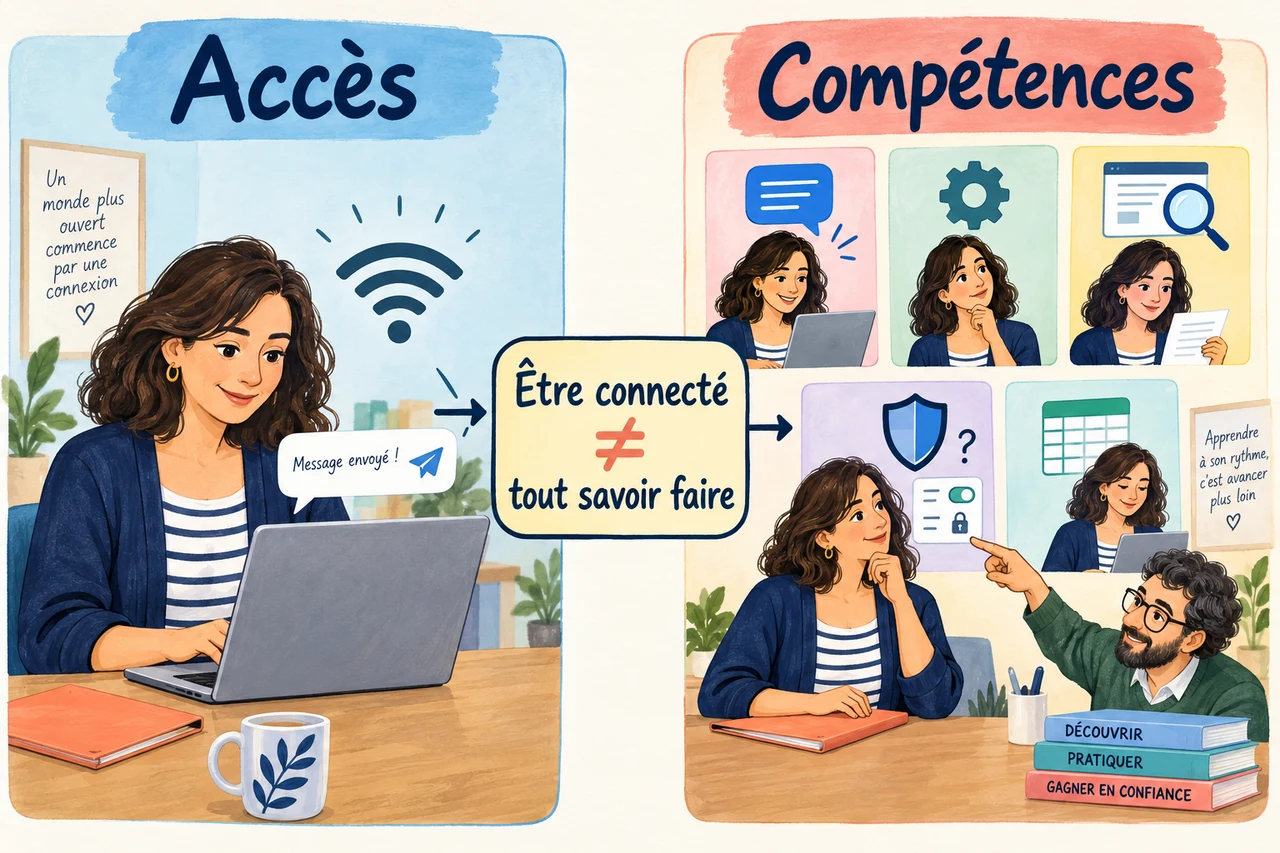
Image: illustration, not a documentary photograph. Access and task skills are different: the same fictional learner can communicate confidently while asking for help with protection. Five activity cards are conceptual examples, not survey scores, population shares or a personal diagnosis. · Original operator-generated conceptual illustration; no institutional photograph, edition illustration or modern critical text copied.
France: digital access is not digital skill
Being connected tells us that someone can reach a service; it does not tell us whether they can judge a suspicious message, protect a document or repair a failed process. This distinction is useful when discussing la cybersociété in French. An argument about digital inclusion needs an explicit definition of inclusion before it proposes a remedy. A fictional library might offer both an internet connection and guided practice. Those are different interventions: the connection removes an access obstacle, while the practice addresses a particular activity. Neither intervention proves that every visitor has the same difficulty.
INSEE's February 2026 publication describes a 2025 indicator for people aged 16–74 in ordinary households in France excluding Mayotte. It separates five activity domains: communication, problem solving, information, privacy and software. The indicator is based on reported activities rather than an individual qualification examination. That boundary matters. When writing « selon l'enquête », attach the population and year to the statement. Do not describe the result as a diagnosis of a person you have never met. A national indicator can help identify a policy question without supplying an explanation of each individual's experience.
The reported groups are 7% in illectronisme and 27% with low skills, together 34% lacking the defined basic level. The source's category names are operational categories, not insults. Within its framework, no skills means a zero in at least four domains; low skills means a zero in one to three. Someone may therefore communicate confidently while having difficulty elsewhere. In a French summary, « ne possède pas toutes les compétences de base retenues » is more careful than « ne sait rien faire ». The second claim erases the domains in which that person may already be capable.
Comparing percentages requires asking what is being divided by what. The 34% is a share of the defined surveyed population, not a share of people using one particular app. A second percentage calculated only among a low-skills group has a different denominator. Imagine an original example with twenty workshop visitors: twelve send messages easily but only five identify a fake login page. Both observations can be true because different tasks are measured. Those fictional counts illustrate a logical possibility; they are not extra INSEE findings and should never be placed inside a sentence that attributes them to the survey.
The reported lack-of-skills share moved from 38% in 2021 to 34% in 2025: a fall of four percentage points. A percentage-point change subtracts the two shares. A relative percentage change instead divides that difference by the starting share, producing about 10.5% from these rounded figures. For an ordinary source summary, the four-point statement is clearer and avoids suggesting that the published rounded values are exact measurements. Neither calculation identifies what caused the change. « A diminué » describes a movement; « a diminué grâce à cette application » adds a causal explanation that these figures alone do not establish.
An effective discussion then separates evidence, inference and a proposal. Evidence: the indicator distinguishes several digital activities. Inference: one uniform workshop may leave some needs unanswered. Proposal: ask visitors which tasks they want to practise and offer focused sessions. The proposal is an original reasoned response, not a policy already evaluated by INSEE. French can keep these stages visible: « l'enquête indique », « cela suggère » and « on pourrait ». Changing from an indicative report to a conditional proposal tells the reader how strongly each sentence is supported. It also leaves room for other practical solutions.
Finally, test whether an apparently precise answer exceeds its source. A population aged 16–74 does not automatically give the rate for seventeen-year-olds. Even a published 16–29 age group cannot identify a single age or a named pupil. If a council asks whether its new local help desk improved residents' skills, national cross-sectional figures cannot answer that local before-and-after question on their own. State what further evidence would be useful: comparable local tasks, a defined sampling method and a period of observation. Intellectual honesty here strengthens the argument; it does not require abandoning the question.
Image caption: Image: illustration, not a documentary photograph. Access and task skills are different: the same fictional learner can communicate confidently while asking for help with protection. Five activity cards are conceptual examples, not survey scores, population shares or a personal diagnosis.
Worked example: En 2025, 7 % relèvent de l'illectronisme et 27 % ont des compétences faibles, selon la définition de l'Insee. En 2021, la part totale correspondante était de 38 %. Résumez les résultats en français, calculez le changement en points et proposez une réponse locale sans prétendre démontrer sa réussite.
The answer labels the source population, adds mutually exclusive published categories, subtracts shares in percentage points and uses the conditional for an unevaluated proposal. It does not attribute an individual deficit or a causal effect to the national indicator.
Answer: Selon l'Insee, en 2025, 34 % des personnes de 16 à 74 ans vivant en ménage ordinaire en France hors Mayotte ne possèdent pas le niveau de base défini par l'indicateur: 7 % relèvent de l'illectronisme et 27 % ont des compétences faibles. La part totale a diminué de quatre points depuis 2021, puisqu'elle est passée de 38 % à 34 %. Il ne s'agit pas d'une baisse de quatre pour cent au sens relatif. Les difficultés peuvent concerner des domaines différents. Une bibliothèque pourrait donc proposer des ateliers ciblés après avoir demandé aux participants ce qu'ils souhaitent apprendre. Toutefois, ces résultats nationaux ne prouvent pas que cet atelier local serait efficace.
Check your understanding: Un camarade écrit: « Puisque 27 % des personnes ont des compétences faibles, exactement 27 % des jeunes de dix-sept ans ne savent pas utiliser Internet. » Corrigez les deux dépassements et indiquez une information supplémentaire nécessaire.
Answer: Cette conclusion dépasse la source. Les 27 % concernent l'ensemble de la population définie par l'enquête, et non les seuls jeunes de dix-sept ans. On ne peut pas attribuer automatiquement la moyenne nationale à un âge précis. De plus, des compétences faibles ne signifient pas que l'on ne sait jamais utiliser Internet: l'indicateur distingue plusieurs domaines et une personne peut réussir certaines activités. Pour connaître la situation à dix-sept ans, il faudrait des résultats fiables pour cet âge, avec la même définition et un effectif suffisant. Pour proposer une aide à un élève particulier, il faudrait également connaître les tâches qu'il souhaite accomplir, sans le classer d'après une moyenne.
Why: This transfer changes the denominator and the meaning of a category. Both errors are answered explicitly; obtaining age-specific evidence would still not justify diagnosing a named person.