Canada: organised and informal volunteering
By UK A Level French · independent study · myAudience
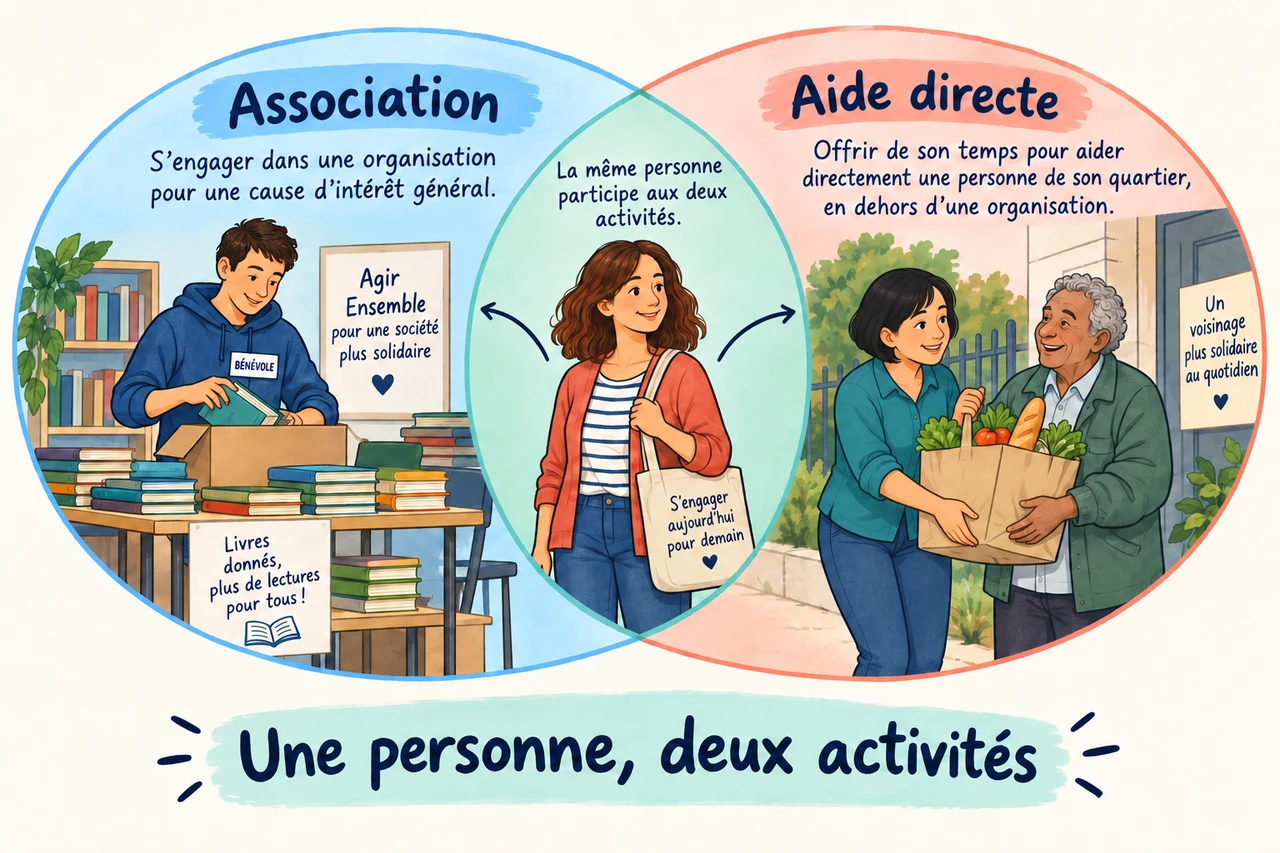
Image: illustration, not a documentary photograph. The central person belongs to both conceptual volunteering categories and is counted once. The outer scenes illustrate activities with different helpers. Oval areas and the number of figures do not encode Canadian rates; the neighbour example concerns help outside one’s own household. · Original operator-generated conceptual illustration; no institutional photograph, edition illustration or modern critical text copied.
Canada: organised and informal volunteering
Voluntary work can be visible through an organisation or almost invisible because it takes place between neighbours. When discussing le bénévolat, start by asking how the source defines the activity rather than deciding which form deserves the label. A fictional person who helps at an association on Saturday and assists a neighbour on Sunday does not become two people. This simple observation explains why category totals may overlap. It also prevents a misleading moral hierarchy in which a registered organisation's work automatically counts as more generous than an equally useful direct contribution.
Statistics Canada's June 2025 report compares volunteering in 2018 and 2023. Its survey population is people aged fifteen and older in the ten provinces, with stated exclusions including full-time institutional residents and Indigenous people living on reserves. These are Canadian national estimates within that scope, not a result specifically about Quebec or all French speakers. Writing in French about Canada does not convert the data into Francophone-only data. A careful opening sentence names the country, years and population before using the figures to frame a question about social participation.
The reported overall participation rate decreased from 79% to 73%; organised volunteering from 41% to 32%; informal volunteering from 74% to 66%. The two types overlap. Organised activity is unpaid work through a group or organisation, while informal activity includes direct help outside an organisation and community improvements; help within one's own household is excluded from the direct-help definition. A monetary gift alone is not automatically volunteer time. Those distinctions allow a learner to classify a fictional case without silently changing the published measure to include every helpful act.
Use an original counting example to see the overlap clearly. Among one hundred fictional residents, thirty volunteer through an organisation, sixty provide informal help and twenty do both. The union contains seventy people: thirty plus sixty minus the twenty counted twice. The method is inclusion and exclusion, not an instruction to invent Canadian counts. With the published rounded estimates, adding the two type rates would wrongly produce 98% rather than the stated overall 73%. The discrepancy is a warning about overlapping categories; apparent numerical precision should not override the source's explicit definitions.
Participation rates and hours answer different questions. A rate asks how many people did an activity; hours ask about its duration. In an original example, ten volunteers giving one hour each contribute ten hours, while two volunteers giving six hours each contribute twelve. The second group is smaller but gives more time. A discussion can therefore acknowledge a change in participation without assuming an identical change in intensity. In French, « la proportion de bénévoles » and « le nombre d'heures consacrées » help keep those measures separate. Neither one alone captures every form of usefulness to a community.
The overall change from 79% to 73% is six percentage points. It does not justify saying that every volunteer became less generous or that a particular generation caused the change. A comparison of estimates describes a population pattern; personal motives require different evidence. When offering an interpretation, make its status explicit: « plusieurs explications sont possibles ». An association might examine scheduling, transport, caring responsibilities or recruitment as practical questions, but this list is an original planning suggestion. It is not a set of independently established causes extracted from the national percentages.
A good conclusion remains useful without being judgemental. Explain the measured change, distinguish organised and informal participation, then suggest what a local organisation could investigate. If a teenager helps a neighbour directly, ask whether the action fits the survey's definition and recall the age scope; do not claim that the national rate predicts their behaviour. If someone requests a Quebec-only comparison, answer that this particular national summary cannot supply it. Keeping the geographical and categorical boundaries visible makes it possible to discuss solidarity seriously rather than turning a survey into a story about national character.
Image caption: Image: illustration, not a documentary photograph. The central person belongs to both conceptual volunteering categories and is counted once. The outer scenes illustrate activities with different helpers. Oval areas and the number of figures do not encode Canadian rates; the neighbour example concerns help outside one’s own household.
Worked example: Les taux publiés sont de 79 % puis 73 % pour l'ensemble du bénévolat, de 41 % puis 32 % pour le bénévolat encadré, et de 74 % puis 66 % pour le bénévolat informel. Expliquez en français pourquoi les deux derniers taux ne s'additionnent pas et résumez le changement global sans conclusion morale.
The answer separates published estimates from the explicitly fictional union example. It retains the national boundary and describes six percentage points without converting a population pattern into a judgement about motives.
Answer: Dans l'enquête canadienne, la proportion totale de bénévoles est passée de 79 % en 2018 à 73 % en 2023, soit une baisse de six points. Les taux du bénévolat encadré et du bénévolat informel ne peuvent pas simplement s'additionner, car une même personne peut pratiquer les deux. Il faut éviter de la compter deux fois. Par exemple, dans un groupe fictif de cent personnes, trente pratiquent le bénévolat encadré, soixante le bénévolat informel et vingt font les deux: soixante-dix personnes participent au total. Cette comparaison décrit des activités définies par l'enquête. Elle ne démontre pas que chaque Canadien est devenu moins généreux et ne représente pas uniquement les francophones ou le Québec.
Check your understanding: Une personne de vingt ans aide gratuitement une voisine qui habite seule, participe aussi à une association et donne de l'argent à une campagne. Classez ces actions sans inventer une fréquence régionale. Une autre personne aide seulement un membre de son propre ménage: que faut-il distinguer ?
Answer: L'aide directe à une voisine extérieure au ménage correspond à la catégorie du bénévolat informel, si elle respecte les autres conditions de l'enquête. L'activité non rémunérée réalisée par l'intermédiaire d'une association relève du bénévolat encadré. La même personne peut donc appartenir aux deux catégories, tout en ne comptant qu'une fois parmi l'ensemble des bénévoles. Le don d'argent n'est pas, à lui seul, une durée de bénévolat. L'aide à un membre de son propre ménage n'entre pas dans la définition de l'aide directe informelle utilisée ici, même si elle peut être utile. Ces cas fictifs expliquent un classement; ils ne fournissent aucun taux pour une province, une langue ou une génération.
Why: The changed answer addresses all four actions, distinguishes value from measurement and refuses an unsupported regional frequency. The recipient and organisational setting determine the category; generosity alone does not determine inclusion in this survey measure.