Belgium: youth participation and an election-specific right
By UK A Level French · independent study · myAudience
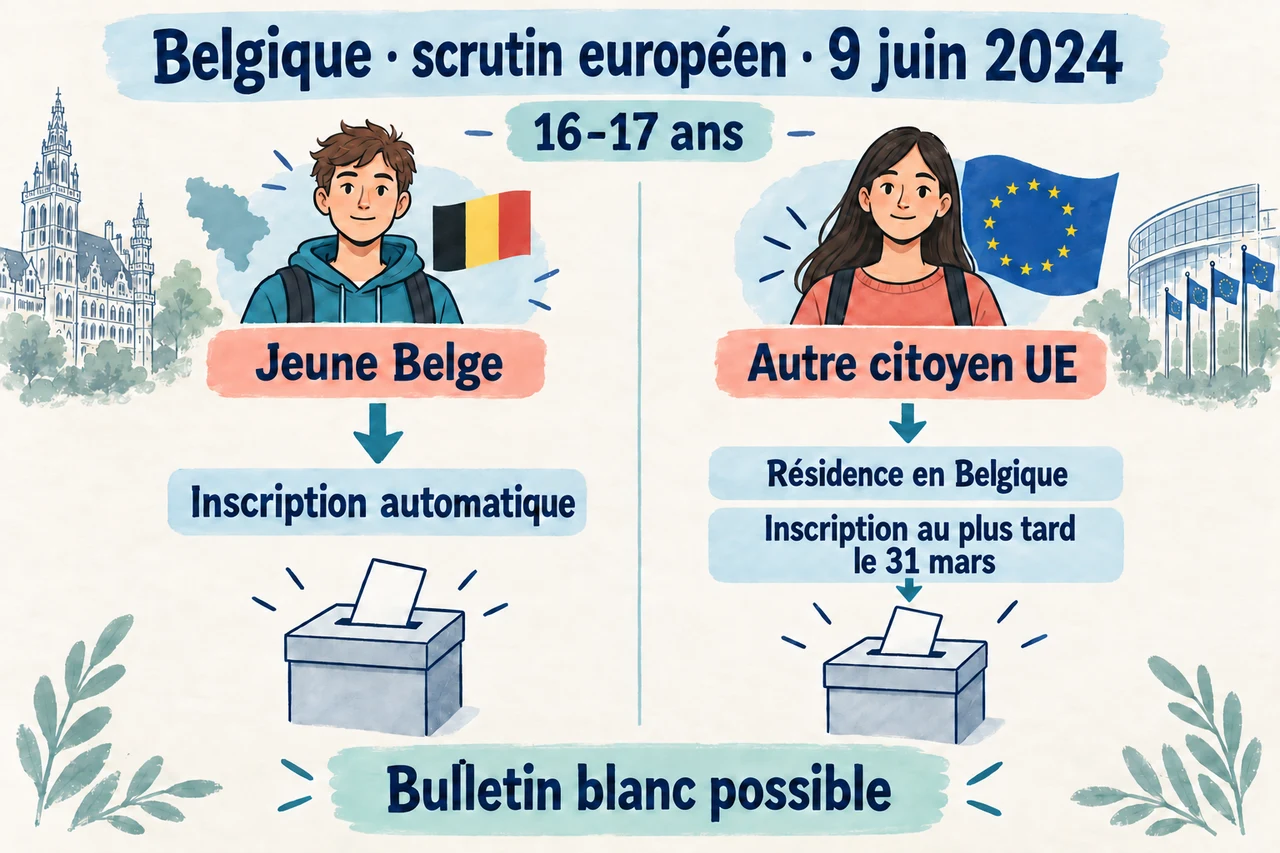
Image: illustration, not a documentary photograph. A dated summary of two registration routes for the Belgian European election on 9 June 2024. The other-EU-citizen deadline includes 31 March 2024. This is not an exhaustive eligibility checklist or current personal advice; the written lesson separately explains the participation obligation and blank-ballot option. · Original operator-generated conceptual illustration; no institutional photograph, edition illustration or modern critical text copied.
Belgium: youth participation and an election-specific right
A sentence such as “young people can vote at sixteen” sounds simple, but it leaves out the election, jurisdiction, nationality and registration conditions. Those omissions can completely change its meaning. In a French discussion of la participation politique, begin with the particular institution being chosen. Voting in an election to the European Parliament is not interchangeable with voting for a national parliament or a local council. A useful civic explanation makes those distinctions visible before asking whether a particular fictional young person could participate. It does not turn a short slogan into personal electoral advice.
The Belgian federal FAQ describes the elections held on 9 June 2024. For that event, sixteen- and seventeen-year-olds could participate in the European election, with a participation obligation under the guidance. Belgian young people were registered automatically. Other European Union citizens resident in Belgium needed the relevant registration by 31 March 2024; once registered, participation was also obligatory. These statements belong to that dated event. They must not be presented as a fresh decision about another election, a person whose residence is unknown, or the position of every sixteen-year-old across Europe.
Age is therefore one condition rather than a complete decision rule. Construct a small fictional information table: age on election day, nationality, residence and registration status. If one field is missing, the conclusion may have to remain open. That is not the same as saying that the person is ineligible. « Les informations ne permettent pas de conclure » identifies an evidential gap; « cette personne n'a pas le droit de voter » makes a substantive claim. The difference matters when the audience may rely on the explanation. Responsible reasoning does not fill an empty field with an assumption.
Registration, eligibility, attendance and choice should also remain distinct. The historical FAQ separates a duty to participate from being required to choose a particular party: a blank ballot is allowed. A student can therefore describe an obligation without implying that political preference is compulsory. French vocabulary helps preserve the distinction: « inscription sur la liste », « conditions de participation », « obligation de participer » and « bulletin blanc » name different ideas. Explaining each step avoids an argument in which one word, voter, silently changes meaning halfway through the discussion.
A comparison between two fictional cases shows how the rule works. Camille is Belgian, seventeen on the election date and covered by automatic registration for that European event. Luca is a seventeen-year-old citizen of another EU country resident in Belgium, with the required registration completed before the deadline. Their routes to registration differ, although both examples fall within the stated European-election conditions. The comparison does not establish their eligibility for every other ballot. Nor does it establish how either person voted or whether younger participation improved democracy: those would require separate evidence.
A source's date matters as much as its institution. A leaflet prepared earlier in 2024 may not reflect later decisions addressed by the FAQ. For this lesson, the retained official FAQ is the authority for the specific historical explanation; an earlier statement should not be substituted merely because its headline is easier to quote. When answering in French, place the date near the claim: « pour le scrutin européen du 9 juin 2024 ». That phrase is a small but effective safeguard against turning a bounded account into an evergreen promise about rights or duties.
To develop a balanced argument, distinguish the legal example from a political proposal. One could argue that youth participation deserves accessible information, opportunities for discussion and clear explanations of institutions. Those are original reasoned suggestions, not outcomes demonstrated by the FAQ. A counterargument might ask how schools can support understanding without instructing pupils which party to choose. The answer can defend informed participation while recognising that electoral eligibility is only one part of civic life. This keeps the discussion intellectually useful without manufacturing participation statistics or declaring that the whole topic has been assessed.
Image caption: Image: illustration, not a documentary photograph. A dated summary of two registration routes for the Belgian European election on 9 June 2024. The other-EU-citizen deadline includes 31 March 2024. This is not an exhaustive eligibility checklist or current personal advice; the written lesson separately explains the participation obligation and blank-ballot option.
Worked example: Pour le scrutin européen belge du 9 juin 2024, comparez Camille, Belge de dix-sept ans, et Luca, citoyen d'un autre pays de l'Union européenne, âgé de dix-sept ans, résidant en Belgique et inscrit avant le 31 mars 2024. Expliquez le rôle de l'inscription et distinguez participation et choix politique.
The answer applies two registration routes to the stated historical event, preserves the election boundary and separates participation from political preference.
Answer: D'après la FAQ fédérale concernant ce scrutin, Camille bénéficie de l'inscription automatique prévue pour les jeunes Belges de seize et dix-sept ans. Luca suit une autre procédure: en tant que citoyen d'un autre pays de l'Union européenne résidant en Belgique, il devait demander son inscription au plus tard le 31 mars 2024; l'énoncé précise qu'il l'a fait. Les deux cas correspondent donc aux conditions décrites pour cette élection européenne. La FAQ indique une obligation de participation, mais cela ne signifie pas l'obligation de soutenir un parti: un bulletin blanc est possible. Ces conclusions ne doivent pas être étendues automatiquement aux élections fédérales, régionales ou locales, ni utilisées pour décider d'une situation actuelle sans vérifier les règles applicables.
Check your understanding: Une affiche annonce: « Tous les jeunes de seize ans peuvent voter à toutes les élections belges. » Un lecteur dit seulement qu'il a seize ans. Corrigez l'affiche et expliquez pourquoi vous ne pouvez pas décider de sa situation à partir de cet âge seul.
Answer: L'affiche est trop générale. L'exemple étudié concerne l'élection européenne du 9 juin 2024 et des conditions précises; il ne démontre pas un droit universel à participer à toutes les élections belges dès seize ans. Pour comprendre la situation du lecteur, il faudrait connaître l'élection envisagée et sa date, sa nationalité, son lieu de résidence ainsi que, lorsque cela est nécessaire, son inscription. L'âge seul ne fournit pas toutes ces informations. L'absence de renseignements ne prouve pas non plus qu'il est exclu. Je dirais donc que les données sont insuffisantes et qu'il faut consulter l'autorité électorale compétente pour le scrutin concerné, au lieu de remplacer les conditions manquantes par une supposition.
Why: The transfer changes the scope from one event to all elections and removes nationality/residence/registration. The response corrects both issues without making unsupported current legal advice.