Senegal: Saint-Louis, heritage and a living city
By UK A Level French · independent study · myAudience
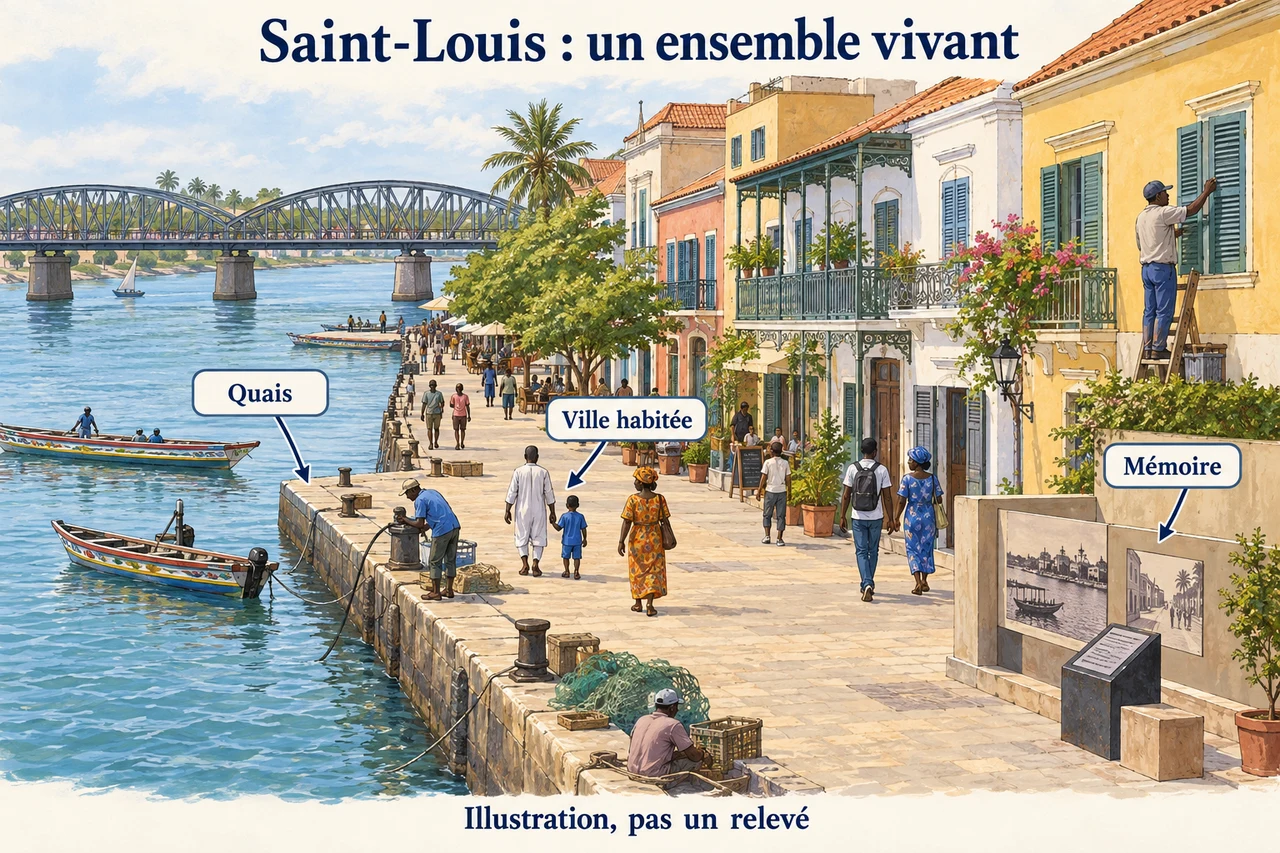
Image: illustration, not a documentary photograph. A conceptual Saint-Louis-inspired ensemble connects quays, bridge, buildings and everyday life. It is not a surveyed street, exact map, historical photograph, approved conservation project or evidence that current risks are resolved. The lesson separately explains colonial power and enslavement. · Original operator-generated conceptual illustration; no institutional photograph, edition illustration or modern critical text copied.
Senegal: Saint-Louis, heritage and a living city
A heritage city is a place where people live, work and make decisions, not simply a collection of attractive façades. Discussing Saint-Louis in French therefore requires two questions: what features carry historical meaning, and whose needs must be considered when the place changes? A visitor's interest in a view is real, but it does not replace a resident's need for a safe home or a working street. This lesson uses the official heritage description to establish a bounded starting point, then develops original ways to reason about conservation rather than claiming to report a current local consultation.
UNESCO's account places the island city at the mouth of the Senegal River and identifies its regular street plan, quays and colonial architecture. The listed property includes the island and the Faidherbe bridge; inscription took place in 2000. Reading the site as an ensemble matters: a bridge, street pattern and waterfront relationship can carry meaning together. An account limited to one picturesque building might miss that connection. In French, « l'ensemble urbain » is useful because it directs attention to relationships between parts rather than suggesting that heritage is only a set of isolated decorative objects.
The history should not be reduced to a celebration of colonial elegance. The official description also identifies Saint-Louis's role in colonial trade, including the trafficking of enslaved people. That fact changes how a respectful interpretation should frame the place. A photograph of a balcony cannot supply the whole human history, and an appealing building does not make coercion disappear. An original explanatory panel could invite visitors to consider both architecture and the systems of power through which the city developed. Such a proposal is not a claim that a particular panel already exists or has been approved.
Authenticity and integrity answer related but different questions. Authenticity asks whether the characteristics through which a place communicates its significance are credible; integrity asks whether the necessary whole and its relationships remain sufficiently intact. These are explanatory distinctions for reading the official account, not a universal checklist that a learner can use to certify a site. A new façade matching a colour may still alter materials or spatial meaning. Conversely, a building adapted for use need not automatically destroy every heritage value. The relevant question is what the proposed change does to the identified attributes and their context.
Consider an original fictional proposal to replace a waterfront building's damaged elements while preserving its relationship to the quay and neighbouring streets. A sensible discussion would ask what can be repaired, what evidence survives, which materials are appropriate and what residents require. It would also ask who has authority to approve work. Neither the attractive appearance of a rendering nor an enthusiastic visitor proves that the proposal is acceptable. Use the conditional in French: « il faudrait examiner ». That phrasing presents an inquiry rather than disguising an unevaluated design as an official conservation decision.
Residents, craftspeople, public authorities and visitors may have different priorities without forming simple opposing camps. Maintaining traditional skills can support repair and employment; keeping a building usable can help avoid abandonment. At the same time, a change designed only for short-term commercial appeal may weaken the ensemble's legibility. These are possible tensions developed for teaching, not measured claims about what particular Saint-Louis residents currently believe. An effective argument states which value is at stake, supplies evidence about the place and identifies an unanswered practical question. It avoids pretending that “tourism” or “the community” speaks with one voice.
Finally, separate a heritage description from a live condition report. Statements about conservation measures in the retained account do not establish that every present risk has been resolved or that any proposed project would be safe. To investigate a current decision, one would need dated local information, technical evidence and the competent authorities' process. A strong French conclusion can still be definite about the principle: conservation should explain historical meaning while considering continued use. It should remain conditional about the particular intervention until the necessary evidence exists. This combination of precision and openness is more useful than either automatic approval or automatic refusal.
Image caption: Image: illustration, not a documentary photograph. A conceptual Saint-Louis-inspired ensemble connects quays, bridge, buildings and everyday life. It is not a surveyed street, exact map, historical photograph, approved conservation project or evidence that current risks are resolved. The lesson separately explains colonial power and enslavement.
Worked example: Expliquez en français pourquoi l'île de Saint-Louis doit être étudiée comme un ensemble vivant. Appuyez votre réponse sur le plan urbain, les quais et le contexte colonial, puis distinguez une proposition de conservation d'une décision officielle.
The response connects ensemble attributes with historical interpretation and continued use. It identifies a proposal as conditional and does not invent an approval or current conservation success.
Answer: L'île de Saint-Louis, inscrite sur la Liste du patrimoine mondial en 2000, ne se réduit pas à quelques façades. Le plan régulier, les quais, les bâtiments et le pont Faidherbe participent aux relations qui donnent son sens à l'ensemble. Il faut aussi expliquer le contexte colonial, notamment le commerce de personnes réduites en esclavage, plutôt que présenter seulement une image séduisante de l'architecture. Cependant, la ville reste un lieu de vie. Une proposition de restauration devrait donc examiner les caractéristiques patrimoniales et les besoins des habitants. Dire qu'il serait souhaitable de réparer un bâtiment ne signifie pas que les travaux sont approuvés: une décision exige des renseignements précis et l'intervention des autorités compétentes.
Check your understanding: Un projet fictif veut remplacer un bâtiment près d'un quai par une grande façade qui en imite les couleurs mais modifie l'implantation et les matériaux. Présentez les questions nécessaires sur l'authenticité, l'intégrité et les besoins des habitants, sans rendre une fausse décision d'expert.
Answer: La ressemblance des couleurs ne suffit pas à établir la qualité du projet. Pour l'authenticité, il faudrait examiner les matériaux, les témoignages conservés et la manière dont le bâtiment communique son histoire. Pour l'intégrité, il faudrait étudier les effets sur le quai, le plan urbain et les relations avec les constructions voisines. Il serait également nécessaire de connaître les besoins des habitants et les possibilités de réparation ou d'adaptation. Je ne peux pas certifier le projet à partir de cette description fictive. Il manque notamment des relevés, une étude technique et la procédure de décision applicable. La conservation n'impose donc ni une approbation automatique de l'imitation ni un refus sans examen de toute modification.
Why: The changed case separates a superficial resemblance from materials and spatial relationships, adds living-use questions and keeps the final decision open.