Tartuffe: repetition and misplaced sympathy
By UK A Level French · independent study · myAudience
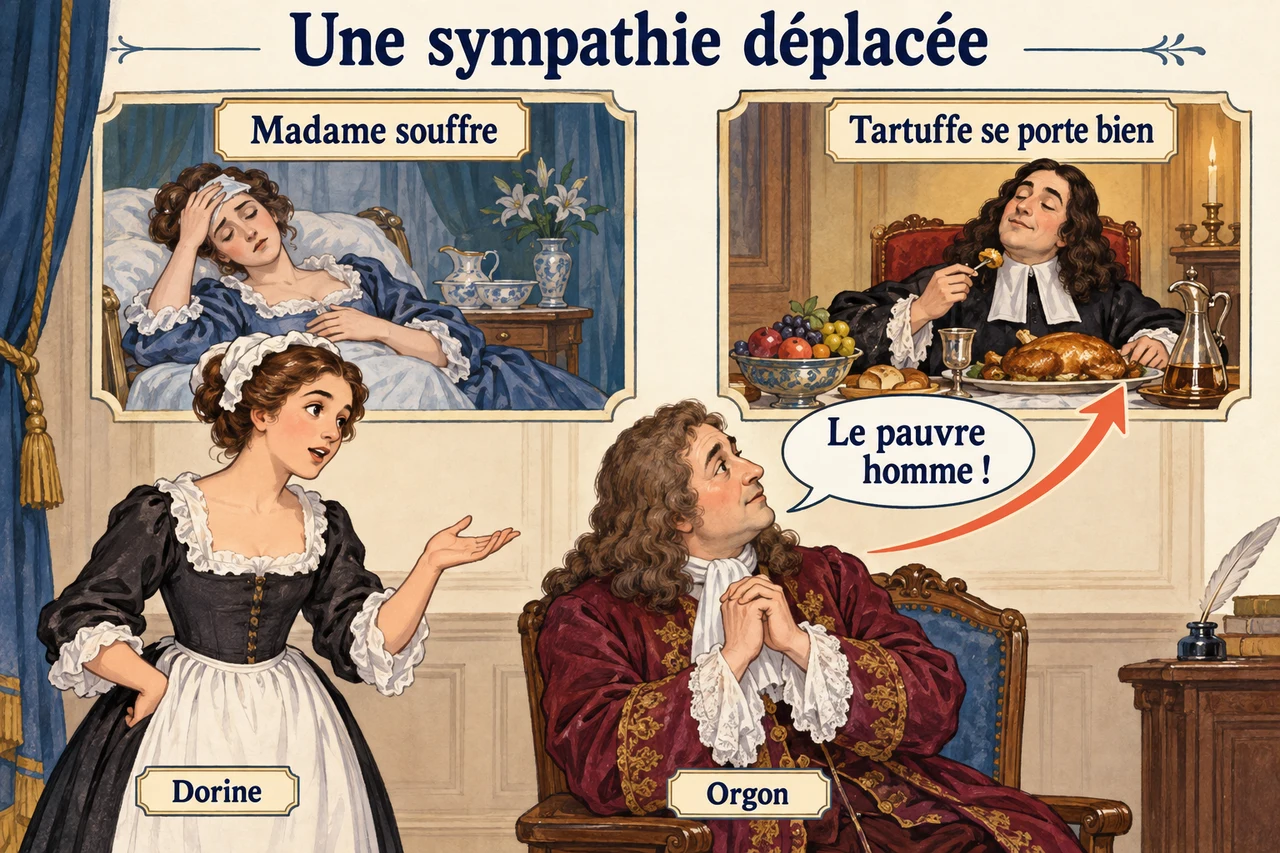
Image: illustration, not a documentary photograph. Foreground Dorine reports contrasting conditions to Orgon. The two framed images visualise her report; they do not put Madame and Tartuffe physically onstage in this selected exchange. Orgon’s ironic sympathetic refrain points toward the comfortable Tartuffe. · Original operator-generated conceptual illustration; no institutional photograph, edition illustration or modern critical text copied.
Tartuffe: repetition and misplaced sympathy
Drama makes meaning through the order in which voices are heard, not only through the events they describe. In the selected exchange, Orgon asks Dorine for news after his return. She describes Madame's illness and repeatedly contrasts it with Tartuffe's comfortable condition. Tartuffe is not speaking in this exchange: his apparent importance comes from other people's attention to him. To analyse the passage, distinguish the person who reports events from the person who responds. The audience receives both the report and the response, giving it an opportunity to notice a mismatch that Orgon's replies fail to acknowledge.
Dorine's first report establishes a straightforward contrast. Madame has had a fever and a painful headache; Tartuffe is described as healthy and well fed. Orgon then says « Le pauvre homme ! » about Tartuffe. The expression would normally signal sympathy for suffering, but the preceding description gives no reason for that sympathy here. The comic effect therefore depends on context rather than on a funny phrase in isolation. A useful analytical sentence names the mismatch, supplies a brief quotation and explains how the surrounding report reverses the phrase's expected function.
Repetition builds the effect across successive turns. Orgon's « Et Tartuffe ? » repeatedly interrupts the sequence of information about Madame, and « Le pauvre homme ! » returns after further evidence of Tartuffe's comfort. The wording remains almost fixed while Dorine's details accumulate. That difference matters: Orgon appears to follow a preoccupation rather than adjust his judgement to the news. A performance might vary pauses, emphasis or pace to make the pattern audible, but those staging choices are interpretations. They should not be presented as instructions recorded by the playwright unless the selected text actually supplies them.
The contrasts involve concrete bodily needs. Madame cannot eat and cannot sleep, while Tartuffe enjoys an abundant meal and an undisturbed night in a warm bed. These details allow the audience to compare responses without needing a psychological diagnosis of Orgon. The problem visible in the language is selective attention and misdirected pity. Saying that the scene demonstrates a clinical condition would go beyond the evidence. Likewise, the passage does not justify a conclusion that every religious person behaves like Tartuffe. Close reading should identify what this exchange shows rather than turn a character into a universal group stereotype.
The account of Madame's bloodletting sharpens the imbalance. Dorine says that Tartuffe drinks to restore the blood that Madame has lost. The reported action assigns replenishment to the person who has not undergone the treatment. That absurd connection exposes the unequal distribution of comfort and concern. Bloodletting belongs to the historical account of illness in the dialogue; this is not a recommendation of the procedure. The analytic focus is the relationship between the two people and Dorine's formulation. The juxtaposition makes the incongruity legible before Orgon repeats his familiar sympathetic refrain.
Dorine is more than a container for information. Her replies organise a sustained comparison, and her final announcement that she will tell Madame about Orgon's concern carries an ironic force. The polite surface makes his lack of appropriate attention more conspicuous. A learner can argue that Dorine controls the exchange's evidence while Orgon tries to control its topic. This is a claim about the selected turn-taking, not proof that she controls every situation in the whole play. Support it with her sequence of reports and the final comment rather than relying only on a general description of her social position.
A strong paragraph of literary analysis moves from an interpretive claim to textual evidence and then to an explanation of effect. It can acknowledge an alternative emphasis: one reader may stress comic repetition, another the troubling displacement of sympathy. These readings need not cancel each other because the same language can make an audience laugh while revealing an imbalance. Keep the selected edition's locator accurate: this Louandre text labels the exchange Act I, Scène 5. Studying this passage provides a substantial exercise in analysis; it does not establish knowledge of the entire play, an assessed essay or a completed literary course.
Image caption: Image: illustration, not a documentary photograph. Foreground Dorine reports contrasting conditions to Orgon. The two framed images visualise her report; they do not put Madame and Tartuffe physically onstage in this selected exchange. Orgon’s ironic sympathetic refrain points toward the comfortable Tartuffe.
Worked example: Dans le passage sélectionné, comment la répétition de « Le pauvre homme ! » produit-elle un effet comique tout en révélant une sympathie déplacée ? Rédigez une réponse analytique avec de courtes citations et expliquez le contraste entre les paroles et les nouvelles rapportées.
The answer explains the normal function, contextual reversal, repeated placement and audience effect. It uses short public-domain evidence and avoids diagnosing Orgon or claiming that repetition alone proves an interpretation.
Answer: La formule « Le pauvre homme ! » exprime normalement la compassion, mais Orgon l'emploie après les descriptions du confort de Tartuffe. Dorine le présente notamment comme « gros et gras », tandis que Madame souffre. Ce décalage inverse la fonction attendue de l'exclamation: la personne qui reçoit la pitié n'est pas celle dont la souffrance est rapportée. La répétition renforce l'effet, car Orgon conserve la même réaction malgré l'accumulation des contrastes entre le repas, le sommeil et la maladie. Le comique ne vient donc pas seulement d'une formule répétée; il dépend de sa place dans l'échange. L'attention d'Orgon semble fixée sur Tartuffe au point de négliger les renseignements concernant Madame. Le public peut percevoir cette disproportion à travers la succession des répliques.
Check your understanding: Un lecteur affirme: « Dorine ne fait que transmettre les nouvelles; elle ne joue aucun rôle dans la critique d'Orgon. » Répondez en étudiant l'organisation de ses contrastes et sa dernière remarque, sans prétendre décrire toute la pièce.
Answer: Dorine transmet des renseignements, mais la manière dont elle les organise contribue à la critique. Elle oppose à plusieurs reprises les difficultés de Madame au bien-être de Tartuffe. Cette structure permet au public de mesurer l'écart entre les nouvelles et la réaction d'Orgon. Sa dernière remarque sur « la part que vous prenez à sa convalescence » ajoute une ironie: elle présente comme de la sollicitude une attention que les répliques précédentes ont précisément détournée vers Tartuffe. On peut donc soutenir qu'elle dirige la comparaison dont le public dispose, même si Orgon tente de ramener la conversation à son favori. Cette lecture concerne le passage choisi. Elle ne suffit pas à établir que Dorine domine toutes les situations de la pièce, ni à remplacer l'étude de ses autres interventions.
Why: The response directly counters the claim through turn organisation and the ironic final line, while retaining selected-passage scope. The final apparent compliment is interpreted in light of the preceding selective attention, rather than treated as an isolated statement of sincere concern.