Candide: splendour and the language of violence
By UK A Level French · independent study · myAudience
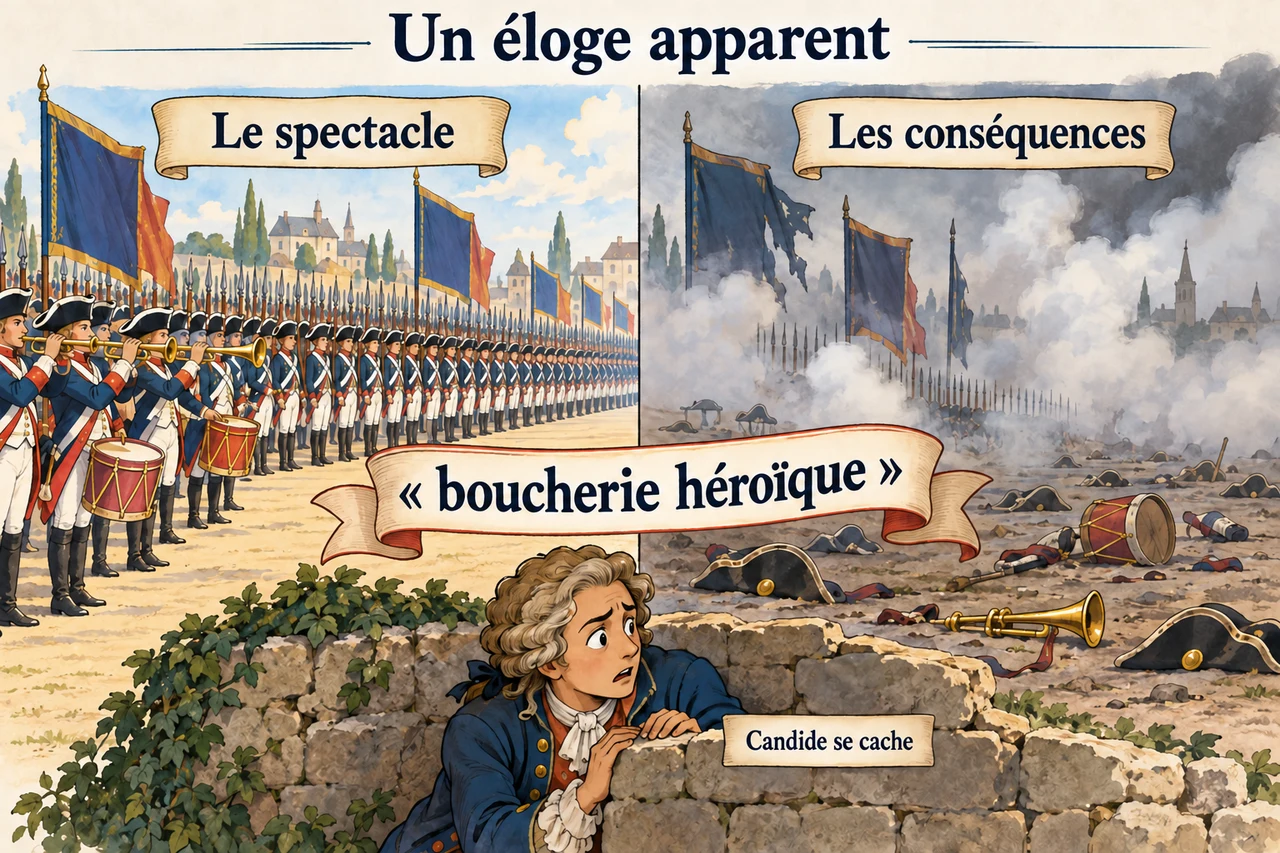
Image: illustration, not a documentary photograph. A non-graphic concept reading of Candide’s fictional Chapter III opening: impressive order contrasts with consequences, while Candide hides. Plain banners do not identify a real army; figures, buildings and discarded items are imagined, not a battle reconstruction or casualty dataset. · Original operator-generated conceptual illustration; no institutional photograph, edition illustration or modern critical text copied.
Candide: splendour and the language of violence
The opening of Chapter III makes war appear splendid before exposing what that splendour conceals. Its repeated « si » introduces a sequence of approving descriptions, while the ordered armies resemble an impressive spectacle. An analysis should first describe how that invitation works, then trace where the passage unsettles it. Simply saying “Voltaire is against war” skips the particular language through which the selected paragraph creates its effect. The task is to examine the arrangement of praise, sound, numbers and reactions, distinguishing the narrator's presentation from a literal endorsement of everything the presentation appears to celebrate.
The list of instruments initially suggests music, but it includes cannon fire. The claimed harmony is associated with hell, disturbing the apparently favourable image. The passage therefore brings aesthetic order and destructive force into the same verbal frame. One can interpret this as a challenge to the habit of admiring a military display while ignoring its consequences. That is an argument from the list and its comparison, not an invented report of a particular historical performance. A short quotation should be followed by an explanation of the transition; identifying a list without explaining its function leaves the most important reasoning unfinished.
The account then moves through casualties using calm approximations and philosophical language. The measured tone sits uneasily beside human loss. Expressions such as « du meilleur des mondes » and « la raison suffisante » connect the description to systems of justification rather than providing a genuine moral defence of killing. To call this irony, explain the tension between the apparent reasoning and the event being rationalised. The words are not a scientific demonstration that these deaths were necessary. Nor should an analyst repeat the narrator's disparaging description of victims as though it were a justified judgement about real people.
The figures belong to a fictional, rhetorically organised account. Their approximate form is part of the passage's distancing effect, not a reliable database of an actual battle. In particular, a reader should not demand an exact arithmetic reconciliation between the approximate losses on each side, the later range and an unspecified number of further deaths. A literary discussion can explain why counting appears impersonal while preserving the human stakes. Treating the passage as historical casualty evidence would confuse genre, narrator and authority. The distinction between precise-looking numbers and an evidenced measurement matters beyond literature as well.
The expression « boucherie héroïque » compresses the conflict into two words. The second word evokes honour and heroic celebration; the first returns the reader to slaughter. Their combination creates a sharp tension rather than a straightforward compliment. A convincing explanation shows why the two associations resist each other in the context already established by the paragraph. Merely naming an oxymoron is not enough: the label does not substitute for interpretation. The phrase invites a reader to question how prestigious language can mask violence, while remaining tied to this particular fictional presentation rather than a universal claim about every use of the word héroïque.
Candide's behaviour provides another disturbance of the heroic frame. He trembles and hides, so the visible response differs from a conventional image of a fearless warrior. The comparison with a philosopher brings ideas into contact with bodily fear. A learner should distinguish this described action from the narrator's vocabulary: the character does not speak all the paragraph's judgements himself. That separation makes room to analyse narrative distance. It also prevents an unsupported claim that the narrator, Candide and Voltaire have identical voices or that a single paragraph proves every development in the character's understanding throughout the novella.
When writing a full response, build a sequence rather than a catalogue of techniques: attractive order, disturbed harmony, detached counting, contested philosophical justification and the final clash of words. Connect each stage to a reading supported by short quotations. An alternative emphasis could foreground the danger of abstract explanations that become indifferent to suffering. The evidence still needs to come from the selected paragraph. This lesson stops at « boucherie héroïque » and does not require the more graphic material that follows. It supports close analysis of one passage; whole-work study, an assessed essay and oral performance remain separate unfinished demands.
Image caption: Image: illustration, not a documentary photograph. A non-graphic concept reading of Candide’s fictional Chapter III opening: impressive order contrasts with consequences, while Candide hides. Plain banners do not identify a real army; figures, buildings and discarded items are imagined, not a battle reconstruction or casualty dataset.
Worked example: Comment le paragraphe passe-t-il de l'apparence d'un spectacle admirable à la critique de la violence ? Analysez les descriptions initiales, l'harmonie, le langage philosophique et l'expression finale, avec de courtes citations.
The answer follows the paragraph’s development and explains each short quotation’s effect. It does not replace interpretation with a list of rhetorical labels or treat the fictional figures as historical data.
Answer: Le début paraît admirer l'ordre des armées grâce à la répétition de « si » et à l'accumulation de qualités. Cependant, cette apparence est rapidement troublée: les canons entrent dans la liste des instruments et l'harmonie évoque l'enfer. Le langage qui semble organiser le spectacle contient donc déjà la violence. Ensuite, les pertes humaines sont présentées avec des approximations et des expressions philosophiques comme « la raison suffisante ». Ce calme apparent crée une distance inquiétante et invite à contester une justification abstraite des morts. Enfin, « boucherie héroïque » associe la célébration de l'héroïsme à une image de massacre. Les deux mots ne forment pas un éloge simple: leur tension révèle le décalage entre le prestige du discours et les conséquences décrites. La progression du paragraphe construit ainsi la critique.
Check your understanding: Un commentaire affirme: « Candide admire courageusement la bataille, et les chiffres prouvent exactement combien de personnes sont mortes dans une bataille réelle. » Corrigez les deux affirmations en distinguant personnage, narration et statut des nombres.
Answer: L'action de Candide ne correspond pas à une admiration courageuse: le passage le décrit tremblant et cherchant à se cacher. Il faut distinguer ce comportement de la présentation initiale des armées par le narrateur. Le vocabulaire apparemment admiratif est ensuite perturbé par les conséquences et par l'expression « boucherie héroïque ». Les chiffres ne constituent pas non plus une mesure historique exacte. Ils appartiennent à un récit fictif et sont formulés comme des approximations ou des fourchettes. Leur présence permet notamment d'analyser la distance créée par le comptage, mais elle ne prouve pas le bilan d'une bataille réelle. La réponse doit donc étudier les choix de narration et la réaction du personnage, sans attribuer à Candide toutes les expressions du narrateur ni transformer la fiction en statistique.
Why: The changed response answers both false assertions, distinguishes action from narrator’s presentation and identifies fictional approximate figures without forcing an exact invented total.