French to English: a community digital service
By UK A Level French · independent study · myAudience
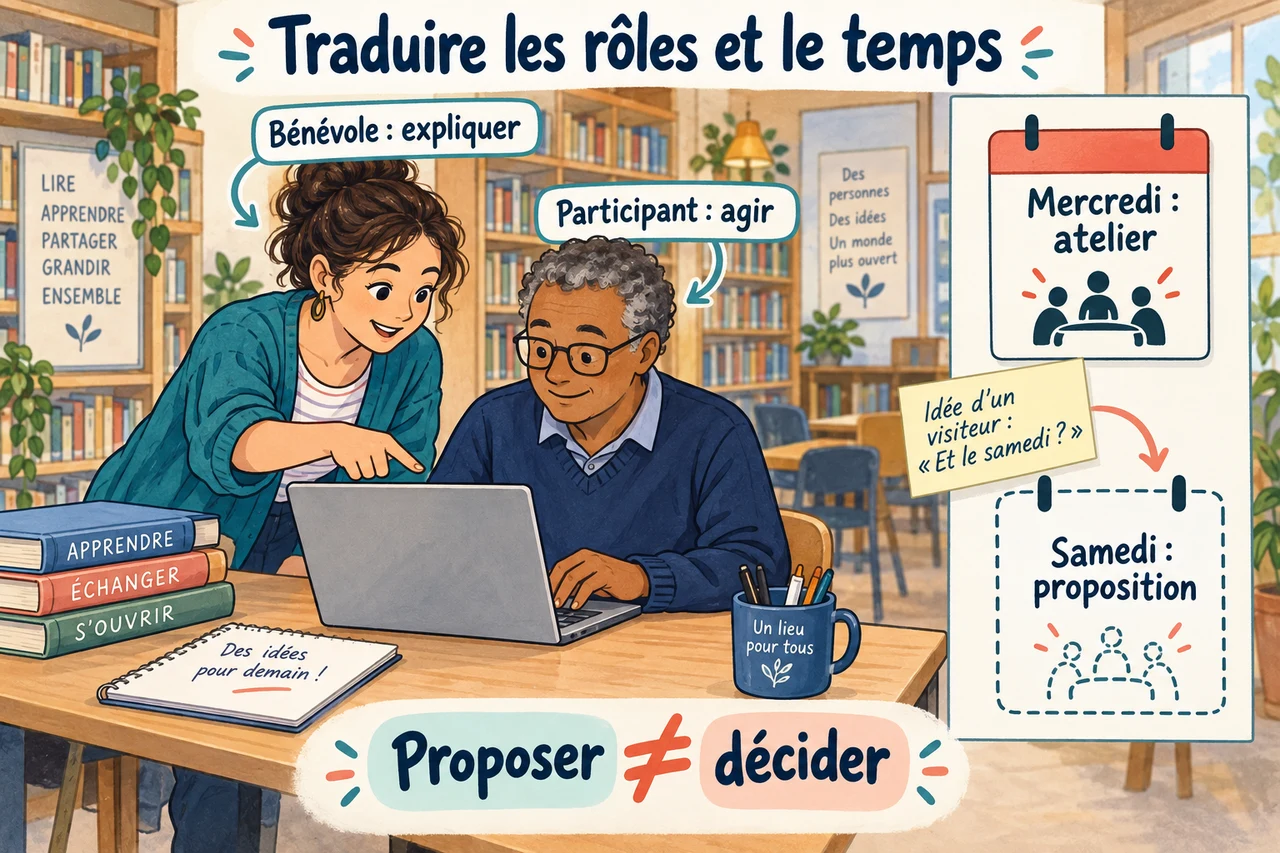
Image: illustration, not a documentary photograph. In the fictional translation setting, the volunteer explains while the participant acts. The solid Wednesday workshop differs from the dashed Saturday proposal; suggesting a session does not mean the calendar has changed. This depicts no real service or privacy guarantee. · Original operator-generated conceptual illustration; no institutional photograph, edition illustration or modern critical text copied.
French to English: a community digital service
A translation is a new text carrying the source's meaning, relationships and degree of certainty into another language. It is not a sequence of dictionary substitutions. Before translating this original fictional account, identify the service, the people responsible, the time sequence and the limits of its promise. A librarian organising a workshop is not necessarily guaranteeing every participant's success. Keep those distinctions visible in the English version. Reading the whole passage first helps resolve a pronoun whose referent appears earlier and prevents a later sentence from contradicting an interpretation chosen too quickly.
French tense choices organise the passage's timeline. A completed decision belongs to the past, a current offer belongs to the present, and a planned change belongs to a future possibility. Do not flatten them into one tense simply because the subject remains the library. English may use different forms to express the same temporal relationships, but it must preserve which events have occurred and which are only proposed. A final comparison of the source and translation should therefore ask not just whether each verb is grammatical, but whether the same sequence of events remains intelligible.
Negation needs equal care. A statement that no document is kept after a session is not the same as a statement that no document is ever used. Likewise, not requiring an account differs from prohibiting an account. These differences may matter to the service's users. In an English translation, put the negative where it governs the intended action and avoid adding a guarantee that the French does not make. The source text's fictional privacy arrangements teach linguistic precision; they are not a description of myAudience's actual data handling or a legal assurance about a real library.
Pronouns often allow French to avoid repeating a noun, but a literal English pronoun may become unclear. Identify what les and leur refer to before deciding whether to repeat “participants” or use “them”. Both can be acceptable when the reference is clear. The criterion is preserved meaning and readable English, not a requirement to reproduce every surface form. Conversely, silently changing the recipient of an explanation is a substantive error even if the English sentence sounds fluent. Make a small actor-action-recipient check when a passage contains several staff members and visitors.
Register also carries meaning. A public-service account should normally use clear, neutral English rather than advertising language or a dismissive description of people seeking help. “Support” or “help” may fit accompagnement in context, while a more specific verb may be better when a particular task is named. Explain such choices by referring to the sentence's function. There is rarely one mandatory English noun for every French noun. Acceptable alternatives remain bounded, however: replacing a conditional proposal with a confident sales promise changes what the source says and is not simply a stylistic preference.
A complete model should translate the whole source, including qualifications and the final sentence. Shortening a passage to its interesting details may produce a useful summary, but it is a different task. Here the model deliberately retains the reason for changing a session and the limitation concerning future results. After producing a draft, compare clause by clause for omissions, added facts, number changes and shifted subjects. Then read the English alone for awkward repetitions or unclear reference. These two readings serve different purposes: fidelity needs the source, while natural target-language flow needs a coherent finished text.
The changed task introduces a different setting and reverses several tempting assumptions. The help is offered through an association rather than the library, an older process is interrupted rather than expanded, and a future decision is explicitly conditional. Do not recycle the first translation's nouns and guarantees. A strong answer shows that the method transfers: map the timeline, preserve negation, trace recipients and translate every clause. The explanations below offer defensible model choices and alternatives, not a unique official examination answer. Independent assessed translation, listening and oral performance remain open beyond these original written exercises.
Image caption: Image: illustration, not a documentary photograph. In the fictional translation setting, the volunteer explains while the participant acts. The solid Wednesday workshop differs from the dashed Saturday proposal; suggesting a session does not mean the calendar has changed. This depicts no real service or privacy guarantee.
Worked example: Translate the entire original French passage into clear English. Preserve the timeline, who helps whom, the privacy limit and the difference between a current service and a future proposal.
Original source passage:
Depuis septembre, une bibliothèque de quartier propose un atelier numérique gratuit le mercredi. L'équipe l'a créé après avoir reçu plusieurs demandes d'habitants qui savaient envoyer des messages mais avaient du mal à remplir certains formulaires. Chaque séance commence par une question simple: quelle tâche souhaitez-vous accomplir aujourd'hui ? Les bénévoles expliquent ensuite les étapes aux participants, sans effectuer toutes les démarches à leur place. Aucun compte personnel n'est exigé pour demander de l'aide, et les documents utilisés ne sont pas conservés après la séance. La semaine dernière, une participante a suggéré une rencontre le samedi pour les personnes qui travaillent. La responsable étudiera cette possibilité, mais elle n'a pas encore modifié le calendrier. Elle précise que l'atelier peut rendre une tâche plus accessible sans garantir que toutes les difficultés disparaîtront. Les retours permettront de choisir les prochains sujets.
“Has offered” preserves the continuing service introduced by depuis; “created” is completed; “will consider” is future. The volunteer action remains explanation rather than substitution. Neither an account requirement nor a guarantee of universal success is added. “Neighbourhood/local”, “manager/person in charge”, and “procedures/steps involved” are contextually acceptable alternatives.
Source: Depuis septembre … propose
Model: Since September … has offered
Reason: Continuing situation reaching the present, not a completed September-only event.
Source: sans effectuer … à leur place
Model: without completing … for them
Reason: Preserves the limit on the volunteers’ role and recipient.
Source: n’a pas encore modifié
Model: has not yet changed
Reason: The suggested schedule is not already implemented.
Answer: Since September, a neighbourhood library has offered a free digital workshop on Wednesdays. The team created it after receiving several requests from residents who could send messages but had difficulty completing certain forms. Each session begins with a simple question: what task would you like to carry out today? The volunteers then explain the steps to participants without completing all the procedures for them. No personal account is required to ask for help, and the documents used are not kept after the session. Last week, a participant suggested a Saturday meeting for people who work. The manager will consider this possibility, but she has not yet changed the schedule. She explains that the workshop can make a task more accessible without guaranteeing that every difficulty will disappear. Feedback will help determine the next topics.
Check your understanding: Translate the complete changed passage. Identify why its cancelled session, conditional restart and paper alternative cannot be replaced with the first passage’s continuing-service timeline.
Original source passage:
Une association avait prévu trois rencontres pour aider les habitants à utiliser un nouveau service en ligne. Après la première séance, plusieurs participants ont expliqué qu'ils ne pouvaient pas revenir le soir, car le dernier bus partait trop tôt. L'équipe a donc annulé la deuxième rencontre au lieu de demander aux personnes concernées de trouver seules une solution. Elle leur a envoyé une fiche imprimée et a recueilli leurs questions par téléphone. Si une salle est disponible près de l'arrêt principal, les bénévoles organiseront une nouvelle séance le mois prochain. Ils ne promettent pas que le transport sera gratuit. Les habitants pourront aussi demander un formulaire papier lorsqu'ils ne souhaitent pas utiliser le service numérique. Avant de fixer une date, la coordinatrice vérifiera les horaires et consultera les personnes qui n'ont pas pu participer. Le projet restera ouvert aux suggestions.
Answer: An association had planned three meetings to help residents use a new online service. After the first session, several participants explained that they could not return in the evening because the last bus left too early. The team therefore cancelled the second meeting rather than asking the people affected to find a solution on their own. It sent them a printed information sheet and collected their questions by telephone. If a room is available near the main stop, the volunteers will organise a new session next month. They do not promise that transport will be free. Residents will also be able to request a paper form when they do not wish to use the digital service. Before setting a date, the coordinator will check the timetables and consult the people who were unable to participate. The project will remain open to suggestions.
Why: The earlier plan uses “had planned”; cancellation is completed, and a restart depends on room availability. “If … is … will” preserves an open condition. The volunteers do not guarantee free transport. A paper route remains available rather than being made compulsory. “Information sheet/printed sheet” and “organise/arrange” are reasonable contextual alternatives.
Source: avait prévu
Model: had planned
Reason: Plan precedes the later disruption.
Source: Si une salle est disponible … organiseront
Model: If a room is available … will organise
Reason: Conditional availability is not an established booking.
Source: ne promettent pas
Model: do not promise
Reason: Does not mean that free transport has definitely been refused.