English to French: heritage and community choices
By UK A Level French · independent study · myAudience
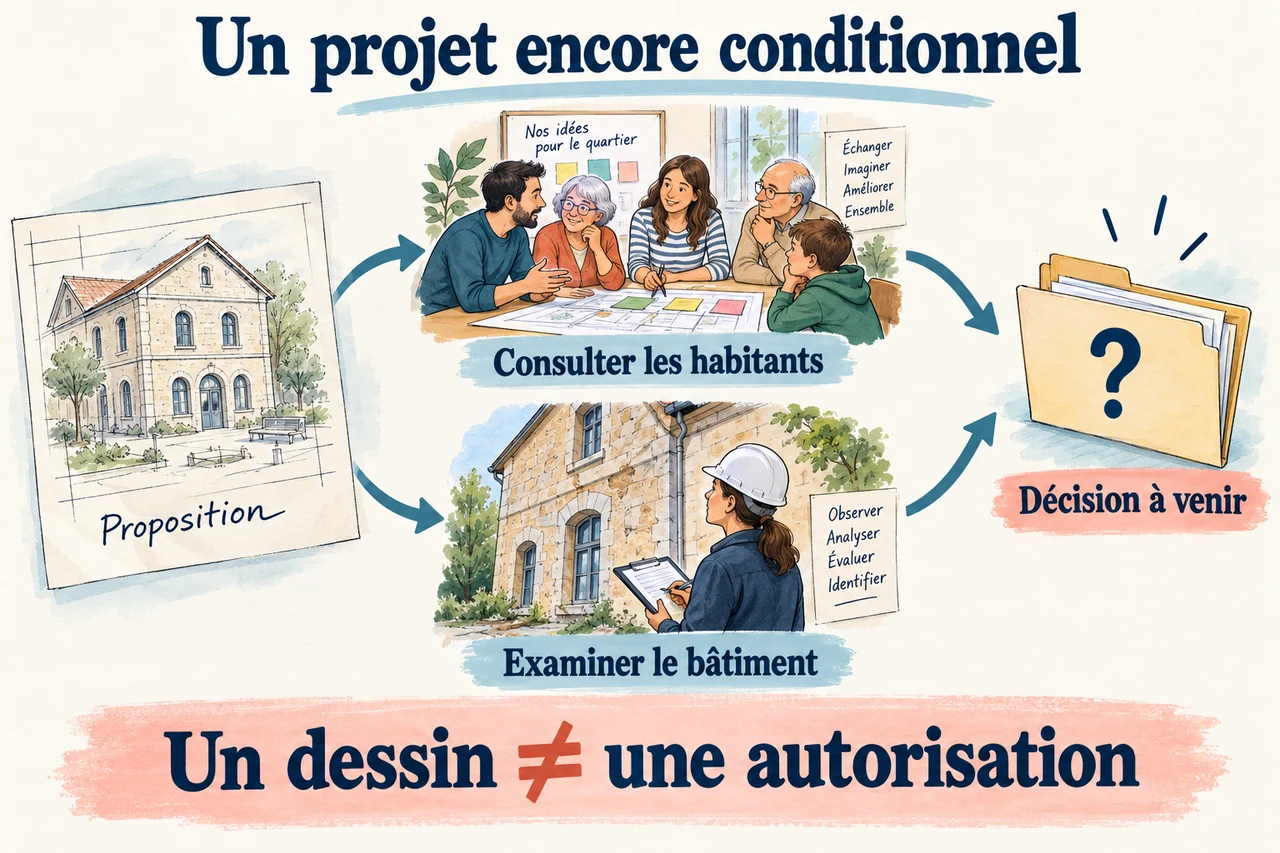
Image: illustration, not a documentary photograph. An imagined heritage proposal requires distinct consultation and examination before an undecided next step. These conceptual arrows do not certify a building, replace a local approval process or claim that a design drawing is an authorisation. · Original operator-generated conceptual illustration; no institutional photograph, edition illustration or modern critical text copied.
English to French: heritage and community choices
Translating into French requires preserving the message while actively controlling agreement, pronoun reference and sentence structure. Read the complete original English source before using its accompanying French support. The support offers vocabulary and constructions in a related fictional setting; it does not license copying unrelated facts into the answer. Identify what the committee has already decided, what remains conditional and who must be consulted. A fluent paragraph that announces an approval which the source explicitly withholds is not an acceptable translation, even if its individual French sentences are grammatically elegant.
The first task contrasts a completed study with an unfinished decision. French can express the completed meeting through the passé composé, the ongoing concern through the present and the proposed outcome through the conditional. English “would” is not a signal to insert the conditional mechanically everywhere: examine whether it belongs to a proposal, a reported future or a habitual past. In this particular fictional passage, the planned adaptation remains unapproved. The translation must maintain that status through its tense choices and final qualification, rather than turning a proposed community room into an existing service.
Agreement provides useful information but can also reveal a changed referent. A feminine plural adjective agreeing with salles cannot simply be retained after substituting un espace. If the model uses « les portes anciennes », the adjective agrees with portes; if it uses « l'ancien bâtiment », the same idea needs a different form. Several formulations may preserve the meaning. Choose one and check its complete chain of noun, determiner, adjective and pronoun. The goal is not to force every learner to reproduce a model's wording, but to make each chosen construction internally consistent.
Pronouns should be planned around the actions. In this text, residents receive questions, the committee reviews answers and specialists examine the building. Assigning one group's action to another changes responsibility. Repeating a noun may be clearer than using a pronoun when two possible antecedents compete. French support can help with constructions such as consulter les habitants and tenir compte de leurs besoins, but a learner must still decide which needs the English refers to. Trace the full reference rather than assuming that a plural possessive always points to the most recent plural noun.
Modality protects the limits of the proposal. “Could be used” is not “will be used”, and “must be checked” is not “has been checked”. A passive form can retain the absence of a named actor when the English leaves responsibility general, but where the source names specialists or the committee, keep that information. Expressions such as « il faudrait » are useful for a conditional requirement; they should not weaken an explicit obligation without reason. Explain each choice in relation to the English sentence and its certainty, not as a universal one-word correspondence.
The changed passage concerns a different project and contains a crucial negative: visitors would not replace local users. It also delays a decision until access and costs are investigated. Those details must survive in the French answer. Recycling the first model's promise or an attractive phrase from the support can accidentally change the meaning. A disciplined second pass checks every time expression, number, negation and responsible actor. Only after that fidelity check should the learner improve flow, perhaps joining related clauses or replacing an awkward repetition with a pronoun whose reference remains unmistakable.
The two full models demonstrate a method rather than an official mark scheme. Each translates its complete source and explains important decisions; alternative French remains acceptable when it preserves the same relationships and register. Both English passages exceed one hundred words, and both have their own substantial original French support. The support is a teaching aid, not evidence that the learner independently mastered every structure it contains. This exercise remains a written, fictional translation task. It does not certify a real conservation proposal, complete the study of a Francophone community or establish assessed oral and listening competence.
Image caption: Image: illustration, not a documentary photograph. An imagined heritage proposal requires distinct consultation and examination before an undecided next step. These conceptual arrows do not certify a building, replace a local approval process or claim that a design drawing is an authorisation.
French support for the original worked passage:
Dans ce quartier fictif, une association réfléchit à l'avenir d'une ancienne salle. Les membres souhaitent tenir compte des besoins des habitants et conserver les éléments qui permettent de comprendre l'histoire du lieu. Ils ont demandé que les propositions soient présentées clairement avant toute décision. Une consultation pourrait réunir les personnes intéressées, mais elle ne remplacerait pas l'examen du bâtiment par des spécialistes. Il faudrait également expliquer comment les dépenses seraient financées. Les groupes locaux aimeraient disposer d'un espace pour leurs rencontres, tandis que les jeunes voudraient participer au choix des activités. Le comité précise qu'une illustration représente seulement une possibilité. Elle ne constitue ni une autorisation de travaux ni une garantie de sécurité.
French support for the changed passage:
L'association fictive envisage de rouvrir un ancien atelier, mais plusieurs questions restent à examiner. Les bénévoles aimeraient accueillir des visiteurs sans priver les habitants des espaces qu'ils utilisent déjà. Des familles ont demandé une entrée accessible ainsi qu'un endroit calme pour la lecture. Avant de fixer une date, il faudrait vérifier l'état des lieux et le coût des adaptations. Une jeune bénévole souhaite recueillir des témoignages, à condition que les personnes interrogées acceptent de participer. Ces récits pourraient enrichir la présentation de l'histoire, sans remplacer une étude de la structure. Si le projet reçoit une autorisation, l'équipe publiera un calendrier et précisera les responsabilités. Pour le moment, aucune ouverture n'est annoncée.
Worked example: Translate the entire English passage into French. Use the original French support for vocabulary and structures where relevant, without importing its separate fictional facts.
Original source passage:
Last month, a neighbourhood committee studied a proposal to turn an unused building into a community room. Several residents supported the idea, but they asked the committee to keep the old doors and explain the history of the site. The room would be used for workshops during the week, and local groups could request it at weekends. Before approving the project, the committee must consult the people who live nearby and ask specialists to examine the building. It has not yet decided how the work will be funded. One resident suggested that young people should help choose the activities rather than simply attend them. The committee will publish the questions it still needs to answer. A drawing can make the proposal easier to understand, but it does not prove that the building is safe or that the project has been approved.
Completed study uses passé composé; proposed use stays conditional; the consultation obligation remains doit. “Demander à en disposer” retains the room as referent without suggesting a guarantee. “Questions auxquelles … répondre” preserves the required preposition. “Ni … ni” carries both withheld claims. Salle commune/espace collectif and inutilisé/inoccupé may be defensible in context; an actual approval or guaranteed funding is not.
Source: would be used / could request
Model: serait utilisée / pourraient demander
Reason: Conditional project remains unapproved.
Source: must consult
Model: doit consulter
Reason: Preserves an explicit prerequisite, not merely a preference.
Source: does not prove … or …
Model: ne prouve ni … ni …
Reason: Both safety and approval claims are withheld.
Answer: Le mois dernier, un comité de quartier a étudié une proposition visant à transformer un bâtiment inutilisé en salle commune. Plusieurs habitants ont soutenu l'idée, mais ils ont demandé au comité de conserver les portes anciennes et d'expliquer l'histoire du lieu. La salle serait utilisée pour des ateliers pendant la semaine, et les groupes locaux pourraient demander à en disposer le week-end. Avant d'approuver le projet, le comité doit consulter les personnes qui habitent à proximité et demander à des spécialistes d'examiner le bâtiment. Il n'a pas encore décidé comment les travaux seront financés. Un habitant a proposé que les jeunes participent au choix des activités plutôt que de simplement y assister. Le comité publiera les questions auxquelles il doit encore répondre. Un dessin peut faciliter la compréhension de la proposition, mais il ne prouve ni que le bâtiment est sûr ni que le projet a été approuvé.
Check your understanding: Translate the entire changed English source with the separate updated French support. Preserve its delayed decision, accessible route and distinction between local users and visitors.
Original source passage:
A local association has proposed reopening a former workshop for exhibitions and practical activities. The volunteers would welcome visitors, but visitors would not replace the residents who already use the neighbouring rooms. Some families have asked for an accessible entrance and a quiet area where children could read. The association will not choose a date until it has checked the cost of these changes and the condition of the entrance. Last week, a young volunteer explained that she wanted to interview older residents about the building, provided that they agreed to take part. Their accounts could help explain its history, but they would not replace an examination of the structure. If the plan is approved, the association will publish a timetable and describe who is responsible for each stage. For now, it is collecting questions rather than announcing the opening.
Answer: Une association locale a proposé de rouvrir un ancien atelier pour des expositions et des activités pratiques. Les bénévoles accueilleraient des visiteurs, mais ceux-ci ne remplaceraient pas les habitants qui utilisent déjà les salles voisines. Certaines familles ont demandé une entrée accessible et un espace calme où les enfants pourraient lire. L'association ne choisira pas de date avant d'avoir vérifié le coût de ces modifications et l'état de l'entrée. La semaine dernière, une jeune bénévole a expliqué qu'elle voulait interroger des habitants plus âgés sur le bâtiment, à condition qu'ils acceptent de participer. Leurs témoignages pourraient contribuer à expliquer son histoire, mais ils ne remplaceraient pas un examen de la structure. Si le projet est approuvé, l'association publiera un calendrier et décrira qui est responsable de chaque étape. Pour l'instant, elle recueille des questions au lieu d'annoncer l'ouverture.
Why: The completed proposal does not imply completed reopening. Ceux-ci unambiguously refers to visitors; the existing residents remain users. Avant d’avoir vérifié preserves the prerequisite. À condition qu’ils acceptent keeps the consent condition, and si … est … publiera preserves an open future. Older residents is comparative plus âgés, not automatically an institutionally defined age group. Practical activities/activités pratiques may also be rendered ateliers pratiques if the context remains clear.
Source: visitors would not replace the residents
Model: ceux-ci ne remplaceraient pas les habitants
Reason: Maintains the negative and its two distinct groups.
Source: will not choose … until it has checked
Model: ne choisira pas … avant d’avoir vérifié
Reason: Date selection follows checks, not a cancellation already completed.
Source: provided that they agreed
Model: à condition qu’ils acceptent
Reason: Consent remains a condition, with subjunctive in this French construction.