Equal rates do not mean equal amounts
By UK GCSE Chemistry · independent study · myAudience
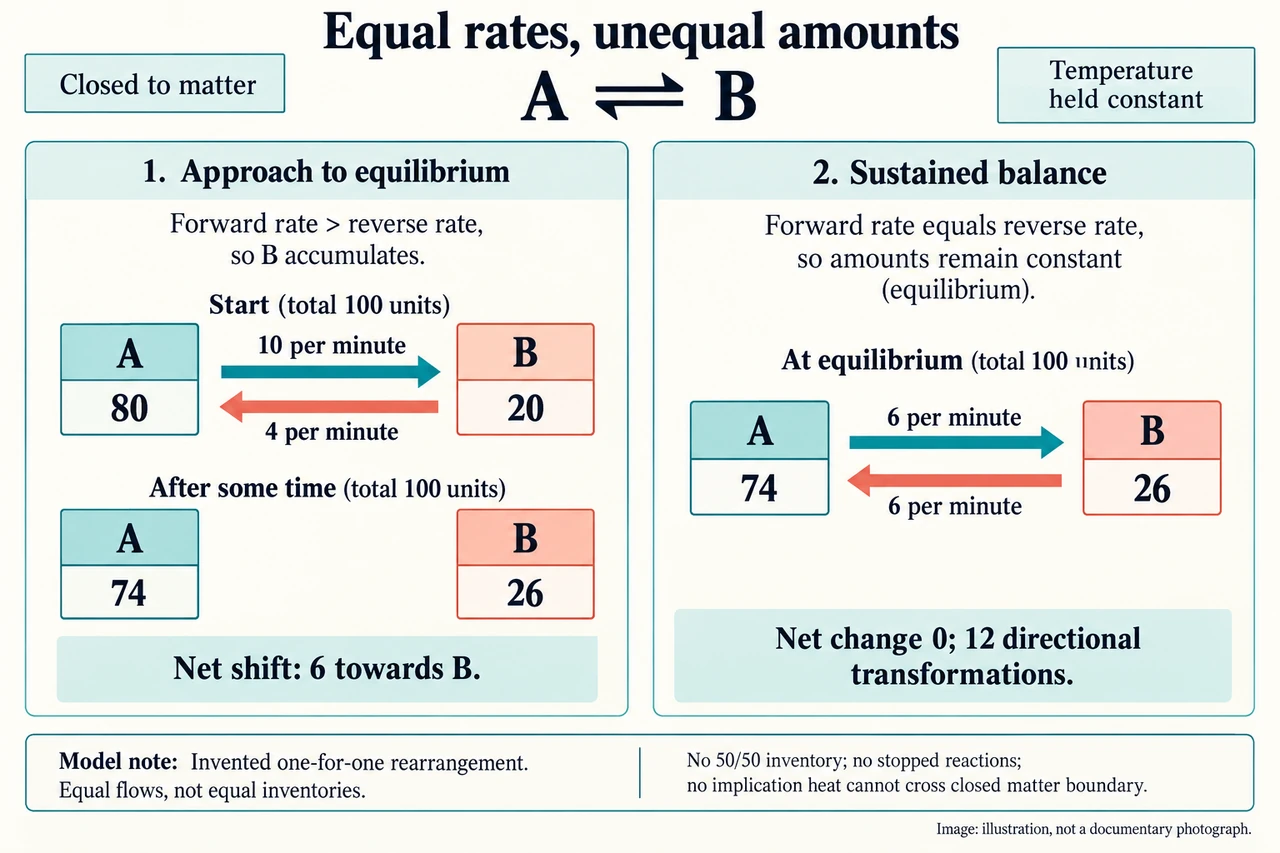
Image: illustration, not a documentary photograph. Invented one-for-one A ⇌ B accounting separates inventory from supplied changes over equal time intervals. Ten forward and four reverse changes take 80/20 to 74/26. Sustained equal six-forward/six-reverse changes keep these unequal inventories unchanged while twelve directional transformations occur. The closed boundary retains matter and does not imply thermal isolation. A still illustration is not evidence that molecular changes occurred or that one balanced observation proves persistent equilibrium. Small previews support recognition, not detailed ledger reading. · Original generated myAudience illustration; not a documentary photograph.
Equal rates do not mean equal amounts
A reversible chemical change allows products to form reactants again under suitable conditions. The double arrow records those two possibilities; it does not say that the two sides contain equal amounts or that every reversible mixture is already at equilibrium. Imagine two molecular arrangements with the same formula, represented by A ⇌ B. We can account for how many change in each direction without assuming a specific kinetic law or pretending that these invented arrangements identify a named laboratory reaction.
A closed system does not exchange the reacting substances with its surroundings. This matters because a product that escapes cannot keep contributing to the reverse process inside the system. Closed does not mean that no heat can be exchanged: a container can be closed to matter while its temperature is controlled externally. For the example below, the substances are retained and temperature is held constant. Opening the container or heating it would change the stated conditions and require a new explanation.
At dynamic equilibrium, the forward and reverse reaction rates are equal. Both directions continue, but their effects on the overall quantities balance. This can leave much more A than B, or much more B than A. Equal rates do not require equal inventories. Nor is the word “dynamic” compatible with saying that the particles have stopped reacting. Macroscopic observations can remain steady while individual molecules continue to change between forms.
Use a simple inventory to make that distinction visible. Start with 80 model units of A and 20 of B. During one specified minute, 10 units turn from A into B while 4 turn back. The net movement is 6 units toward B, leaving 74 of A and 26 of B. The total remains 100 units. In this hypothetical one-for-one rearrangement, a forward event consumes one A and produces one B; a reverse event does the opposite. The supplied numbers describe an interval, not rates derived from the initial amounts.
Now suppose that, over a later interval of the same duration, 6 units change in each direction. The inventories stay at 74 and 26 because each loss is matched by a gain. Twelve directional transformations have occurred, even though the net change is zero. Equal flows in only one observed interval do not by themselves prove that equilibrium will persist indefinitely; the equilibrium statement includes sustained balance under unchanged conditions. The example illustrates that balance rather than furnishing experimental proof of it.
An optional Higher-tier quantitative recap expresses each model unit as 0.001 mol and assigns both forms a molar mass of 60 g/mol. The initial amounts are then 0.080 and 0.020 mol, and the first interval leaves 0.074 and 0.026 mol. Their total is 0.100 mol, representing 6.00 g in this one-for-one model. Mole and mass calculations are an extension of quantitative chemistry, not an extra Foundation requirement for understanding dynamic equilibrium. Actual reactions with different stoichiometric coefficients need their own balanced accounting.
The changed task supplies a different pair of opposing changes after the 74/26 state: 3 units move forward and 5 reverse. A gains a net 2 units, becoming 76, while B falls to 24. The instantaneous direction cannot be read from which inventory is larger alone. To determine a direction or final equilibrium composition for a real mixture, one needs its conditions and relevant chemical information. Here the opposing changes are explicitly given; no equilibrium constant, rate expression or final composition is being inferred.
The illustration separates the inventory from the arrows: unequal quantities on each side, with equal opposing changes in the equilibrium panel. A frozen still picture cannot itself prove that reactions are occurring; the caption and explanation supply the model. Energy changes in reverse reactions are a linked recap, while the dedicated energy-reversibility topic remains separate. Understanding the equal-rate condition is not full curriculum coverage, independent assessed mastery or evidence that a supervised investigation has been performed.
Image: illustration, not a documentary photograph. Invented one-for-one A ⇌ B accounting separates inventory from supplied changes over equal time intervals. Ten forward and four reverse changes take 80/20 to 74/26. Sustained equal six-forward/six-reverse changes keep these unequal inventories unchanged while twelve directional transformations occur. The closed boundary retains matter and does not imply thermal isolation. A still illustration is not evidence that molecular changes occurred or that one balanced observation proves persistent equilibrium. Small previews support recognition, not detailed ledger reading.
Source and scope: Independent explanation, using version 1.2, 16 January 2026. Dynamic-equilibrium understanding is shared-tier content; mole and mass accounting is explicitly an optional Higher-tier quantitative recap. Independent assessment and full qualification coverage remain open.
Worked example: Start with 80 model units of A and 20 of B in a closed A ⇌ B system. In one minute, 10 move forward and 4 reverse. Find the inventories. Then 6 move each way during another minute. Explain both net change and total directional activity. Optional Higher-tier recap: each unit is 0.001 mol and both forms have molar mass 60 g/mol; verify total mass.
First interval: A loses 10 and regains 4, so A = 80−10+4 = 74. B gains 10 and loses 4, so B = 20+10−4 = 26.
The conserved total is 74+26 = 100 model units. The net shift is 6 toward B; the given flows are unequal, so this interval does not represent equilibrium balance.
Next interval: A becomes 74−6+6 = 74 and B becomes 26+6−6 = 26. Net change is zero, although 6+6 = 12 directional transformations occur.
Optional Higher-tier recap: the amounts after the first interval are 0.074 and 0.026 mol, summing to 0.100 mol. Their masses are 4.44 and 1.56 g.
Total mass is 6.00 g before and after because the same 0.100 mol of equal-molar-mass forms is retained. Equal opposing rates can sustain these unequal inventories; observations of one interval alone do not establish persistent equilibrium.
Answer: After the first minute A = 74 and B = 26, with net movement 6 toward B. Equal subsequent changes of 6 each way leave those unequal inventories unchanged while 12 directional transformations occur. Optional Higher-tier amounts are 0.074 and 0.026 mol; multiplying by 60 g/mol gives 4.44+1.56 = 6.00 g, the original total. Sustained equal forward/reverse rates at unchanged conditions, not equal amounts or a stopped reaction, define dynamic equilibrium.
Check your understanding: From the 74 A / 26 B state, a new one-minute interval has 3 units changing forward and 5 reverse. Find the inventories and direction of net change. A student says the larger A inventory proves that the system must always move forward. Evaluate that claim and give the optional Higher-tier amount/mass check.
Answer: A becomes 74−3+5 = 76 and B becomes 26+3−5 = 24. Net movement is 2 units toward A, so the supplied reverse change is larger in this interval despite A already being more abundant. Inventory size alone does not specify either reaction rate or the final equilibrium composition. Optional Higher-tier amounts are 0.076 and 0.024 mol, totalling 0.100 mol; their masses are 4.56 and 1.44 g, still 6.00 g. These are given-flow bookkeeping results, not a prediction from a rate law.
Why: Account for gains and losses in both directions. Equal flows cancel their net effect without erasing the ongoing transformations. Unequal inventories cannot substitute for rate information; keep the optional mole calculation separate from the both-tier equilibrium concept.