Faster production and a larger equilibrium fraction are different questions
By UK GCSE Chemistry · independent study · myAudience
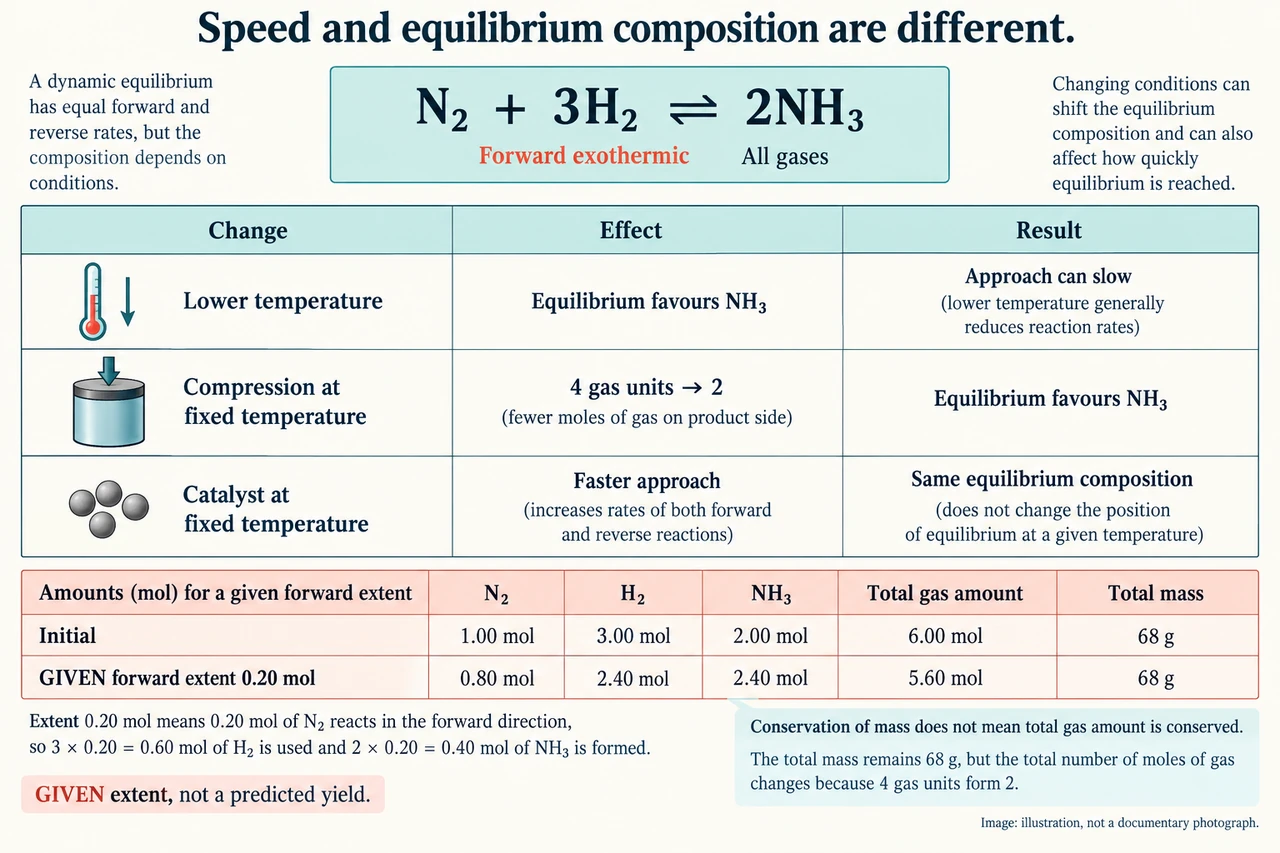
Image: illustration, not a documentary photograph. Higher-tier qualitative equilibrium rules are shown for the stated exothermic, all-gas N₂ + 3H₂ ⇌ 2NH₃ system. Compression is at fixed temperature. Speed and equilibrium composition are separate questions; a catalyst at fixed temperature changes approach speed, not equilibrium composition. The 0.20 mol forward extent is GIVEN solely for balanced accounting, producing amounts 0.80/2.40/2.40 mol, total gas amount 5.60 mol and conserved 68 g mass. It is not a predicted yield or industrial operating model. Small previews support recognition, not detailed matrix or number reading. · Original generated myAudience illustration; not a documentary photograph.
Faster production and a larger equilibrium fraction are different questions
A reaction’s speed and its equilibrium composition answer different questions. Speed concerns how quickly changes happen; composition concerns the proportions reached when forward and reverse rates balance under stated conditions. A condition can increase speed while reducing the equilibrium fraction of a desired product. A useful explanation names the change, identifies the relevant reaction direction and keeps those two effects separate. This lesson’s equilibrium-condition reasoning is Higher-tier content.
Consider the stated gaseous reaction N₂ + 3H₂ ⇌ 2NH₃ with an exothermic forward direction. Raising temperature favours the endothermic direction, which here is reverse, reducing the equilibrium ammonia fraction under the other stated conditions. Lowering temperature favours the exothermic forward direction, but can slow the approach to equilibrium. Neither qualitative statement tells us a numerical percentage yield or how long equilibration takes. The competing effects explain why “hotter always makes more product” is not an adequate conclusion.
Compression of this equilibrium gas mixture at fixed temperature favours the side with fewer gas molecules. The balanced coefficients give four gas units on the reactant side and two on the product side, so the direction favoured is forward. The comparison concerns gaseous species and a specified compression, not simply any event that raises a total-pressure reading. We do not need to claim a particular pressure, industrial optimum or percentage conversion to identify that direction in the school model.
Changing concentration can also disturb a prior equilibrium. Adding a reactant makes the forward direction the response that uses some of the added material; removing product can favour production of more product. The response does not promise to restore the original concentration exactly. Treat a temporary addition or removal as a change to the system, then describe the subsequent conditions. A continuously fed or emptied process needs a flow model beyond the closed-mixture reasoning used here.
Keep a balanced amount ledger separate from an equilibrium prediction. In an invented state, the mixture contains 1.00 mol N₂, 3.00 mol H₂ and 2.00 mol NH₃. Their masses, using molar masses 28, 2 and 17 g/mol, add to 28+6+34 = 68 g. If we are GIVEN a subsequent forward extent of 0.20 mol, the coefficients specify changes −0.20, −0.60 and +0.40 mol. They do not tell us that pressure or temperature alone would produce exactly that extent.
The given forward change leaves 0.80, 2.40 and 2.40 mol, totalling 5.60 mol rather than the initial 6.00 mol of gas species. Mass remains 22.4+4.8+40.8 = 68.0 g. A change in the number of gas molecules is compatible with conservation of atoms and mass because the balanced reaction combines them differently. Since compression also changes volume, this ledger does not by itself calculate a final pressure. The quantity of extent was supplied for a bookkeeping check, not obtained from an equilibrium constant.
Two further distinctions help test the reasoning. For the stated all-gas equation H₂ + I₂ ⇌ 2HI, both sides have two gas units, so a pressure change alone at fixed temperature does not favour either side by the gas-coefficient rule in this model. A catalyst is different again: at fixed temperature it can help the system approach equilibrium more quickly without changing its equilibrium composition. That connection is context, not a claim to complete the separate catalyst topic or determine an industrial process.
When explaining an unfamiliar condition change, first mark the forward heat direction, identify which species are gases and count their balanced coefficients. Then state which variable changes and which conditions stay fixed. Qualitative movement is not a licence to invent its size, final yield or a numerical rate ratio. The teaching matrix and amount ledger are illustrations of these distinctions, not plant designs, operating instructions or experimental measurements. Independent assessment and full qualification coverage remain open.
Image: illustration, not a documentary photograph. Higher-tier qualitative equilibrium rules are shown for the stated exothermic, all-gas N₂ + 3H₂ ⇌ 2NH₃ system. Compression is at fixed temperature. Speed and equilibrium composition are separate questions; a catalyst at fixed temperature changes approach speed, not equilibrium composition. The 0.20 mol forward extent is GIVEN solely for balanced accounting, producing amounts 0.80/2.40/2.40 mol, total gas amount 5.60 mol and conserved 68 g mass. It is not a predicted yield or industrial operating model. Small previews support recognition, not detailed matrix or number reading.
Source and scope: Independent explanation, using version 1.2, 16 January 2026. Condition-shift reasoning is Higher-tier only. All-gas compression is at fixed temperature; exact extents are supplied, not predicted yields. Independent assessment and full qualification coverage remain open.
Worked example: For the stated exothermic gas reaction N₂+3H₂⇌2NH₃, explain separately the equilibrium and speed considerations when temperature is lowered, and the direction favoured by compression at fixed temperature. Start from 1.00/3.00/2.00 mol and use a GIVEN forward extent 0.20 mol to check species amounts, total gas amount and mass.
Lower temperature favours the exothermic forward direction and therefore the equilibrium ammonia fraction, but can slow approach to that equilibrium. No time or numerical yield is supplied.
Compression at fixed temperature favours the product side’s 2 gas units rather than the reactant side’s 1+3 = 4. This is a qualitative direction, not a calculated extent.
The given extent consumes 0.20 mol N₂ and 3×0.20 = 0.60 mol H₂ while forming 2×0.20 = 0.40 mol NH₃.
New amounts are 0.80, 2.40 and 2.40 mol. Total gas amount falls from 6.00 to 5.60 mol.
Initial mass is 1×28+3×2+2×17 = 68 g. New mass is 0.80×28+2.40×2+2.40×17 = 22.4+4.8+40.8 = 68 g. The amount ledger conserves mass; it does not predict final pressure or an equilibrium percentage.
Answer: Lowering temperature favours the exothermic forward direction but may slow the reaction’s approach to equilibrium. Compression at fixed temperature favours the fewer-gas-unit product side. The explicitly given 0.20 mol extent leaves 0.80 mol N₂, 2.40 mol H₂ and 2.40 mol NH₃: total gas amount 5.60 mol and unchanged mass 68 g. The direction follows the condition rules; the exact amount change follows the given extent, not those rules alone.
Check your understanding: Return to the original 1.00/3.00/2.00 mol mixture and apply a GIVEN reverse extent 0.10 mol. Find the amounts, total gas amount and mass. Separately consider compression of the all-gas H₂+I₂⇌2HI system at fixed temperature, and a catalyst added at fixed temperature: may either be described as necessarily raising equilibrium product fraction?
Answer: The reverse extent forms 0.10 mol N₂ and 0.30 mol H₂ while consuming 0.20 mol NH₃. The amounts become 1.10, 3.30 and 1.80 mol, totalling 6.20 mol. Mass is 1.10×28+3.30×2+1.80×17 = 30.8+6.6+30.6 = 68.0 g. In the stated all-gas H₂/I₂/HI model, equal gas coefficients give no pressure preference at fixed temperature. A catalyst can speed equilibration at fixed temperature but does not raise the equilibrium product fraction. Neither case supplies a percentage yield, and the given reverse extent is not inferred from an unspecified condition change.
Why: Use balanced coefficients for the amount ledger and the stated heat/gas conditions for qualitative shifts. Do not equate conserved mass with conserved number of gas molecules, or faster equilibration with a larger equilibrium fraction. Equal-gas and catalyst counterexamples expose an overgeneralised pressure or speed rule.