A formula counts atoms; a structure shows their connections
By UK GCSE Chemistry · independent study · myAudience
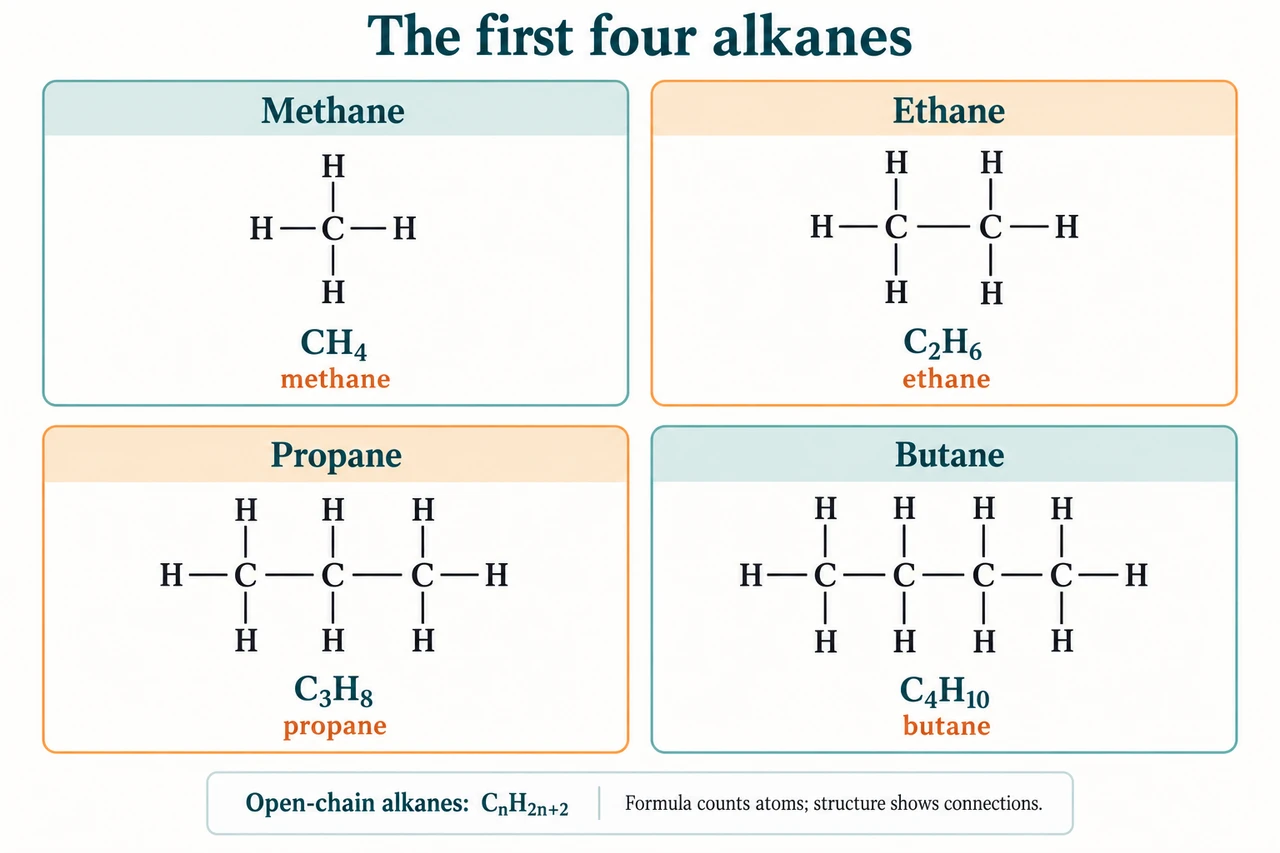
Image: illustration, not a documentary photograph. Flat displayed formulas show methane CH₄, ethane C₂H₆, propane C₃H₈ and straight-chain butane C₄H₁₀. Each displayed carbon has four single bonds and each hydrogen one; the diagrams explain connections, not three-dimensional geometry or measured bond lengths. The open-chain alkane formula CₙH₂ₙ₊₂ counts atoms but does not identify every possible arrangement uniquely. The 160 px preview supports recognition only; read the full diagram and explanation for individual atoms and bonds. · Original generated myAudience illustration; not a documentary photograph.
A formula counts atoms; a structure shows their connections
Crude oil is a finite mixture found in rocks, formed from ancient biomass that included large amounts of plankton buried in sediment. Geological change over very long times helped turn that material into the mixture we extract today. A reservoir is not renewed on the timescale on which we use its contents. The word mixture matters: crude oil contains many compounds, so one sample does not have a single molecular formula or a single boiling point. Most of those compounds are hydrocarbons, but that does not make every constituent identical.
A hydrocarbon contains only carbon and hydrogen. That definition lets us decide what belongs in the class before asking which family it belongs to. CH₄ and C₃H₈ contain only those elements; C₄H₁₀O also contains oxygen, so it is not a hydrocarbon even though it contains carbon. Carbon compounds can form many other families. Confusing “contains carbon” with “is a hydrocarbon” loses the chemical distinction that explains why alcohols, fuels and polymers can behave differently.
In the simple neutral alkane structures used here, each carbon forms four covalent bonds and each hydrogen forms one. A displayed formula draws all atoms and bonds, so it lets us check whether that accounting is possible. A line represents a bond, not a length measurement or a claim that the molecule is flat. A carbon joined to one neighbouring carbon by a single bond needs three hydrogen bonds; a carbon joined to two neighbours needs two. Count connections at each atom before counting the total formula.
Alkanes are saturated hydrocarbons: their carbon–carbon bonds are single bonds. For the open-chain alkane family, the molecular formula is CₙH₂ₙ₊₂. Here n is a positive whole-number count of carbon atoms, not a mass or a concentration. An unbranched chain has two end carbons with three hydrogens each and n−2 middle carbons with two each when n≥2. The total is 6+2(n−2)=2n+2. Methane is the separate one-carbon case, with four hydrogens, and it also satisfies the formula.
The first four members are methane CH₄, ethane C₂H₆, propane C₃H₈ and butane C₄H₁₀. Each successive molecular formula adds one carbon and two hydrogens. That regular change is one feature of a homologous series; its members share a structural family and show related chemical behaviour. The straight-chain condensed formulas are CH₄, CH₃–CH₃, CH₃–CH₂–CH₃ and CH₃–CH₂–CH₂–CH₃. Read each CH₂ or CH₃ as a carbon with attached hydrogens, rather than treating the groups as separate molecules.
A molecular formula records totals; it does not draw the connections. C₄H₁₀ can have a straight carbon chain or a branched arrangement while keeping the same total carbon and hydrogen counts. Both are open-chain saturated hydrocarbons. This example prevents a common overclaim: recognising an alkane formula does not always identify one unique structure. We use the first four familiar names and do not require a system for naming every possible branch. More detailed structure must be supplied if a question asks about one particular molecule.
Apply the general formula as a test with a stated scope. If an unknown contains six carbons, the open-chain alkane prediction is 2×6+2=14 hydrogens. C₆H₁₂ contains only carbon and hydrogen but does not match that prediction. Its formula alone does not tell us whether its atoms form a ring or contain a double bond; those are possible structural explanations, not a unique identification. Likewise, matching CₙH₂ₙ₊₂ is useful within the ordinary neutral hydrocarbon models here, rather than a license to ignore a supplied structure.
To build a reliable explanation, move between three kinds of evidence: the element list classifies the compound, the atom counts test the family formula, and the displayed connections check bonding and structure. None substitutes for all the others. The illustration makes the first four alkane structures easy to compare without suggesting that molecular formulas always specify one arrangement. This lesson explains a bounded part of the fuels and feedstock topic; the later chemistry of other carbon families, independent assessment and full qualification coverage remain open. Image: illustration, not a documentary photograph. Flat displayed formulas show methane CH₄, ethane C₂H₆, propane C₃H₈ and straight-chain butane C₄H₁₀. Each displayed carbon has four single bonds and each hydrogen one; the diagrams explain connections, not three-dimensional geometry or measured bond lengths. The open-chain alkane formula CₙH₂ₙ₊₂ counts atoms but does not identify every possible arrangement uniquely. The 160 px preview supports recognition only; read the full diagram and explanation for individual atoms and bonds. Source and scope: GCSE Chemistry version 1.2, 16 January 2026, topic the related topic. Shared Foundation/Higher teaching uses the first four alkane names; additional structure observations are explanatory context, not a new naming requirement. Original explanatory prose and schematic illustration; no copied source figure. Assessment and full qualification coverage remain open.
Worked example: For the straight-chain structure CH₃–CH₂–CH₃, determine the molecular formula, check the bonds at each carbon, and test the open-chain alkane formula. Then give the first four alkane formulas and explain whether C₄H₁₀ identifies only one carbon arrangement.
The three written carbon groups contain three carbon atoms and 3+2+3=8 hydrogen atoms, so the molecular formula is C₃H₈.
Each end carbon has three C–H bonds and one C–C bond, giving four bonds. The middle carbon has two C–H bonds and two C–C bonds, also giving four.
For n=3, 2n+2=8. The supplied open-chain structure has only single carbon–carbon bonds, so both the formula and the connections support its classification as propane, an alkane.
For n=1,2,3,4 the formula gives CH₄, C₂H₆, C₃H₈ and C₄H₁₀: methane, ethane, propane and butane.
C₄H₁₀ is an atom count. Straight-chain and branched carbon arrangements can have that count, so the molecular formula alone does not choose a unique arrangement.
Answer: The given structure is propane, C₃H₈, with four bonds at every carbon and one at every hydrogen. Its hydrogen count agrees with 2×3+2=8. The first four alkane formulas are CH₄, C₂H₆, C₃H₈ and C₄H₁₀. C₄H₁₀ can represent more than one carbon arrangement; a displayed structure supplies information that the molecular formula does not.
Check your understanding: A learner says: “C₄H₁₀O is an alkane because its hydrogen count is 2×4+2. C₆H₁₂ is definitely an open-chain alkane because it contains only carbon and hydrogen.” Evaluate both claims. Does the second formula identify one unique alternative structure?
Answer: Both claims are incorrect. C₄H₁₀O contains oxygen, so it is not a hydrocarbon and therefore not an alkane, despite the matching carbon-to-hydrogen count. C₆H₁₂ is a hydrocarbon, but an open-chain alkane with six carbons would have fourteen hydrogens, C₆H₁₄. C₆H₁₂ therefore does not match the open-chain alkane formula. A ring or a double bond can explain that different count, but the molecular formula alone does not identify one unique structure. A supplied structure would be needed to distinguish the alternatives.
Why: Check every element before applying a family formula, then compare the predicted and supplied hydrogen counts. Element classification and molecular totals are separate tests. A failed alkane test rules out that family under the stated scope; it does not by itself establish one replacement structure.