A fraction is a collected mixture, not a new molecule
By UK GCSE Chemistry · independent study · myAudience
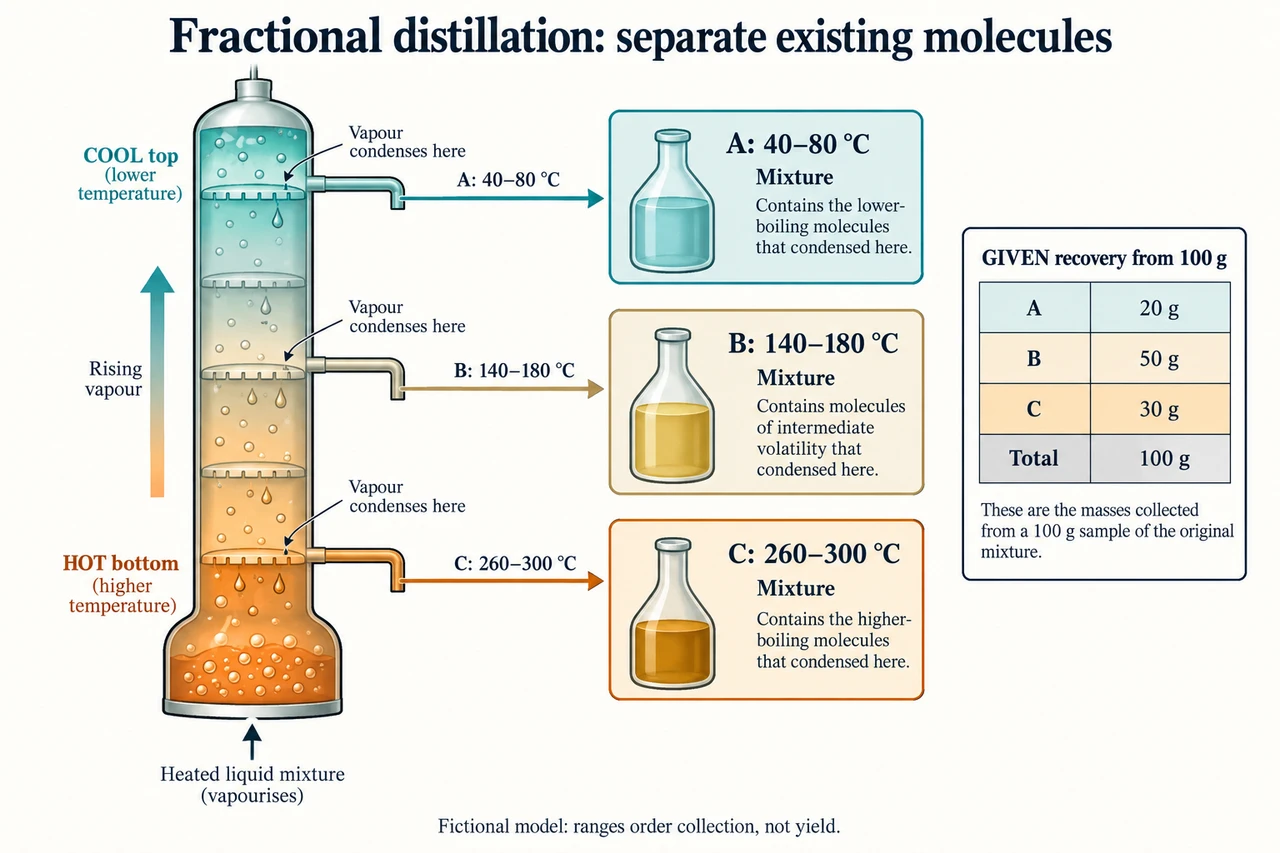
Image: illustration, not a documentary photograph. A schematic column has a hot bottom, cool top and upward vapour. Fictional same-pressure boiling ranges A 40–80 °C, B 140–180 °C and C 260–300 °C order collection from upper to lower regions; they are not measured column temperatures, plant settings or exact separation heights. All three fractions remain mixtures. The GIVEN 20 g, 50 g and 30 g recovery totals 100 g; these amounts are not calculated from boiling ranges. Decorative bubbles and liquid levels are not particle counts or quantities. The 160 px preview supports recognition, not detailed reading. · Original generated myAudience illustration; not a documentary photograph.
A fraction is a collected mixture, not a new molecule
Fractional distillation separates parts of crude oil by their different boiling behaviour. It is a physical separation: evaporation and condensation move existing molecules between states and locations, rather than turning them into new compounds. This distinction explains why a refinery needs further chemical processes as well as separation. Recovering a useful fraction answers “which molecules do we collect together?”, whereas a chemical reaction answers “which new substances are formed?”. Neither question can be replaced by the other.
Heating gives molecules enough energy for some of the liquid to enter the vapour. Boiling temperatures must be compared at the same pressure, because pressure affects boiling behaviour. In the column model, the lower region is hotter and the upper region cooler. Vapour rises into progressively cooler surroundings. Different constituents condense when the conditions no longer support them remaining in the vapour to the same extent. Real mixtures evaporate and condense over ranges; the school model explains the trend without promising a perfectly sharp division.
In a simplified explanation, higher-boiling hydrocarbons condense in hotter, lower parts of the column, while lower-boiling constituents can remain vapour farther upwards and condense in cooler regions. Some of the lightest constituents are collected as gases. Do not read “upper” as “higher boiling”: it is the opposite ordering in this hot-bottom, cool-top model. A useful sketch labels both the temperature direction and the direction of rising vapour, so a learner can explain the location rather than memorise a list of outlet names.
A fraction is still a mixture containing molecules with broadly similar boiling behaviour and, often, similar numbers of carbon atoms. It is not necessarily one pure compound or one exact carbon-chain length. Adjacent fractions can have overlapping properties. A labelled boiling range describes a collection of constituents under specified conditions; it does not supply the full composition. Distillation improves separation for useful purposes but does not make every outlet chemically pure. “Fraction” therefore names a collected part of a mixture, rather than a new family of molecular bonds.
Consider a fictional batch with three labelled boiling ranges at one pressure: A, 40–80 °C; B, 140–180 °C; and C, 260–300 °C. In the stated column model, A belongs nearer the cooler upper collection region, B between, and C nearer the hotter lower region. These invented ranges teach relative ordering, not industrial set points. Their numbers do not determine how many grams of each fraction a particular crude oil contains. That amount depends on the feed composition and the actual recovery process, neither of which is specified by a boiling range alone.
If a problem supplies recovered masses of 20 g of A, 50 g of B and 30 g of C from a 100 g batch, the ledger closes: 20+50+30=100 g. Their mass percentages are 20%, 50% and 30%. These are given recovered quantities, not predictions made from the temperatures. A real incomplete collection could have losses or uncollected material, so a total below the starting mass would call for an explicit remainder. Conservation is an accounting check; it does not guarantee that a fictional recovery table describes a real refinery.
Fractions provide fuels and feedstocks. Petrol, diesel, kerosene and heavier fuels serve different uses because their mixtures have different relevant properties; feedstocks enter processes that make products such as polymers, detergents, solvents and lubricants. A use is not evidence that a fraction contains only one molecule or that burning it has no environmental cost. Separation also cannot change a supply shortage of small molecules into a larger supply merely by moving outlets; a chemical process such as cracking can change molecular sizes later.
When explaining a column, connect the observation to the particle process: the bottom is hotter, vapour rises, the upper region is cooler, and constituents condense according to their boiling behaviour. Then state what the model leaves out, including detailed plant design and exact yields. The schematic shows those relationships without presenting guessed operating instructions. This is written reasoning about separation and an invented recovery ledger; no practical performance, full industrial process coverage or whole-qualification mastery is established. Image: illustration, not a documentary photograph. A schematic column has a hot bottom, cool top and upward vapour. Fictional same-pressure boiling ranges A 40–80 °C, B 140–180 °C and C 260–300 °C order collection from upper to lower regions; they are not measured column temperatures, plant settings or exact separation heights. All three fractions remain mixtures. The GIVEN 20 g, 50 g and 30 g recovery totals 100 g; these amounts are not calculated from boiling ranges. Decorative bubbles and liquid levels are not particle counts or quantities. The 160 px preview supports recognition, not detailed reading. Source and scope: GCSE Chemistry version 1.2, 16 January 2026, topic the related topic. Shared Foundation/Higher explanation of evaporation and condensation; all boiling ranges and recovery quantities in the worked case are invented and given. The diagram is not a plant design or operating procedure. Original explanatory prose and illustration; independent assessment remains open.
Worked example: Three fictional fractions A, B and C have boiling ranges 40–80, 140–180 and 260–300 °C at the same pressure. A hot-bottom, cool-top column recovers 20, 50 and 30 g respectively from a 100 g batch. Order their collection regions, calculate their mass percentages, and explain whether the ranges predict those masses or guarantee pure substances.
A has the lowest boiling range, so it can remain vapour farther into the cooler upper region. C has the highest range and condenses nearer the hotter lower region; B is between them.
The recovered total is 20+50+30=100 g, equal to the supplied initial batch mass. This fictional ledger has no unaccounted remainder.
For each fraction, divide its recovered mass by 100 g and multiply by 100%. A is 20%, B is 50% and C is 30%.
The mass values are given observations for the invented case. Boiling ranges alone provide separation ordering, not the composition or recovered mass of the starting mixture.
Each fraction may contain several hydrocarbons with similar boiling behaviour. No covalent bonds need to be broken to explain the separation, and a fraction need not be pure.
Answer: In this column model, A is collected towards the cooler upper region, B between, and C towards the hotter lower region. The supplied recovery ledger gives 20%, 50% and 30% by mass and closes at 100 g. Those percentages come from the given masses, not from the boiling ranges. Fractions remain mixtures; distillation changes collection and physical state rather than manufacturing new molecular structures.
Check your understanding: A second fictional 100 g collection produces 18 g of low-boiling material, 47 g of an intermediate fraction and 29 g of a high-boiling fraction. A learner calls each fraction pure and says the column broke carbon–carbon bonds to make the low-boiling molecules. Account for the missing mass and evaluate both claims.
Answer: The collected total is 18+47+29=94 g, leaving 6 g unaccounted for in the stated collection ledger. The collected portions are 18%, 47% and 29% of the starting mass; they do not sum to 100% because the remainder is not assigned. It could include uncollected or lost material, but the table does not identify its cause or composition. Calling each fraction pure is unjustified because a fraction can contain several compounds with similar boiling behaviour. Ordinary fractional distillation separates existing molecules through evaporation and condensation; breaking carbon–carbon bonds would be a chemical change such as cracking, not the explanation for this physical separation.
Why: Close the mass ledger before making a process claim, and distinguish the starting-mass denominator from the collected-mass total. Similar boiling behaviour supports collecting substances together but does not prove chemical purity. A missing mass is an accounting remainder, not permission to invent a reaction or a specific loss mechanism.