Boiling separates molecules; combustion rearranges their atoms
By UK GCSE Chemistry · independent study · myAudience
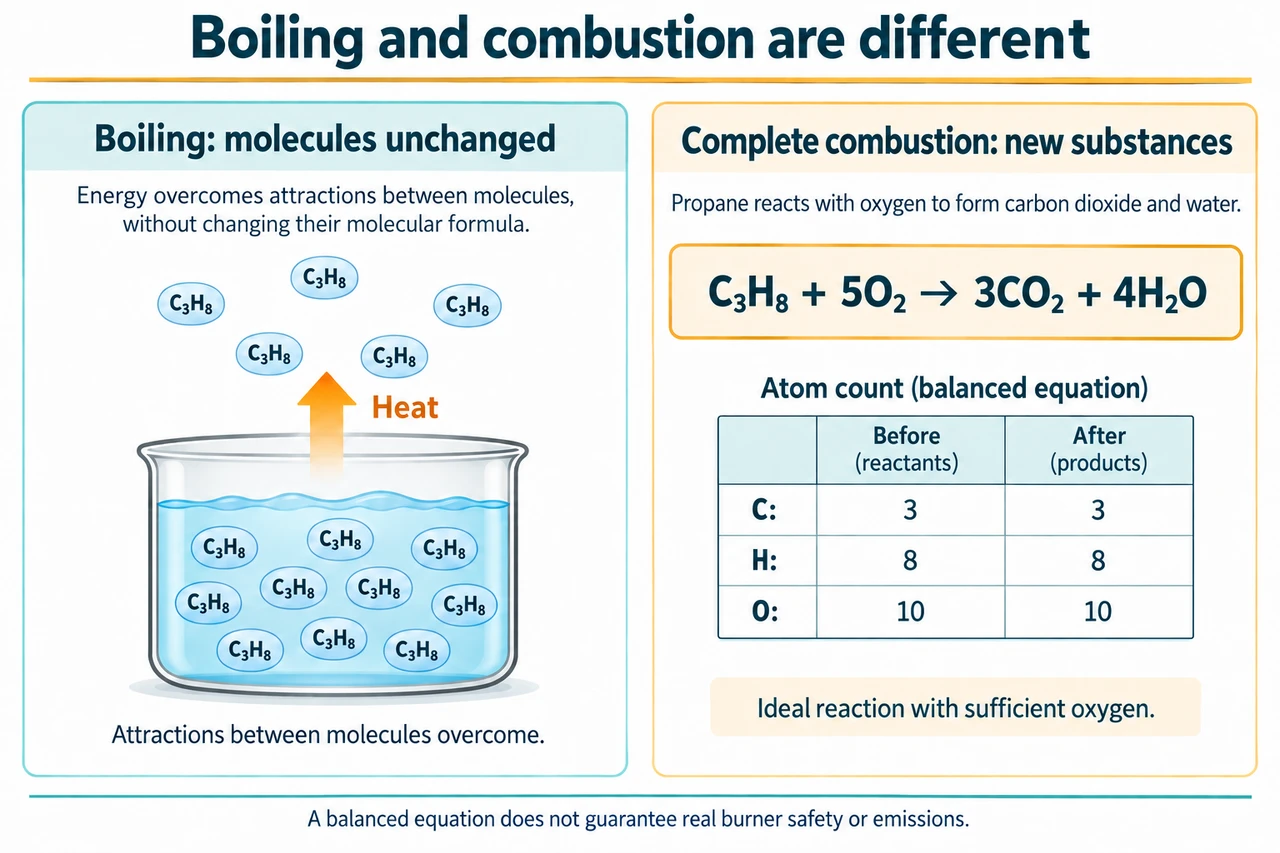
Image: illustration, not a documentary photograph. Left: propane tokens retain C₃H₈ during boiling; energy overcomes attractions between molecules without changing their formula. Token spacing and number are schematic, not a measured population or a before-and-after conservation experiment. At constant-pressure boiling, energy transfer need not raise average kinetic energy. Right: ideal complete combustion C₃H₈ + 5O₂ → 3CO₂ + 4H₂O conserves C: 3, H: 8 and O: 10 on each side. Sufficient oxygen is a stated condition; a balanced equation alone does not prove real burner safety or emissions. The 160 px preview is for recognition; read the full equation and table at larger size. · Original generated myAudience illustration; not a documentary photograph.
Boiling separates molecules; combustion rearranges their atoms
Hydrocarbons in the same alkane family show useful trends as molecular size increases. For comparable structures, boiling point generally increases, viscosity increases and ease of ignition decreases. These are family trends, not a claim that one carbon count predicts every property of every possible structure. A molecule’s arrangement and the measurement conditions also matter. The trends help explain why different fractions have different uses, but a suitable fuel is chosen for a task using more information than molecular size alone.
Boiling separates molecules from one another in a physical state change. It does not normally break the covalent carbon–carbon or carbon–hydrogen bonds within an alkane molecule. Larger comparable molecules have stronger overall intermolecular attractions, so more energy is needed to separate them into the gas phase. Keep the levels separate: intermolecular attractions act between molecules, whereas covalent bonds join atoms within a molecule. Calling both simply “bonds” without explaining their location can make a physical change sound like a chemical reaction.
Viscosity describes resistance to flow. Larger hydrocarbons in comparable conditions generally flow less readily, so their viscosity is greater. Flammability in this school trend concerns how readily the fuel catches fire: smaller hydrocarbons tend to ignite more easily. Larger molecules’ lower volatility can contribute to a smaller supply of fuel vapour for ignition under comparable conditions. This is not an instruction to test fuels at home, and lower ease of ignition is not the same as being nonflammable or harmless.
Combustion is different from boiling because it forms new substances and releases energy overall. During complete combustion of a hydrocarbon with sufficient oxygen, its carbon atoms form carbon dioxide and its hydrogen atoms form water. Reactant bonds are broken and product bonds formed; the overall energy change depends on both processes. The fuel is not merely changing state. A balanced equation accounts for atoms in the idealised reaction, while a boiling explanation retains the molecular formula of the substance being boiled.
Balance the atoms without changing a substance’s formula. For propane C₃H₈, three carbons require 3CO₂ and eight hydrogens require 4H₂O. The products then contain six oxygen atoms in carbon dioxide and four in water, giving ten altogether. Supply those as 5O₂. The resulting equation is C₃H₈+5O₂→3CO₂+4H₂O. A coefficient multiplies the entire formula: 4H₂O represents eight hydrogen atoms and four oxygen atoms, rather than a molecule with its subscripts altered.
For butane C₄H₁₀, balancing carbon and hydrogen first gives C₄H₁₀+(13/2)O₂→4CO₂+5H₂O. A fraction is useful bookkeeping, but multiplying every coefficient by two gives the integer ratio 2C₄H₁₀+13O₂→8CO₂+10H₂O. Check both sides after that multiplication: eight carbon atoms, twenty hydrogen atoms and twenty-six oxygen atoms. These coefficients are ratios for the stated ideal reaction, not measurements of how much fuel or air a particular engine consumes.
If oxygen is insufficient or mixing is poor, incomplete combustion can produce carbon monoxide and carbon particles as well as other products. Carbon monoxide is poisonous; a balanced complete-combustion equation does not establish that a real burner avoids it. Carbon dioxide from complete combustion also has climate consequences. Therefore “complete” describes a chemical outcome under suitable conditions, not a guarantee of cleanliness, safety or an acceptable total environmental impact. Those questions require actual conditions and evidence beyond the atom ledger.
A strong answer combines the correct trend, its molecular explanation and a checked equation where relevant. Do not explain higher boiling points by saying that a larger alkane must have its carbon chain broken before it becomes a gas. The illustration distinguishes between intermolecular separation and chemical atom rearrangement. These written models assess an explanation and balancing method; they do not demonstrate performed fuel investigations, predict real emissions or establish full qualification coverage. Image: illustration, not a documentary photograph. Left: propane tokens retain C₃H₈ during boiling; energy overcomes attractions between molecules without changing their formula. Token spacing and number are schematic, not a measured population or a before-and-after conservation experiment. At constant-pressure boiling, energy transfer need not raise average kinetic energy. Right: ideal complete combustion C₃H₈ + 5O₂ → 3CO₂ + 4H₂O conserves C: 3, H: 8 and O: 10 on each side. Sufficient oxygen is a stated condition; a balanced equation alone does not prove real burner safety or emissions. The 160 px preview is for recognition; read the full equation and table at larger size. Source and scope: GCSE Chemistry version 1.2, 16 January 2026, topic the related topic. Shared Foundation/Higher molecular trends and complete-combustion equation accounting; no compulsory mole calculations or real burner performance claim. Original explanatory prose and illustration; written examples do not demonstrate performed fuel investigations or full qualification coverage.
Worked example: Balance the complete combustion of propane C₃H₈. Count every element on both sides. Explain how the process differs from boiling propane and state the general boiling-point, viscosity and ease-of-ignition trends for increasing alkane size in comparable conditions.
Propane contains three carbon atoms, so put 3 before CO₂ without changing the formula CO₂.
Eight hydrogen atoms require 4H₂O, because each water molecule contains two hydrogens.
The products contain 3×2+4×1=10 oxygen atoms. Put 5 before O₂ to supply ten oxygen atoms.
The equation C₃H₈+5O₂→3CO₂+4H₂O has C:3=3, H:8=8 and O:10=10. Its coefficients express the ideal reaction ratio.
Boiling separates unchanged propane molecules rather than producing CO₂ and H₂O. Increasing comparable alkane size generally raises boiling point and viscosity and lowers ease of ignition.
Answer: C₃H₈+5O₂→3CO₂+4H₂O is balanced, with three carbon, eight hydrogen and ten oxygen atoms on each side. Combustion forms new substances; boiling is a physical separation of molecules into the gas phase. Across comparable alkanes, larger molecular size generally means higher boiling point, greater viscosity and lower ease of ignition. These trends do not guarantee a real fuel’s safety or emissions.
Check your understanding: Balance complete combustion of butane C₄H₁₀ using whole-number coefficients. A learner then says, “When butane boils, its carbon–carbon bonds break, and because its combustion equation contains only CO₂ and water, a real butane burner must be safe and clean.” Evaluate the two explanations.
Answer: The whole-number equation is 2C₄H₁₀+13O₂→8CO₂+10H₂O. It has eight carbon, twenty hydrogen and twenty-six oxygen atoms on each side. Boiling overcomes attractions between butane molecules; it does not require breaking their covalent carbon–carbon bonds or changing C₄H₁₀ into new molecules. The equation models complete combustion with sufficient oxygen, not every condition in a real burner. Insufficient oxygen or poor mixing can produce poisonous carbon monoxide or carbon particles, and even complete combustion releases carbon dioxide. The ideal atom-balanced equation alone therefore proves neither safety nor an absence of environmental effects.
Why: Balance carbon and hydrogen before oxygen, then clear a fractional oxygen coefficient by multiplying the entire equation. Do not change molecular subscripts to make the counts fit. Separately identify which interactions change during boiling and which atoms are rearranged during combustion; neither the balancing exercise nor a family trend is a real safety assessment.