A balanced cracking example is one possible product set
By UK GCSE Chemistry · independent study · myAudience
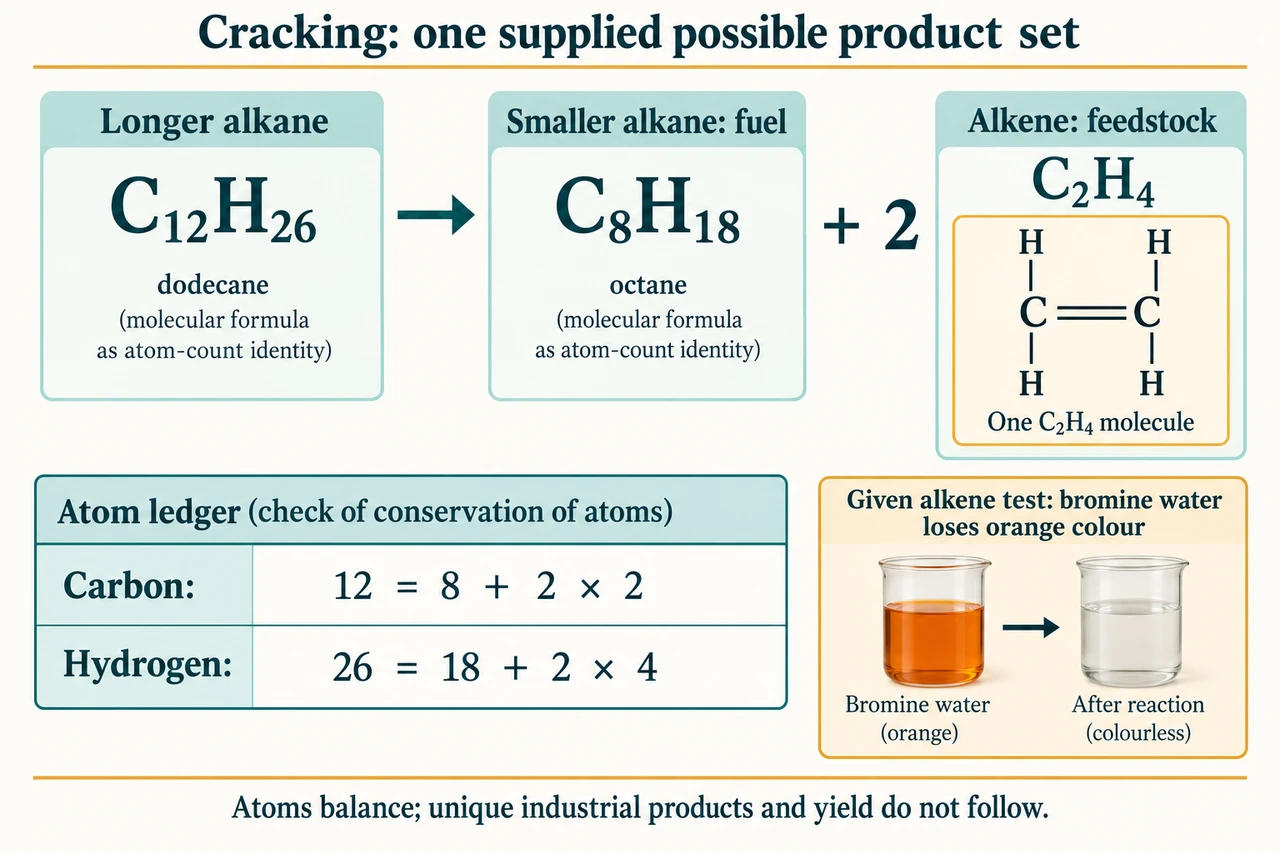
Image: illustration, not a documentary photograph. One GIVEN possible cracking model C₁₂H₂₆ → C₈H₁₈ + 2C₂H₄ balances C: 12 = 8 + 2×2 and H: 26 = 18 + 2×4. The displayed ethene represents one C₂H₄ molecule: each carbon has two hydrogen bonds and a carbon–carbon double bond. The main coefficient gives two such molecules. Larger name labels are illustrative, not additional naming requirements or proof of a unique arrangement from a formula alone. The orange-to-colourless bromine-water inset illustrates a supplied alkene observation, not an unsupervised procedure or measured result. Neither balancing nor colour loss establishes unique industrial products or yield. The 160 px preview supports recognition only. · Original generated myAudience illustration; not a documentary photograph.
A balanced cracking example is one possible product set
Crude oil does not automatically supply hydrocarbons in the sizes and quantities people want. Some longer-chain fractions can be processed to make smaller molecules used as fuels and chemical feedstocks. Cracking is a chemical change: covalent bonds are broken and rearranged, producing different molecules. Unlike fractional distillation, it changes molecular structures rather than collecting an existing mixture into fractions. The usefulness of a product helps explain the process’s purpose but does not establish its yield in a particular industrial plant.
At this level, describe cracking conditions in general terms. Catalytic cracking heats hydrocarbons so they vaporise and passes the hot vapour over a catalyst. Steam cracking involves vaporising hydrocarbons, mixing the vapour with steam and heating to a high temperature. Both descriptions involve substantial energy and industrial controls. They are explanations of categories of process, not laboratory instructions or exact operating settings. The catalyst provides a different reaction pathway; it is not a source of extra carbon or hydrogen atoms for the products.
Cracking products include smaller alkanes and alkenes. An alkene has a carbon–carbon double bond and is more reactive than an alkane in the reactions discussed here. Smaller alkanes can serve as fuels, while alkenes provide starting materials for polymers and other chemicals. Recognising that double-bond cue helps explain the different uses without silently covering every chemistry-only topic on alkene structures, addition reactions or polymers. Detailed requirements for those later families remain separate and open.
A supplied cracking equation is an atom-conservation problem. Consider the invented possible product set C₁₂H₂₆→C₈H₁₈+2C₂H₄. The right side contains eight carbon atoms in the alkane plus four in the two alkene molecules, giving twelve. It contains eighteen hydrogens plus eight, giving twenty-six. Both element totals therefore match the reactant. The coefficient 2 multiplies the whole C₂H₄ formula. Atom balance is necessary for a proposed chemical equation, but does not show that this exact product mixture is what a real reactor makes.
In that given model, the two-carbon product can be represented as H₂C=CH₂. Each carbon has two bonds to hydrogen and a double bond to the other carbon, giving four bond units in total. The double bond is a structural difference from an alkane, not evidence of two extra carbon atoms. A displayed structural diagram should keep atom counts and valence consistent, while a molecular formula alone need not identify a unique larger alkene. We use the supplied product structure rather than guessing one from an unrestricted formula.
Bromine water can supply evidence for an alkene under the stated test conditions: its orange colour is lost as bromine reacts with the double bond. An alkane does not show that alkene response in the usual stated comparison. A reported colour change is not the same as proving the exact identity or purity of every product in a mixture. Nor does it prove that cracking produces only alkenes; the balanced model includes an alkane as well. Interpret supplied observations rather than treating this lesson as an unsupervised procedure with hazardous reagents.
A changed atom ledger can be solved before identifying a structural family. If the given reaction is C₁₀H₂₂→C₆H₁₄+X, subtract the atoms in C₆H₁₄: X must account for four carbons and eight hydrogens, so its molecular formula is C₄H₈. In a supplied open-chain alkene product context that fits an alkene, but the formula alone does not determine where a double bond lies or exclude every ring arrangement. The specified context and a displayed structure provide information that conservation alone cannot.
Good reasoning separates three claims: the example conserves atoms, the stated structure contains a reactive double bond, and the process can make useful products. None predicts a unique industrial product distribution or a percentage yield without further evidence. The illustration shows one clearly labelled supplied product set and a correct atom ledger, rather than implying that all long chains break in that one way. Full chemistry-only alkene and polymer depth, performed test competence and qualification coverage remain open. Image: illustration, not a documentary photograph. One GIVEN possible cracking model C₁₂H₂₆ → C₈H₁₈ + 2C₂H₄ balances C: 12 = 8 + 2×2 and H: 26 = 18 + 2×4. The displayed ethene represents one C₂H₄ molecule: each carbon has two hydrogen bonds and a carbon–carbon double bond. The main coefficient gives two such molecules. Larger name labels are illustrative, not additional naming requirements or proof of a unique arrangement from a formula alone. The orange-to-colourless bromine-water inset illustrates a supplied alkene observation, not an unsupervised procedure or measured result. Neither balancing nor colour loss establishes unique industrial products or yield. The 160 px preview supports recognition only. Source and scope: GCSE Chemistry version 1.2, 16 January 2026, topic the related topic. Shared Foundation/Higher explanation uses supplied possible cracking products and observations. Chemistry-only alkene reaction/structure and polymer topics remain distinct and unbound here. Original explanatory prose and illustration; no unsupervised test procedure, industrial yield or full qualification claim.
Worked example: The supplied possible cracking model is C₁₂H₂₆→C₈H₁₈+2C₂H₄. Check its carbon and hydrogen totals. Explain the different usefulness of the alkane and the supplied H₂C=CH₂ product, the expected bromine-water observation for that alkene, and whether balancing proves a unique product set or yield.
The reactant contains twelve carbon atoms. Products contain 8+2×2=12, so carbon is conserved.
The reactant contains twenty-six hydrogen atoms. Products contain 18+2×4=26, so hydrogen is conserved.
C₈H₁₈ fits the open-chain alkane formula. In the supplied H₂C=CH₂ structure, each carbon has two C–H bonds and a C=C double bond, giving four bond units.
The alkane can be used as a fuel. The alkene’s double bond supports its use as a chemical feedstock; it removes the orange colour of bromine water in the stated test comparison.
Balance demonstrates atom conservation for this given possible model. It does not establish a unique industrial product mixture, measured conversion or percentage yield.
Answer: The equation balances C:12=8+4 and H:26=18+8. The alkane can be useful as a fuel and the supplied double-bond alkene as a chemical feedstock. The stated alkene test changes bromine water from orange to colourless. This does not mean all products are alkenes: C₈H₁₈ is also present. Neither atom balance nor the reported test predicts a unique real cracking mixture or yield.
Check your understanding: In a different supplied model, C₁₀H₂₂→C₆H₁₄+X, find X’s molecular formula and verify both element totals. A reported product sample removes the orange colour of bromine water. Does this prove that X has one unique structure, that every product is an alkene, or that the reaction had a particular percentage yield?
Answer: Subtracting the supplied alkane leaves X with ten minus six = four carbon atoms and twenty-two minus fourteen = eight hydrogen atoms, so X is C₄H₈. The completed model C₁₀H₂₂→C₆H₁₄+C₄H₈ balances carbon as 10=6+4 and hydrogen as 22=14+8. In the stated alkene test context, the colour loss supports the presence of a reactive alkene; the formula alone does not specify one unique arrangement. The product set also explicitly includes C₆H₁₄, an alkane, so the observation does not make every product an alkene. No measured mass, amount, conversion or yield is supplied, so no particular percentage yield follows.
Why: Use separate carbon and hydrogen ledgers to obtain the missing formula, then check the completed equation. Keep atom conservation, structural identification and test interpretation distinct. A mixture can contain an alkene and an alkane at the same time, and a positive qualitative observation does not supply the quantities needed for a yield calculation.