Why the squares on a right triangle balance
By UK GCSE Mathematics · independent study · myAudience
Original myAudience generated teaching illustration; source and all delivery variants independently reviewed. Caption limits apply. · Original project artwork; no exam-board figures or textbook illustrations reused.
Why the squares on a right triangle balance
A right triangle has one angle of 90 degrees. The side opposite that angle is the hypotenuse. Label the two perpendicular sides a and b, and the hypotenuse c. Pythagoras' theorem states a squared plus b squared equals c squared. The equation compares areas of squares drawn on the sides, not the side lengths themselves. The hypothesis matters: a triangle with sides 4, 5 and 6 is not right-angled because 4 squared plus 5 squared is 41, whereas 6 squared is 36. A rough sketch, a horizontal-looking side, or a familiar-looking number does not establish a right angle.
We can prove the relationship by accounting for one area in two ways. Start with four congruent right triangles, each with perpendicular legs a and b. Each triangle has area ab divided by 2. Arrange them inside a square of side a plus b, one at each corner, with their hypotenuses facing inward. The four remaining sides each have length c. To prove that the central shape is a square, more than equal sides is needed: equal sides alone could describe a non-square rhombus. The two acute angles of a right triangle sum to 90 degrees. At each inner vertex, those two angles and the central angle lie on a straight line, so the central angle is 180 minus 90, or 90 degrees. Thus the inner quadrilateral has four equal sides and four right angles.
The large square's area is (a plus b) squared. The four triangles occupy four times ab divided by 2, which is 2ab. The remaining central square has area c squared. Therefore (a plus b) squared equals 2ab plus c squared. Expanding the left side gives a squared plus 2ab plus b squared. Subtract the same 2ab from both sides: a squared plus b squared equals c squared. The argument applies to positive lengths a and b, not just to a single numerical drawing. The cancellation is an equality-preserving step; it is not a claim that one area is negative or that pieces have physically disappeared.
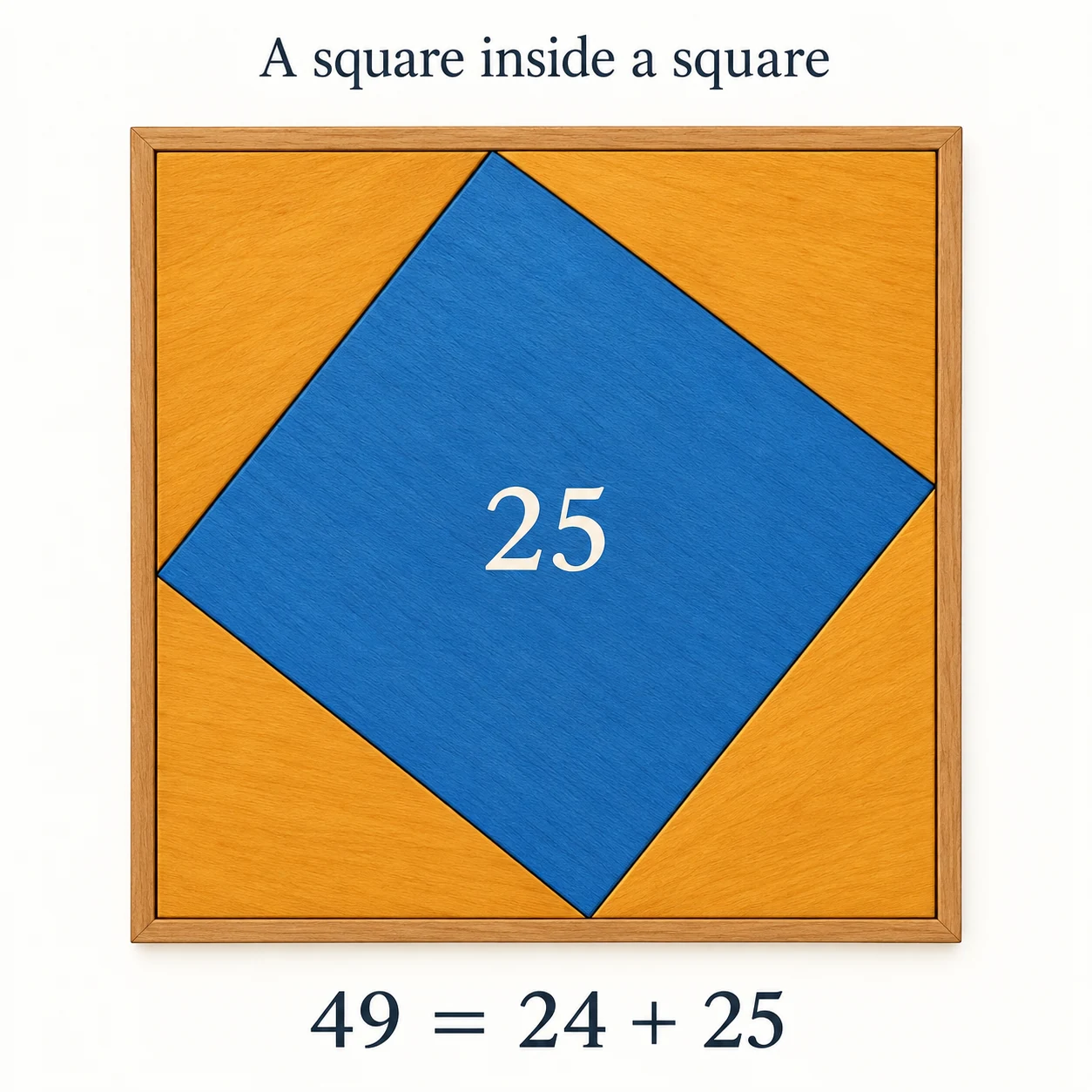
For a concrete example, take legs 3 and 4. The outer square has side 7 and area 49 square units. Each of the four corner triangles has area 6, so together they occupy 24. The central square has area 49 minus 24, or 25, so its positive side length is 5. The outer square's side is 7, not 5; the diagram contains two different squares. If an illustration shows a tilted central square, its tilt changes neither its side lengths nor its area. The conclusion c equals 5 is a positive square root because c is a length. It does not give both positive and negative lengths.
To calculate a hypotenuse, first establish which side is opposite the right angle. Square the perpendicular lengths, add, then take the positive square root. A right triangle with legs 6 and 8 has c squared equal to 36 plus 64, or 100, giving c equals 10. To calculate a shorter side, rearrange the same equation: if c is 13 and a is 5, then b squared is 169 minus 25, or 144, so b equals 12. Subtracting the lengths directly, 13 minus 5 equals 8, does not follow the theorem. Keep lengths in one unit before squaring; adding 6 centimetres squared to 8 metres squared is not a consistent calculation.
Coordinates give a useful transfer because horizontal and vertical changes are perpendicular. For A at (-2, 1) and C at (4, 9), the horizontal change is 6 and the vertical change is 8. The straight-line distance AC is the positive square root of 6 squared plus 8 squared, or 10 coordinate units. The route along a horizontal segment and then a vertical segment is 14 units; that is a different distance. Changing the sign of a coordinate difference reverses a direction but does not change its square. Moving both endpoints by the same translation preserves the two differences and therefore preserves the distance. This example assumes ordinary perpendicular coordinate axes with the same unit scale, not distances read from a distorted map.
A proof, an example and a converse have different jobs. The area argument proves a relationship for every nondegenerate right triangle. The 3, 4, 5 example illustrates it but cannot prove the universal statement by itself. The converse says that a triangle whose longest side satisfies c squared equals a squared plus b squared is right-angled. One justification constructs a right triangle with perpendicular legs a and b: the theorem gives its third side length c. The original triangle has the same three side lengths, so SSS congruence makes the corresponding angle a right angle. This uses a proved theorem and the known congruence criterion; it does not assume that the original triangle was right-angled in order to test it.
Check the scale and the conditions before trusting an answer. Multiplying every length by a positive factor k multiplies every square area by k squared. The 5, 12, 13 triangle enlarged by 1.5 has sides 7.5, 18 and 19.5: the areas 56.25 and 324 sum to 380.25, which is 19.5 squared. Pythagoras does not determine a triangle from two arbitrary side lengths unless their role and a right angle are known. If two equal sides of an isosceles triangle are given, a perpendicular line from the apex to the base can create useful right triangles, but its perpendicularity and the halving of the base require geometric justification. This reading supplies one area proof and distance transfer. It does not complete similarity proofs, all G6 reasoning, practical constructions or assessed mastery.
Image: illustration, not a documentary photograph. Four right triangles with legs3 and4 surround a square with side5 inside a7-by-7 square. The areas balance49=24+25. Schematic, not to scale; do not infer lengths or angles by measuring the illustration. The written proof establishes the central right angles and the general theorem.
Worked example: A right triangle has perpendicular legs 3 and 4. Explain the four-triangle area proof, then calculate the straight-line distance from (-2, 1) to (4, 9) without confusing it with a two-segment route.
Four congruent triangles each have area 3 times 4 divided by 2, or 6; their total area is 24.
The outer square has side 3 plus 4 equals 7, so its area is 49.
The inward-facing hypotenuses form an equal-sided quadrilateral; the acute-angle sum makes each interior angle 90 degrees, so this is a square.
The central square has area 49 minus 24 equals 25; its side is the positive square root, 5.
The coordinate differences are 4 minus (-2) equals 6 and 9 minus 1 equals 8, perpendicular changes in matching units.
The straight-line distance is the square root of 36 plus 64 equals 10; the horizontal-then-vertical route has length 6 plus 8 equals 14 and is not AC.
Answer: The 3-4-5 configuration balances 49 = 24 + 25 square units. For the separate coordinate example, AC = 10 units, whereas the two perpendicular route segments total 14 units. Equal central side lengths and right-angle reasoning establish the inner square before its area is used.
Check your understanding: Repeat the area proof for legs 5 and 12. Recover a missing leg when the hypotenuse is 13 and the other leg is 5. Then test the claim that enlarging every side by 1.5 makes the square on the hypotenuse 1.5 times as large. Explain whether sides 4, 5 and 6 form a right triangle.
Answer: The outer square has area 17 squared = 289. Each triangle has area 30; four use 120, leaving 169, so the hypotenuse is 13. The missing leg is the positive square root of 13 squared minus 5 squared, or 12; subtracting 13 minus 5 would be invalid. At scale1.5, the hypotenuse is19.5 and its square has area380.25, which is169 times2.25, not169 times1.5. The longest side6 has square36, while4 squared plus5 squared is41; the converse rules out a right angle. These tests assume positive lengths and a valid triangle; all three lengths4,5,6 satisfy the triangle inequality.
Why: Area is measured in squared units, so length scaling and area scaling differ. Identifying the hypotenuse precedes rearrangement. The direct area proof establishes the theorem only after proving the central shape is a square. The converse is justified separately by constructing a right triangle and applying SSS, rather than by assuming the angle being tested.