Translate every vertex by the same vector
By UK GCSE Mathematics · independent study · myAudience
Original myAudience generated teaching illustration; source and all delivery variants independently reviewed. Caption limits apply. · Original project artwork; no exam-board figures or textbook illustrations reused.
Translate every vertex by the same vector
A coordinate names a position relative to a chosen origin, whereas a displacement tells us how to move from one position to another. The point (1, 1) is a location. A translation by (−4, 3) means four units left and three units up from wherever we start. Those numbers are changes in position, not the destination coordinates. Keeping this distinction prevents a common error: sending every vertex to the same point instead of moving the whole shape.
A two-dimensional translation can be written as a column vector, with the horizontal change above the vertical change. Here we also write the displacement as (−4, 3) in text to keep it accessible. Positive horizontal values move right and positive vertical values move up on standard axes. Negative values reverse those directions. A complete description gives both signed components; saying only “move the triangle five units” leaves its direction undetermined.
To construct the image, apply exactly the same displacement to every vertex. Let A = (1, 1), B = (3, 1) and C = (1, 2). Adding (−4, 3) gives A′ = (−3, 4), B′ = (−1, 4) and C′ = (−3, 5). Connect the image vertices in the same order as the originals. The movement can cross an axis; there is no rule requiring the image to stay in the starting quadrant.
The inverse translation uses the opposite displacement. Adding (4, −3) to the image vertices returns the original triangle. This supplies a useful check without measuring a picture. For example, (−3, 4) + (4, −3) = (1, 1). Reversing only one component would fail to undo the other component. The inverse describes the movement from image back to original, so the question’s direction of mapping must be read carefully.
Translation preserves lengths because the same changes cancel when we compare two vertices. If one point gains horizontal change h and another gains h, their horizontal difference is unchanged; the same is true vertically. In our triangle, AB has squared length 4 before and after the movement, AC has squared length 1, and BC has squared length 5. Squared-length checks avoid approximating the sloping side and help detect a wrongly moved vertex.
The shape’s angles, area and orientation also remain unchanged. Translation shifts every point together without turning or flipping the polygon. The original ordered triangle A, B, C has positive signed double area 2, and A′, B′, C′ has the same value. Ordinary area is therefore 1 square unit in each case. Signed area is a checking tool here, not an extra GCSE requirement: its sign records the order of vertices rather than a negative physical area.
When identifying a translation from two diagrams, pair corresponding vertices before calculating. Subtract each original coordinate from its proposed image coordinate. Every pair must give the same vector. If A moves by (−4, 3) but B moves by (−3, 3), the proposed mapping is not one translation of the whole triangle. A correct shift for a single vertex is insufficient evidence. Distinctive labelled corners help avoid pairing a different corner merely because it looks nearby.
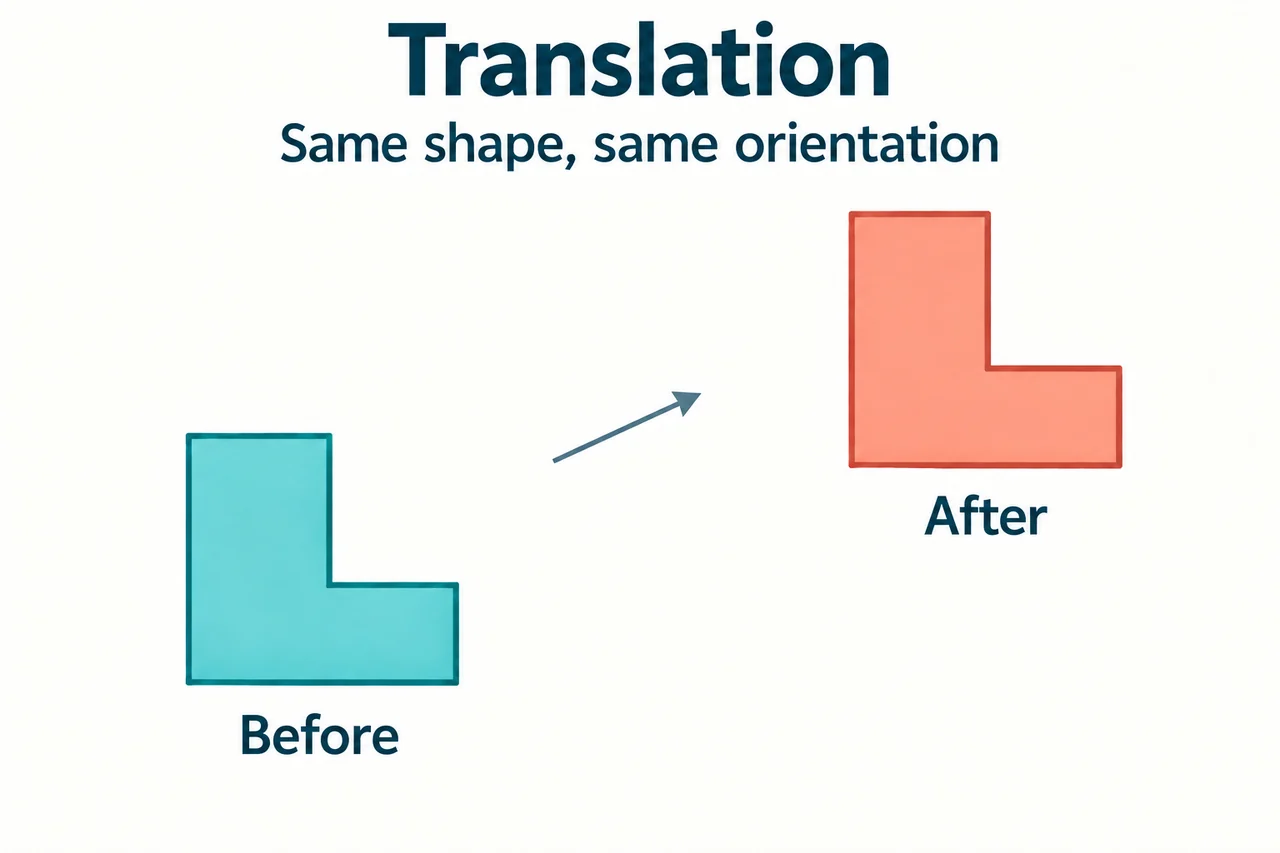
The changed task below uses the same original triangle with a new vector, making the signs and correspondence do the work. The selected conceptual illustration shows the whole asymmetric shape sliding up and right, with one separate arrow indicating the overall direction. It does not supply corner-to-corner displacement arrows or a numbered grid. It must not be measured as a calibrated coordinate grid unless every plotted point and unit spacing has been checked. The complete coordinates in this text remain the mathematical authority. Following these examples is not evidence that an independent construction has been performed or assessed.
Image: illustration, not a documentary photograph. Teal and coral asymmetric tiles keep the same orientation; a separate arrow indicates a shift up and right. No vertex correspondence or exact vector is measured in the plate. Exact coordinates and complete mathematical answers are provided in the text. The 160-pixel image is for recognition; use the 1280-pixel image and accessible prose for detail.
Worked example: Translate A(1,1), B(3,1), C(1,2) by (−4,3). Give every image coordinate, a complete inverse description and an exact length check.
Add the vector to positions, not to side lengths, and apply it to all vertices. Check equal corresponding displacements and exact squared lengths. An inverse reverses both components. Do not infer a translation from only one matching corner or an uncalibrated illustration.
Answer: A′(−3,4), B′(−1,4), C′(−3,5). The inverse is translation by (4,−3). Original AB displacement is (2,0), so AB²=4; image A′B′ displacement is also (2,0), so its squared length remains 4. AC²=1 and BC²=5 also remain unchanged. Each vertex receives the same signed changes.
Check your understanding: Instead translate the original triangle by (2,−5). A student proposes A′(3,−4), B′(5,−3), C′(3,−3). Find the correct image, identify the error and give the inverse.
Answer: Correct images are A′(3,−4), B′(5,−4), C′(3,−3). The proposed B′ uses vertical change−4 rather than−5. It changes the horizontal side into a sloping side: the incorrect squared length from A′ to B′ would be 2²+1²=5 instead of 4. The inverse translation is (−2,5). All correct corresponding displacements are (2,−5).
Why: Add the vector to positions, not to side lengths, and apply it to all vertices. Check equal corresponding displacements and exact squared lengths. An inverse reverses both components. Do not infer a translation from only one matching corner or an uncalibrated illustration.