Rotate about a specified centre
By UK GCSE Mathematics · independent study · myAudience
Original myAudience generated teaching illustration; source and all delivery variants independently reviewed. Caption limits apply. · Original project artwork; no exam-board figures or textbook illustrations reused.
Rotate about a specified centre
A rotation needs a centre, an angle and a direction. Saying “rotate ninety degrees” is incomplete because different centres send the same point to different destinations, while clockwise and anticlockwise quarter-turns usually differ. The centre itself stays fixed. Every other point travels along a circle around it, retaining its distance from that centre. An image that has the correct orientation but has drifted away from its centre is not the specified rotation.
Begin with coordinates relative to the centre instead of automatically using the origin. Our centre O is (1, −1). Point A = (1, 1) lies zero units horizontally and two units vertically from O, so its relative vector is (0, 2). B = (3, 1) has relative vector (2, 2), and C = (1, 2) has (0, 3). These differences describe the positions to turn; O’s coordinates must be added back afterward.
A ninety-degree anticlockwise turn sends a relative vector (u, v) to (−v, u). Apply that to A’s (0, 2), obtaining (−2, 0), then add O to get A′ = (−1, −1). B’s (2, 2) becomes (−2, 2), giving B′ = (−1, 1). C’s (0, 3) becomes (−3, 0), giving C′ = (−2, −1). Joining those labelled points completes the rotated polygon.
The changed clockwise quarter-turn uses (u, v) to (v, −u). With the same centre and original triangle it gives A′ = (3, −1), B′ = (3, −3) and C′ = (4, −1). The difference is not merely a new sign attached to the final coordinates: the turn operates on relative vectors. Rotating around the origin by habit would instead send A to (1, −1) clockwise, which is the centre here and therefore cannot be the correct image of A.
Check distance from the centre for each original-image pair. A and its anticlockwise image both have squared radius 4; B and its image both have squared radius 8; C and its image both have squared radius 9. Equal radii alone do not establish the requested angle or direction, because many points share a circle. A correct construction must satisfy the radius condition and the quarter-turn relation together, with one common centre for the entire figure.
Rotation preserves the distances between vertices as well as their distances from the centre. In our example the squared side lengths remain 4, 5 and 1, and the ordered triangle retains positive signed double area 2. Its ordinary area and angles remain unchanged, so it is congruent to the original. A reflected triangle could preserve those lengths while reversing orientation. That is why side-length agreement alone does not distinguish every possible rigid transformation.
The inverse of a ninety-degree anticlockwise rotation is a ninety-degree clockwise rotation about the same centre. A half-turn sends a relative vector (u, v) to (−u, −v); clockwise and anticlockwise descriptions coincide for 180 degrees. They do not coincide for a general quarter-turn. When describing a rotation found in a diagram, state the centre explicitly and verify the same angle for more than one corresponding vertex rather than judging the turn from one edge.
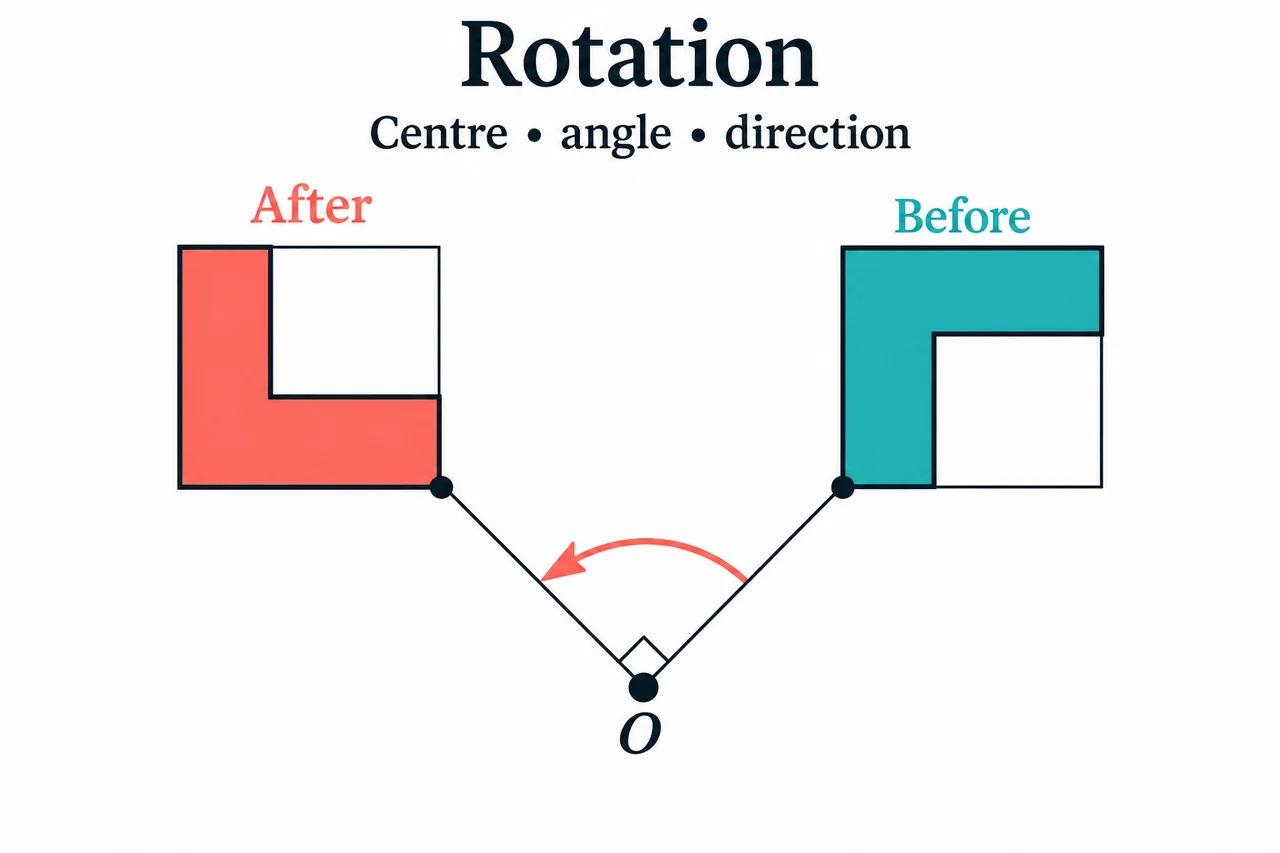
The selected teaching illustration shows a marked fixed centre and an asymmetric shape turning anticlockwise, with the original and final shapes in distinct colours. Its curved arrow and perpendicular spokes express the quarter-turn relationship schematically rather than supplying a measured coordinate construction. If labelled as a ninety-degree plate, the spokes must actually be perpendicular and the paired distances equal; otherwise it must remain an explicitly conceptual sketch. The exact off-origin coordinates above are the authority, and independent drawing and assessed construction remain separate tasks.
Image: illustration, not a documentary photograph. Teal and coral asymmetric tiles illustrate an anticlockwise quarter-turn about O, with schematic perpendicular spokes. The tiles and radii are conceptual, not a calibrated plot of the off-origin worked triangle. Exact coordinates and complete mathematical answers are provided in the text. The 160-pixel image is for recognition; use the 1280-pixel image and accessible prose for detail.
Worked example: Rotate A(1,1), B(3,1), C(1,2) ninety degrees anticlockwise about O(1,−1). Give full coordinates and verify the radius of B.
Subtract the centre, turn the relative vector, then add the centre. Radius checks detect the wrong origin but must be combined with angle/direction checks. Keep all vertices under one centre and preserve complete mapping direction in the inverse.
Answer: Subtract O: A→(0,2), B→(2,2), C→(0,3). Turn (u,v)→(−v,u): (−2,0),(−2,2),(−3,0). Add O: A′(−1,−1), B′(−1,1), C′(−2,−1). B has squared radius 2²+2²=8; B′ has relative vector(−2,2), also squared radius 8. The inverse is ninety degrees clockwise about O(1,−1).
Check your understanding: Change only the direction to ninety degrees clockwise. Give all image coordinates and explain why rotating A around the origin is an invalid shortcut.
Answer: Relative vectors are still(0,2),(2,2),(0,3). The clockwise rule(u,v)→(v,−u) gives(2,0),(2,−2),(3,0). Adding O gives A′(3,−1), B′(3,−3), C′(4,−1). The shortcut around the origin sends A(1,1) to(1,−1), which is O; its distance from O becomes 0 instead of 2. It uses the wrong centre and cannot be the requested rotation.
Why: Subtract the centre, turn the relative vector, then add the centre. Radius checks detect the wrong origin but must be combined with angle/direction checks. Keep all vertices under one centre and preserve complete mapping direction in the inverse.