Reflect in a diagonal mirror
By UK GCSE Mathematics · independent study · myAudience
Original myAudience generated teaching illustration; source and all delivery variants independently reviewed. Caption limits apply. · Original project artwork; no exam-board figures or textbook illustrations reused.
Reflect in a diagonal mirror
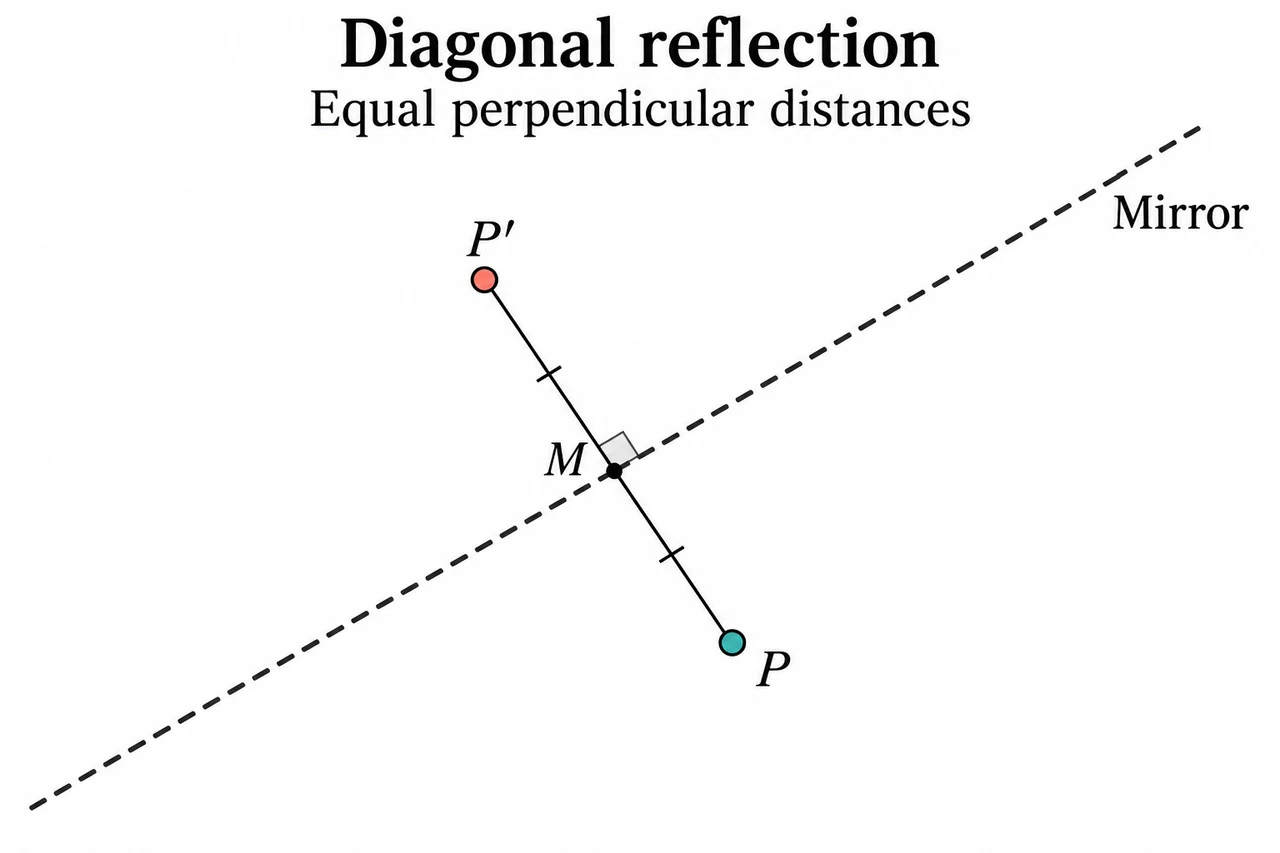
A diagonal mirror is a line, not an instruction to move each point diagonally. Reflection still uses equal perpendicular distances on opposite sides. The line y = x passes through points whose coordinates are equal. Its geometry treats the horizontal and vertical directions symmetrically, which leads to a particularly simple rule: reflecting (x, y) in y = x gives (y, x). That exchange is different from changing one sign or applying a quarter-turn.
Reflect the triangle A(1, 1), B(3, 1), C(1, 2) in y = x. The images are A′(1, 1), B′(1, 3) and C′(2, 1). A remains fixed because its coordinates are equal and it lies on the mirror. For B and B′, the midpoint is (2, 2), on y = x. Their joining segment has direction (−2, 2), perpendicular to the mirror’s direction (1, 1). This checks the geometric meaning of swapping coordinates.
The other principal diagonal, y = −x, has reflection rule (x, y) to (−y, −x). It both swaps the coordinates and changes their signs. The changed triangle becomes A′(−1, −1), B′(−1, −3), C′(−2, −1). Merely changing both signs without swapping would instead give a half-turn about the origin. Keeping those two operations distinct is especially important for points whose coordinates differ, where the erroneous shortcut becomes visible.
Check perpendicular bisectors rather than trusting the appearance of a slanted drawing. For B(3, 1) and its y = −x image (−1, −3), the midpoint is (1, −1), which lies on the mirror. The connecting displacement is (−4, −4), perpendicular to the mirror direction (1, −1). For the y = x image, the corresponding perpendicular direction is instead (−2, 2). The midpoint and perpendicular conditions together establish the reflection relationship.
Both diagonal reflections preserve the three squared side lengths 4, 5 and 1 and ordinary area 1 square unit, but reverse the ordered triangle’s orientation. Neither enlarges the triangle. A fixed point must satisfy the mirror’s equation: x = y for the first mirror and y = −x for the second. The fact that A is fixed by the first reflection does not make it fixed by the second. A point’s position, rather than its label, decides that.
Applying the same reflection twice returns the starting coordinates. Swapping twice sends (x, y) to (y, x) and back; swapping and negating twice also restores (x, y). This inverse check can expose a mistaken sign. It verifies these single-reflection rules without asserting that the wider study of combinations of different transformations has been completed. In particular, no general conclusion about two distinct mirrors is needed for the present tasks.
Describing an observed diagonal reflection requires the mirror line itself, not just the word “diagonal”. Use labelled correspondences and identify the line that perpendicularly bisects them. Symmetric figures can make different transformations look similar, so an asymmetric polygon and more than one point give stronger evidence. An apparent forty-five-degree line on a distorted photograph is not calibrated proof of y = x. The axes must have equal physical unit spacing for that visual interpretation to be reliable.
The selected concept plate uses a sloping mirror with one original point and its partner on opposite sides. Its midpoint, right-angle symbol and matching marks express the perpendicular-bisector condition schematically; its pixels are not a calibrated measurement, and it does not depict the complete worked triangle. Exact coordinate rules and every vertex are stated above and below. Diagonal reflection belongs in this proposed both-tier lesson; negative enlargement is a different Higher-only topic. Independent plotting, construction competence and assessed mastery remain open rather than being inferred from reading a worked example.
Image: illustration, not a documentary photograph. P and P′ lie either side of a diagonal mirror, with M, matching marks and a right-angle symbol expressing the perpendicular-bisector condition. Marks specify the intended relationship; pixel lengths are not calibrated and no particular mirror equation is assigned. Exact coordinates and complete mathematical answers are provided in the text. The 160-pixel image is for recognition; use the 1280-pixel image and accessible prose for detail.
Worked example: Reflect A(1,1), B(3,1), C(1,2) in y=x. Give all images and show why B and B′ satisfy the perpendicular-bisector condition.
Identify the exact mirror before choosing a coordinate rule. Swap for y=x; swap and negate for y=−x. Check fixed points and perpendicular midpoints with asymmetric correspondences. Do not mistake a half-turn, which preserves orientation, for a diagonal reflection, which reverses it.
Answer: Swapping coordinates gives A′(1,1), B′(1,3), C′(2,1). B and B′ have midpoint(2,2), on y=x. Their joining vector is(−2,2); its scalar product with mirror direction(1,1) is−2+2=0, so it is perpendicular. A is fixed; squared side lengths remain 4,5,1. The scalar-product calculation is an independent verification tool, not an extra proposed exam-board requirement.
Check your understanding: Change the mirror to y=−x. Give the image of every vertex. A student changes both signs only and sends B to(−3,−1). Explain the incorrect transformation and verify the correct B image.
Answer: The reflection rule is(x,y)→(−y,−x), giving A′(−1,−1), B′(−1,−3), C′(−2,−1). B→(−3,−1) comes from(x,y)→(−x,−y), a 180-degree rotation about the origin, not reflection in y=−x. For correct B′, midpoint is(1,−1), on the mirror, and joining vector(−4,−4) is perpendicular to(1,−1) because−4+4=0.
Why: Identify the exact mirror before choosing a coordinate rule. Swap for y=x; swap and negate for y=−x. Check fixed points and perpendicular midpoints with asymmetric correspondences. Do not mistake a half-turn, which preserves orientation, for a diagonal reflection, which reverses it.