Enlarge from a centre, not from the origin by habit
By UK GCSE Mathematics · independent study · myAudience
Original myAudience generated teaching illustration; source and all delivery variants independently reviewed. Caption limits apply. · Original project artwork; no exam-board figures or textbook illustrations reused.
Enlarge from a centre, not from the origin by habit
An enlargement is specified by a centre and a scale factor. It changes each displacement from that centre by the same factor. When the positive factor is greater than one, the image lies farther from the centre along the same ray. The centre remains fixed. A diagram showing a larger shape without identifying the centre does not fully describe a particular enlargement: different centres can produce similar images in different positions.
Work with the displacement from the centre rather than multiplying the point’s coordinates indiscriminately. If the centre is O and a vertex is P, the image is O + k(P − O), where k is the scale factor. The expression says to subtract the centre, multiply the difference and add the centre back. Multiplying absolute coordinates directly is valid only when the centre is the origin. This distinction matters even when every final coordinate is an integer.
For A(1, 1), B(3, 1), C(1, 2), use centre O(−1, 0) and factor 2. Relative vectors are (2, 1), (4, 1) and (2, 2). Doubling gives (4, 2), (8, 2) and (4, 4). Adding O produces A′(3, 2), B′(7, 2) and C′(3, 4). Each image lies on the same ray from O as its original. The centre is not the leftmost triangle vertex or an arbitrary convenient corner.
Corresponding side lengths, not absolute coordinates, reveal the scale factor. AB is two units long and A′B′ is four, so their ratio is 2. A’s horizontal coordinate changes from 1 to 3, but 3 is not the scale factor: that comparison ignores the centre at x = −1. Check another pair of corresponding sides as well. A single correct ratio does not guarantee that every vertex belongs to the same enlargement.
An enlargement preserves angles and produces a similar polygon. With factor 2, each squared side length is multiplied by 4: the original values 4, 5 and 1 become 16, 20 and 4. The ordinary area also changes from 1 to 4 square units, but this is a supporting consistency check rather than a replacement for the existing similarity-and-area lesson. Unless the length factor has magnitude one, the new figure is not congruent to the original.
The changed task uses centre (2, 1) and positive factor 3. A lies one unit left of this centre, so its image lies three units left at (−1, 1). B lies one unit right, so B′ is (5, 1). C has relative vector (−1, 1), giving C′(−1, 4). This case makes the centre visible as the midpoint between A and B without requiring it to be a vertex. The same method works for a centre outside the polygon.
The inverse enlargement uses reciprocal factor 1/k about the same centre when k is nonzero. Halving the doubled image’s displacement returns every original vertex. Factor 1 is the identity and leaves all points fixed; the unchanged image alone therefore cannot identify a unique centre. Factor 0 collapses all vertices to the centre and is not used here as an enlargement between non-degenerate similar polygons. State these limits rather than assuming every numerical factor has the same geometric meaning.
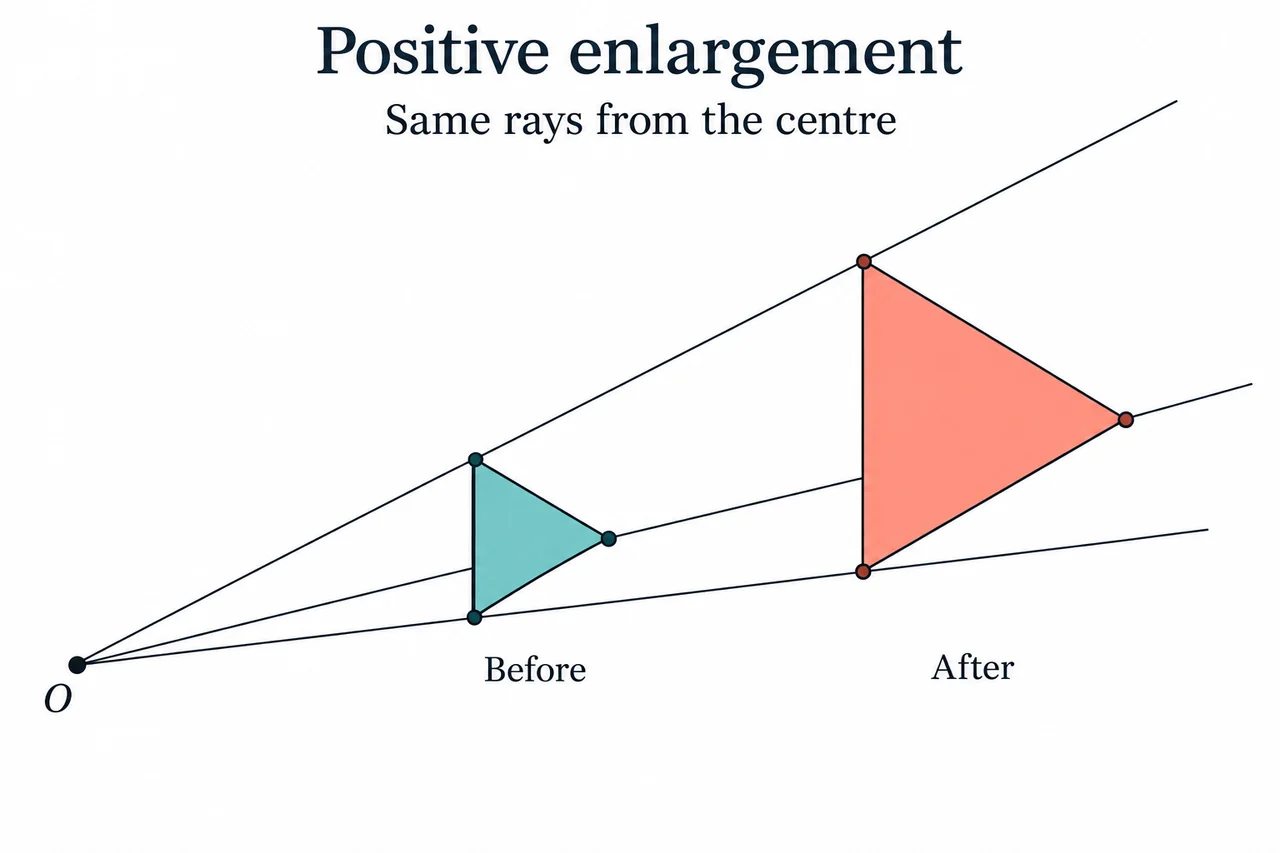
The selected concept image shows a smaller and a larger triangle on rays from a marked centre, preserving their orientation and corresponding side directions. It must not falsely claim a factor of 2 unless the rendered geometry actually supports that factor. A schematic plate may illustrate the ray relationship without calibrated distances, leaving all exact coordinates and ratios in this text. The worked and changed answers below describe complete mappings; reading them does not establish independent construction or assessed mastery.
Image: illustration, not a documentary photograph. Teal and coral triangles lie along three rays from O with the larger image farther from the centre. No numerical scale factor or worked coordinates are assigned to the schematic. Exact coordinates and complete mathematical answers are provided in the text. The 160-pixel image is for recognition; use the 1280-pixel image and accessible prose for detail.
Worked example: Enlarge A(1,1), B(3,1), C(1,2) by factor 2 about O(−1,0). Give all image coordinates, one corresponding-side check and the inverse.
Subtract the specified centre before multiplying. Check collinearity and directed centre-to-vertex ratios as well as corresponding side ratios. A matching size does not establish a matching centre. Reciprocal factors undo nonzero enlargements, while zero collapse and identity ambiguity need explicit limits.
Answer: Relative vectors are(2,1),(4,1),(2,2). Double and add O to obtain A′(3,2), B′(7,2), C′(3,4). AB=2 and A′B′=4, so the side ratio is 2. All squared sides become 16,20,4, four times the original 4,5,1. The inverse is factor 1/2 about the same O(−1,0), not about the origin.
Check your understanding: Change the centre to(2,1) and factor to 3, keeping the original triangle. Find all images and explain why multiplying A’s coordinates by 3 gives the wrong result.
Answer: Relative vectors are(−1,0),(1,0),(−1,1). Triple them and add(2,1): A′(−1,1), B′(5,1), C′(−1,4). Multiplying A(1,1) by 3 gives(3,3), which enlarges about the origin instead. Correct OA displacement(−1,0) becomes(−3,0); the wrong point has displacement(1,2) from the specified centre and is not even on the same ray.
Why: Subtract the specified centre before multiplying. Check collinearity and directed centre-to-vertex ratios as well as corresponding side ratios. A matching size does not establish a matching centre. Reciprocal factors undo nonzero enlargements, while zero collapse and identity ambiguity need explicit limits.