Use fractional scale factors without losing the centre
By UK GCSE Mathematics · independent study · myAudience
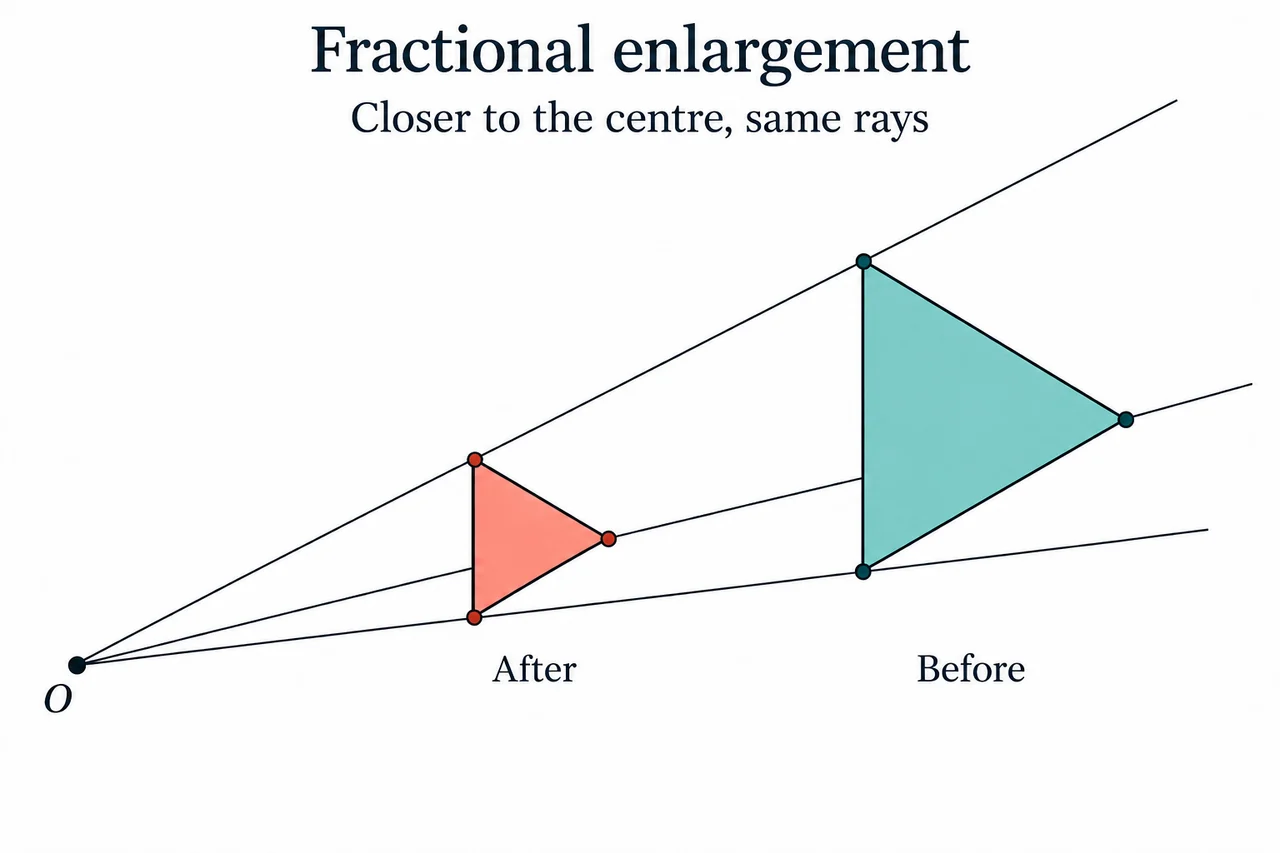
Original myAudience generated teaching illustration; source and all delivery variants independently reviewed. Caption limits apply. · Original project artwork; no exam-board figures or textbook illustrations reused.
Use fractional scale factors without losing the centre
The mathematical name “enlargement” also includes a reduction when its positive scale factor is between zero and one. A factor of one-half puts each image point halfway from the centre to its original point. The image stays on the same ray and retains the same orientation; it simply lies nearer the centre. The factor applies to lengths from the centre and corresponding sides, not directly to area or to the number of vertices.
Use the larger triangle A(2, 2), B(6, 2), C(2, 4). With the origin as centre and factor one-half, the images are A′(1, 1), B′(3, 1) and C′(1, 2). In this special case halving coordinates works because the centre is (0, 0). Label that assumption explicitly. Otherwise a shortcut that appears successful for the origin can be carried into an off-origin problem where it produces the wrong image.
Change only the centre to O(2, 0), keeping factor one-half. A’s displacement from O is (0, 2), B’s is (4, 2) and C’s is (0, 4). Halving and adding O gives A′(2, 1), B′(4, 1) and C′(2, 2). The x-coordinate of A does not halve because its horizontal displacement from O is zero. A point aligned vertically above the centre stays on that vertical ray.
Each original-image pair has the same centre-to-point distance ratio one-half. Between vertices, AB falls from length 4 to length 2 and AC from 2 to 1. Squared side lengths therefore change from 16, 20 and 4 to 4, 5 and 1. Angles are preserved, so the image is similar rather than congruent to the original. The area falls from 4 to 1 square unit, illustrating why a half-length scale should not be mistaken for a half-area scale.
The inverse has factor 2 about the same centre. For the off-origin example, A′(2, 1) has relative vector (0, 1); doubling it and adding O returns (2, 2). Changing the centre for the inverse would not undo the original operation. When a question asks for the transformation from the smaller image back to the larger original, say factor 2, not one-half. Correspondence direction determines the reciprocal.
Fractional coordinates should be kept exact rather than rounded to a nearby grid point. A vertex three units from the centre becomes one and a half units away under factor one-half. A correct construction can therefore place an image between integer grid lines. Rounding every resulting coordinate separately may spoil parallel sides, angle equality and a common scale factor. The fact that our chosen examples give integers is a convenience, not a restriction on valid fractional enlargements.
The centre can be inside, outside or on the boundary of a polygon. If it coincides with one vertex, that vertex remains fixed while the others move along their rays. A reduction does not mean that all points move toward the origin unless the origin is actually the centre. Nor does it mean that the image must sit entirely inside the original polygon: with an external centre, the whole smaller image may occupy a different region of the plane.
The selected illustration makes the same-ray order clear: centre, reduced coral image point, original teal point. A positive reduction must not put corresponding points on opposite sides of the centre, which would indicate a negative scale factor instead. A conceptual plate can show nested shapes with a marked centre without pretending that its pixels give a measured factor. Exact worked and changed coordinates are supplied below. Positive fractional enlargement belongs to both tiers here; independent plotting and formal assessment remain open.
Image: illustration, not a documentary photograph. The smaller coral image lies between O and the larger teal original on the same rays. This illustrates positive reduction without claiming a measured factor of one half. Exact coordinates and complete mathematical answers are provided in the text. The 160-pixel image is for recognition; use the 1280-pixel image and accessible prose for detail.
Worked example: Reduce A(2,2), B(6,2), C(2,4) by factor 1/2 about the origin. Give all images, compare AB and state the full inverse transformation.
A fractional factor acts on displacements from the stated centre. Keep exact fractions, reverse the correspondence for an inverse and distinguish length from area factors. Ray collinearity catches the wrong-origin shortcut even when the mistaken image has the correct size.
Answer: A′(1,1), B′(3,1), C′(1,2). AB originally has length 4 and A′B′ has length 2, so image/original=1/2. Squared sides change 16,20,4 to 4,5,1. The inverse is enlargement by factor 2 about(0,0). It restores the original triangle, not merely a congruent triangle somewhere else.
Check your understanding: Use the same original triangle and factor 1/2 but change the centre to O(2,0). Find the images and test the mistaken shortcut of halving every absolute coordinate.
Answer: Subtract O: A(0,2), B(4,2), C(0,4). Halve, then add O: A′(2,1), B′(4,1), C′(2,2). The shortcut would give(1,1),(3,1),(1,2), all one unit too far left. For A, the correct displacement from O is(0,1), half of(0,2); the shortcut displacement is(−1,1) and is not collinear with OA. The inverse remains factor 2 about O(2,0).
Why: A fractional factor acts on displacements from the stated centre. Keep exact fractions, reverse the correspondence for an inverse and distinguish length from area factors. Ray collinearity catches the wrong-origin shortcut even when the mistaken image has the correct size.