Negative scale sends vertices through the centre
By UK GCSE Mathematics · independent study · myAudience
Original myAudience generated teaching illustration; source and all delivery variants independently reviewed. Caption limits apply. · Original project artwork; no exam-board figures or textbook illustrations reused.
Negative scale sends vertices through the centre
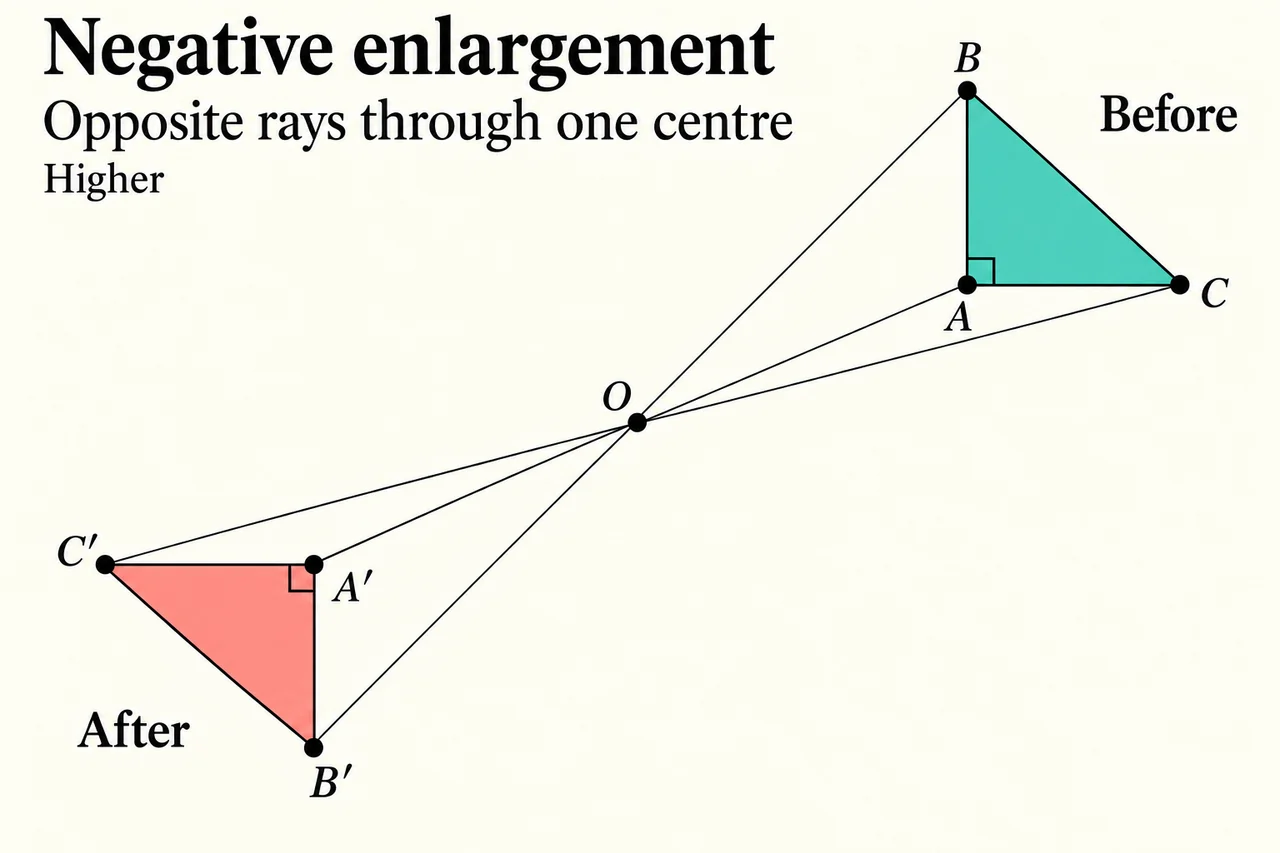
A negative enlargement multiplies each displacement from the centre by a negative number. The image therefore lies on the opposite ray through the centre, not on the same ray as its original point. Its distance from the centre is multiplied by the factor’s absolute value. A factor of −2 places the image twice as far away on the other side; a factor of −1/2 places it half as far away on the other side. This lesson’s negative-factor content is Higher only.
The same coordinate method works: subtract the centre, multiply the displacement and add the centre back. Let O = (1, −1) and A(1, 1), B(3, 1), C(1, 2). Their relative vectors are (0, 2), (2, 2) and (0, 3). Multiplying by −2 gives (0, −4), (−4, −4) and (0, −6). Adding O yields A′(1, −5), B′(−3, −5) and C′(1, −7).
For each original-image pair, O lies between the two points, and the directed displacement ratio is −2. A is two units above O while A′ is four below it. That is stronger evidence than merely observing a large triangle somewhere across the page. The correspondence lines for B and C must pass through the same centre too. A different crossing point for one pair would show that the proposed image does not follow one enlargement.
Side lengths cannot be negative. AB has length 2 and its image has length 4, so the length multiplier is |−2| = 2. All squared side lengths are multiplied by 4 and the ordinary area is multiplied by 4. A ratio of corresponding side lengths alone therefore gives the magnitude of the scale factor, not its sign. To determine the sign, examine whether corresponding centre-to-point vectors run along the same or opposite rays.
A negative enlargement is not a reflection in a line. In two dimensions it reverses both relative coordinate directions, so an ordered polygon keeps its orientation. Our original signed double area is 2 and the factor −2 image has signed double area 8, still positive. A line reflection would reverse that sign. Factor −1 produces a half-turn about the centre and a congruent image. Other negative factors combine a changed size with the opposite-ray placement, while remaining within the single-enlargement scope here.
The changed factor −1/2 about the same centre gives A′(1, −2), B′(0, −2) and C′(1, −5/2). The last coordinate is an exact fraction and must not be rounded to a nearby integer. Side lengths halve, squared lengths become one quarter of their originals, and orientation remains unchanged. This is a smaller image on the other side of O, unlike positive one-half, which places a smaller image on the original rays.
The inverse uses the reciprocal negative factor about the same centre. The inverse of −2 is −1/2, because their product is 1; the inverse of −1/2 is −2. Multiplying by the positive reciprocal would return a point on the wrong ray. Factor 0 has no inverse and collapses the polygon, so it is excluded from the non-degenerate similar-shape examples. Keep the sign throughout the calculation instead of discarding it after finding a side ratio.
The selected conceptual illustration shows three labelled vertex pairs on opposite sides of one marked centre O. Each pair is linked by a straight construction line through O, and the coral triangle has a half-turn orientation relative to the teal original. The plate does not assign a numerical scale factor or coordinates. Exact factor −2 and −1/2 coordinates are fully supplied in the text and tasks. This Higher-only lesson does not complete G8 combinations or prove assessed construction competence.
Image: illustration, not a documentary photograph. A teal right triangle ABC and a coral half-turned triangle A′B′C′ lie on opposite sides of O. Three straight construction lines link the matching vertex pairs through that same centre, showing opposite rays. Higher tier. No numbered axes, coordinate plot or numerical scale factor is assigned. Exact coordinates and complete mathematical answers are provided in the text. The 160-pixel image is for recognition; use the 1280-pixel image and accessible prose for detail.
Worked example: Enlarge A(1,1), B(3,1), C(1,2) by factor−2 about O(1,−1). Give all images, the length multiplier and the inverse.
Use signed centre displacements for position and absolute factor for lengths. Check common-centre collinearity, opposite rays and exact fractions. Two sign reversals preserve planar orientation; one line reflection reverses it. Do not identify sign from a positive side-length ratio alone.
Answer: Subtract O to get(0,2),(2,2),(0,3). Multiply by−2 and add O: A′(1,−5), B′(−3,−5), C′(1,−7). Length multiplier is|−2|=2, not−2. Squared side lengths are 16,20,4; signed double area is 8, preserving orientation. The inverse is enlargement by−1/2 about O(1,−1). Every corresponding pair lies on opposite rays through O.
Check your understanding: Change only the factor to−1/2. Give exact image coordinates and distinguish this map from both positive 1/2 enlargement and a line reflection.
Answer: Relative vectors become(0,−1),(−1,−1),(0,−3/2). Adding O gives A′(1,−2), B′(0,−2), C′(1,−5/2). Positive 1/2 would instead give A′(1,0), B′(2,0), C′(1,1/2), on the original rays. The negative-factor triangle keeps orientation: its signed double area is 1/2, positive; a line reflection reverses orientation. The inverse factor is−2 about the same centre.
Why: Use signed centre displacements for position and absolute factor for lengths. Check common-centre collinearity, opposite rays and exact fractions. Two sign reversals preserve planar orientation; one line reflection reverses it. Do not identify sign from a positive side-length ratio alone.