Recover a centre and verify the whole correspondence
By UK GCSE Mathematics · independent study · myAudience
Original myAudience generated teaching illustration; source and all delivery variants independently reviewed. Caption limits apply. · Original project artwork; no exam-board figures or textbook illustrations reused.
Recover a centre and verify the whole correspondence
An enlargement can be described from its original and image if the correspondence is clear. Begin by pairing labelled vertices and comparing corresponding side lengths. For a positive factor, that ratio supplies k. Then join each original vertex to its image: their lines should meet at one centre. Looking only at which polygon is larger is incomplete. A correct scale factor with an incorrect centre gives a different transformation and different vertex positions.
Consider A(2, 2), B(4, 2), C(2, 4), with proposed images A′(5, 5), B′(9, 5), C′(5, 9). AB has length 2 and A′B′ has length 4, so the positive scale factor is 2. The same ratio applies to AC and A′C′. Because the factor exceeds one, the originals should lie between the centre and their images. This ray-order condition matters alongside the side ratio.
The relationship P′ = O + k(P − O) can be rearranged to O = (kP − P′)/(k − 1) when k is not 1. With A and k = 2, O = 2A − A′ = (4, 4) − (5, 5) = (−1, −1). Using B gives (8, 4) − (9, 5) = (−1, −1) again. This algebra checks the same intersection that a geometric construction would locate; it is not a replacement for practising that construction.
Validate the remaining vertex instead of stopping after two convenient matches. From O(−1, −1), C’s relative vector is (3, 5). Doubling it and adding O gives (5, 9), exactly the proposed C′. If C′ were instead (5, 8), the first two pairs would still identify a plausible centre and factor, but the third would fail. The complete triangle would not be the specified enlargement. A whole-shape claim needs every required correspondence.
The changed task gives A′(3, 1), B′(4, 1), C′(3, 2) for the same original triangle. The corresponding side ratio is one-half. Rearranging with A gives O = ((1/2)(2, 2) − (3, 1))/(1/2 − 1) = (4, 0). Check B: its displacement from O is (0, 2), so halving and adding O produces (4, 1). The centre is different from the first problem; a reciprocal factor alone does not mean the two displayed mappings are inverses.
The inverse of the first mapping is factor one-half about (−1, −1), whereas the inverse of the changed mapping is factor 2 about (4, 0). Each inverse retains its own centre. Inverse correspondence swaps the original and image roles, so a side ratio must be computed in the requested direction. These cases show why saying only “enlarge by two” is not a full answer, and why “reduce by half” is also incomplete without a centre.
Some data do not determine a unique centre. If k = 1 and every image equals its original, the transformation is the identity for any centre. The formula’s zero denominator correctly warns that this data cannot isolate one centre. If the factor were 0, every point would collapse to a single centre and the image would not be a non-degenerate similar polygon. Symmetric or unlabelled shapes can also create correspondence ambiguity, so say which vertices have been paired before making a uniqueness claim.
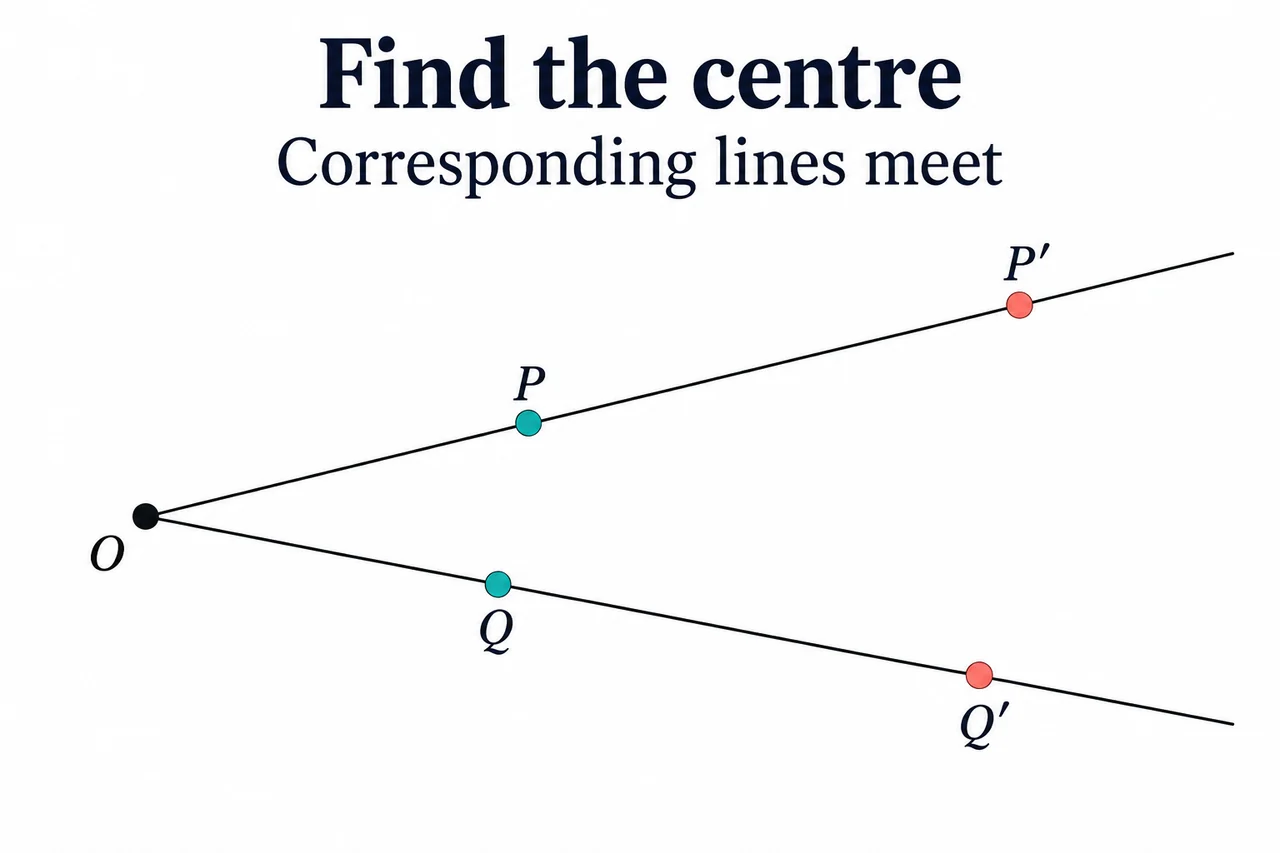
The selected concept illustration shows two lines through paired points meeting at one marked centre. It depicts two correspondences, not a whole polygon or a completed check of every vertex. It should not infer a numerical factor from an uncalibrated drawing or claim that two rays alone validate every vertex. The exact tasks below provide all coordinates and a deliberately incorrect third image for checking. All centre-finding, independent drawing and assessed mastery remain open; the broader curriculum on combinations of transformations is deferred rather than bundled into this lesson.
Image: illustration, not a documentary photograph. Two corresponding point pairs P/P′ and Q/Q′ define lines meeting at O. Two pairs alone do not validate the remaining vertices, similarity or a numerical scale factor. Exact coordinates and complete mathematical answers are provided in the text. The 160-pixel image is for recognition; use the 1280-pixel image and accessible prose for detail.
Worked example: A(2,2), B(4,2), C(2,4) map to A′(5,5), B′(9,5), C′(5,9). Identify a positive enlargement fully and verify every vertex.
Match corresponding vertices first, infer the side ratio in the specified direction, locate or solve for the centre and check all vertices. A balanced-looking sketch or two matching pairs does not certify the third. Handle k=1 identity ambiguity and k=0 collapse explicitly; do not divide by a zero denominator or confuse different centres with inverse maps.
Answer: Corresponding AB lengths 2 and 4 give k=2. Centre O=2A−A′=(−1,−1); B gives the same centre. From O, relative vectors for A,B,C are(3,3),(5,3),(3,5). Double and add O to get(5,5),(9,5),(5,9), all correct. The full description is enlargement by factor 2 about(−1,−1); the inverse is factor 1/2 about that same centre.
Check your understanding: For the same originals, proposed images are A′(3,1), B′(4,1), C′(3,2). Recover the positive factor and centre. Then decide whether replacing C′ with(3,5/2) would still be one enlargement of the whole triangle.
Answer: AB length 2 becomes length 1, so k=1/2. O=(kA−A′)/(k−1)=((1,1)−(3,1))/(−1/2)=(4,0). Relative vectors from O are(−2,2),(0,2),(−2,4). Halving and adding O gives(3,1),(4,1),(3,2), all matching. Replacing C′ with(3,5/2) fails the same rule: C’s vertical displacement 4 must halve to 2, not 5/2. The unchanged A/B pairs already fix k and O, so the incorrect third image cannot belong to that enlargement. The inverse is factor 2 about(4,0).
Why: Match corresponding vertices first, infer the side ratio in the specified direction, locate or solve for the centre and check all vertices. A balanced-looking sketch or two matching pairs does not certify the third. Handle k=1 identity ambiguity and k=0 collapse explicitly; do not divide by a zero denominator or confuse different centres with inverse maps.