Translations: follow the journey, then combine the movement
By UK GCSE Mathematics · independent study · myAudience
Original myAudience generated teaching illustration; accepted caption limits apply. · Original project artwork; no exam-board figures or textbook illustrations reused.
Translations: follow the journey, then combine the movement
A combination of transformations applies one complete rule and then another. The input to the second transformation is the first image, not the original shape. Label the original vertices A, B and C, the intermediate vertices A′, B′ and C′, and the final vertices A″, B″ and C″. Those labels describe stages rather than different kinds of point. A coordinate table with one column per stage makes the order visible and gives a place to check every vertex. Even when there is a short way to describe the final mapping, keep the intermediate stage if the question asks for the route. A final answer alone does not show which instruction was followed first.
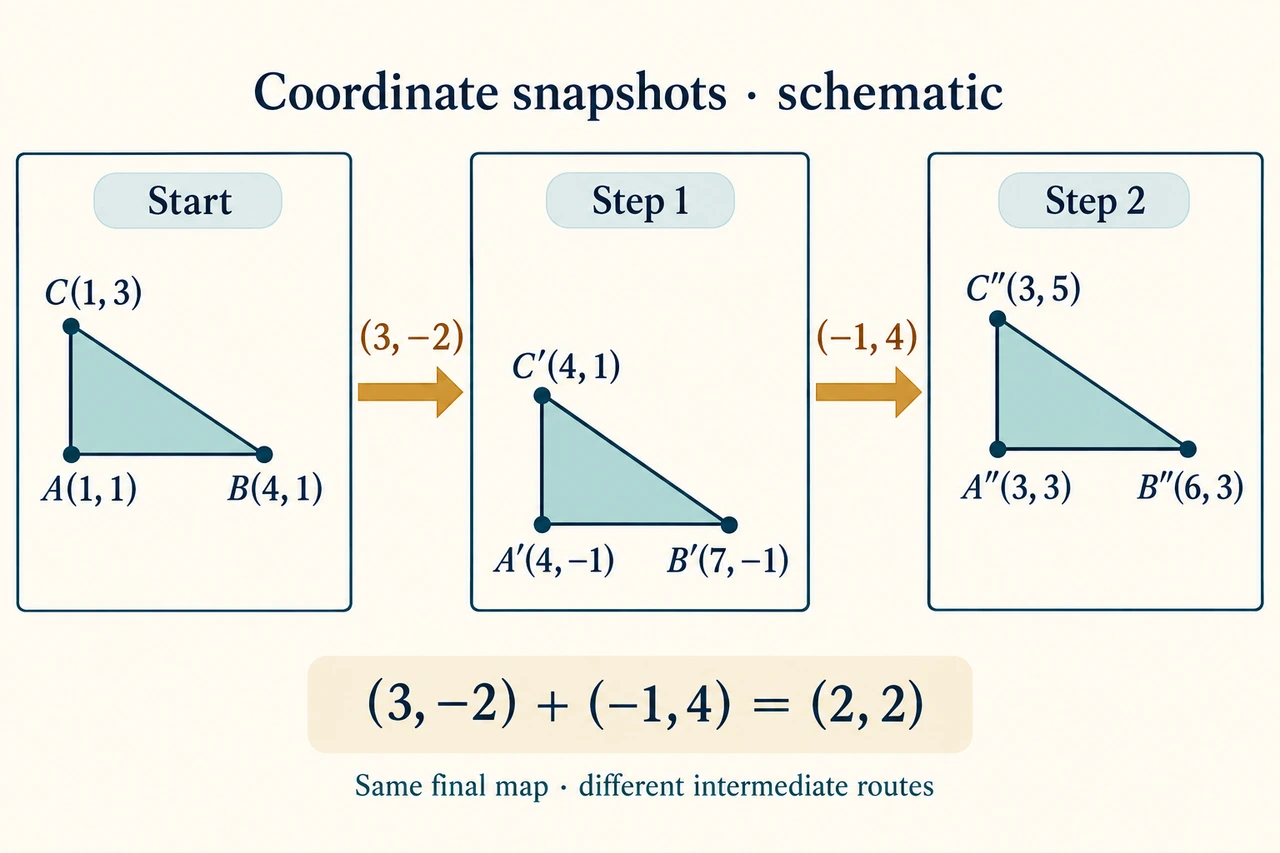
Translation by a vector (u,v) sends every point (x,y) to (x+u,y+v). The first component controls horizontal movement and the second controls vertical movement, with positive directions fixed by the coordinate axes. Apply translation (3,−2) to A (1,1), B (4,1), C (1,3). The intermediate triangle is A′(4,−1), B′(7,−1), C′(4,1). Now use (−1,4) on those intermediate coordinates. The final triangle is A″(3,3), B″(6,3), C″(3,5). The displacement from each original vertex to its final image is (2,2). Checking all three displacements prevents a correctly moved first vertex from concealing an error on the other two.
The combined translation adds components. For a general point, the two stages give (x+3−1,y−2+4), which is (x+2,y+2). More generally, translations (u,v) and (r,s) combine to (u+r,v+s). This is addition of displacement, not multiplication of coordinates or vector components. The rule holds for points anywhere in the plane, so it establishes a transformation of the entire shape rather than a coincidence at one vertex. A route three units right and one unit left has net movement two units right, while two units down and four units up has net movement two units up. The same signed accounting works when components are fractions.
Translation order commutes: doing (r,s) and then (u,v) gives the same final point because ordinary addition commutes in each component. The intermediate positions can be different, however. Reversing our example first gives A′(0,5), B′(3,5), C′(0,7), then the same final vertices (3,3), (6,3), (3,5). Thus “same final mapping” does not mean “same route”. This special property of translations must not be extended to arbitrary transformation pairs. A rotation can change the direction of a later displacement, and two parallel reflections can reverse the direction of their combined translation when their order changes. Test the actual rules rather than relying on a remembered slogan about combinations.
To undo the route, undo the last stage first. After the final triangle, translate by (1,−4) to recover the intermediate triangle and then by (−3,2) to recover the original. The single inverse is translation (−2,−2). Negating both components is necessary; reversing just one direction undoes only part of the movement. In this translation-only example the two inverse translations also commute, but reversing stage order is the reliable method that will work for mixed transformations later. An inverse check is more informative than judging a sketch: each final vertex should return exactly to its own original coordinate, preserving the A-to-A and B-to-B correspondences.
Opposite translations cancel. For example, translating by (3/2,−2) and then by (−3/2,2) returns every point to its starting position. Their component sums are zero, giving the identity transformation. The identity fixes all points; it has no unique nonzero movement direction. It does not imply that no journey occurred: the intermediate triangle can be displaced before it returns. Distinguish the transformation of the whole plane from the appearance of an unlabelled symmetric object, which can look unchanged after other operations. Coordinate correspondence establishes identity. A zero combined vector can arise from many different cancelling pairs, so the final image alone cannot uniquely reconstruct the original two instructions.
Translations preserve lengths, angles, ordinary area and orientation. The original displacements AB=(3,0), BC=(−3,2), CA=(0,−2) have squared lengths 9,13 and 4. Adding the same vector to both endpoints cancels when taking their difference, so those squared lengths are unchanged after each stage. The triangle has base 3 and perpendicular height 2, giving area 3. Its labelled counterclockwise order also remains counterclockwise. These invariants check scale and shape, but do not locate the image: many congruent triangles have the same side lengths and area. Combine an invariant check with exact vertex displacements to establish both where the image is and how it was obtained.
When comparing competing answers, identify the operation that would have produced the error. Adding only the first vector leaves the triangle at the intermediate stage; applying the second vector to the original gives a different intermediate stage; multiplying vector components is not a translation-composition rule. In the changed task below, exact fractions cancel without rounding. Work with 3/2 until the final step rather than rounding it to a nearby whole number. This lesson develops a bounded Higher-tier combination of translations under the existing transformation objective. It does not claim independent construction skill, assessed mastery, vector-proof curriculum completion or complete qualification coverage.
Image: illustration, not a documentary photograph. Separate schematic coordinate snapshots show A (1,1), B (4,1), C (1,3); then A′(4,−1), B′(7,−1), C′(4,1); then A″(3,3), B″(6,3), C″(3,5). The ordered translations (3,−2) and (−1,4) combine to (2,2). Arrows show stage order, not displacement on one plotted plane. Panels are not a calibrated common coordinate system: do not measure lengths, movement, angles or area from their pixel positions. The full coordinate rules establish the quantitative result and explain the reversed route. The 160 px version is recognition only; open the larger image and full accessible teaching for labels and reasoning.
Worked example: For A (1,1), B (4,1), C (1,3), translate first by (3,−2) and then by (−1,4). Give all intermediate and final vertices, the equivalent single transformation, the reversed-order image and a complete inverse. Verify squared side lengths and area.
A translation changes position by adding one common displacement to every vertex. Derive the general point rule and check all correspondences; do not multiply components. Stage-by-stage labels separate route from net movement. Undo operations in reverse order even though translations themselves commute. Exact cancellation proves identity for every point, while unchanged lengths alone would prove only congruence.
Answer: First stage: A′(4,−1), B′(7,−1), C′(4,1). Second stage: A″(3,3), B″(6,3), C″(3,5). The equivalent single translation is (2,2), since (3,−2)+(−1,4)=(2,2). In reversed order the intermediate vertices are (0,5),(3,5),(0,7), and adding (3,−2) produces the same final vertices (3,3),(6,3),(3,5). Undo the second stage with (1,−4), giving (4,−1),(7,−1),(4,1); then undo the first with (−3,2), giving (1,1),(4,1),(1,3). The equivalent inverse is (−2,−2). AB²=9, BC²=13 and CA²=4 in the original and final triangles. Both ordinary areas are 3, and labelled orientation is unchanged. The different intermediate triangles explain how two journeys can share one endpoint mapping. Signed component addition determines the displacement for every point.
Check your understanding: Use the same original triangle, but translate first by (3/2,−2) and then by (−3/2,2). A student says the final image is (−9/4,−4) times each original coordinate because the components should be multiplied. Give every intermediate and final vertex, correct the rule, compare reversed order and specify the inverse route.
Answer: First stage: A′(5/2,−1), B′(11/2,−1), C′(5/2,1). Adding (−3/2,2) gives A″(1,1), B″(4,1), C″(1,3). Components add to (0,0), so the equivalent mapping is identity, not componentwise multiplication. Reversed order first gives (−1/2,3),(5/2,3),(−1/2,5); the second translation restores the same original vertices. Undo the last stage with (3/2,−2), recovering the intermediate triangle, then use (−3/2,2) to recover the original. Both combined forward and inverse maps are identity. Squared side lengths remain 9,13,4 and ordinary area remains 3; every labelled point is fixed by the complete combination. Returning all labelled vertices exactly separates genuine identity from the misleading appearance of an unlabelled symmetric shape.
Why: A translation changes position by adding one common displacement to every vertex. Derive the general point rule and check all correspondences; do not multiply components. Stage-by-stage labels separate route from net movement. Undo operations in reverse order even though translations themselves commute. Exact cancellation proves identity for every point, while unchanged lengths alone would prove only congruence.