Two mirrors: why parallel reflections slide and crossing mirrors turn
By UK GCSE Mathematics · independent study · myAudience
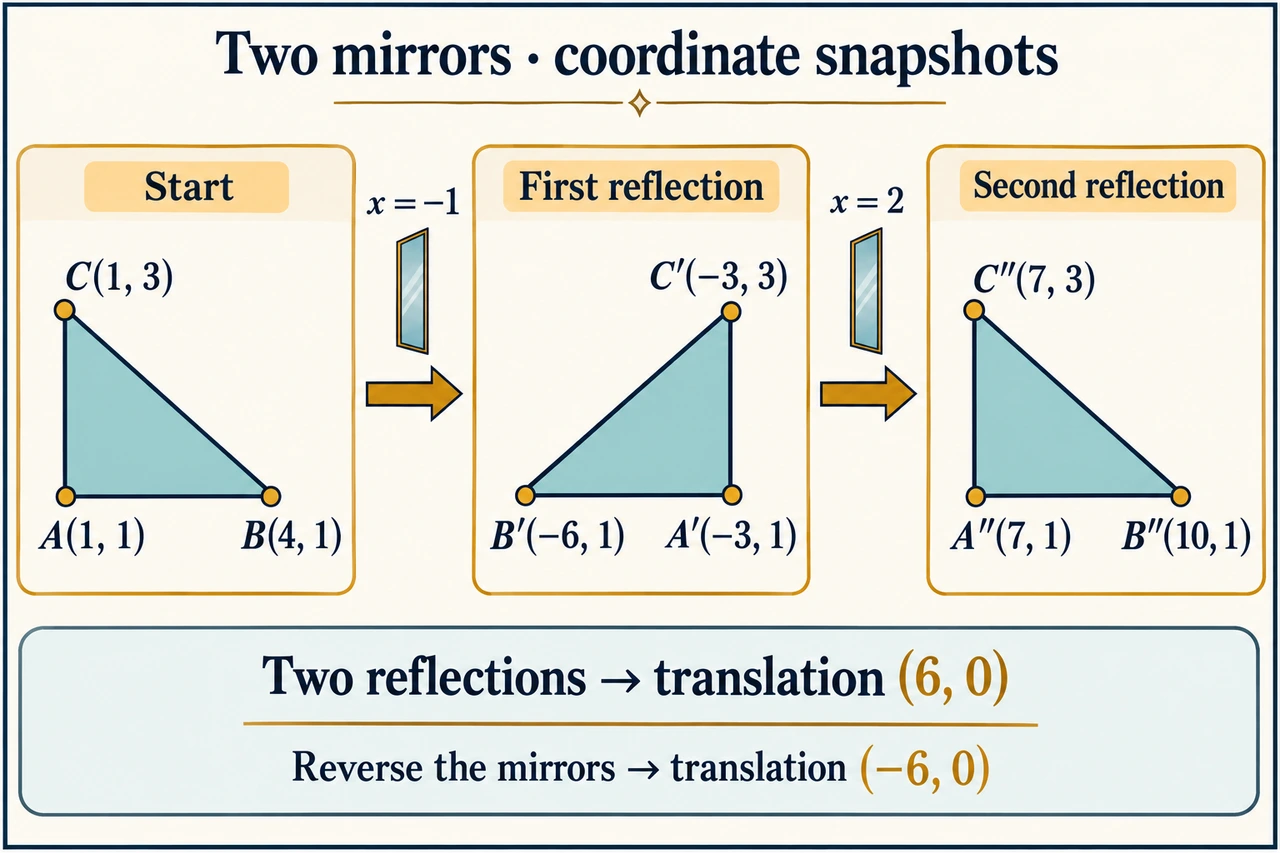
Original myAudience generated teaching illustration; accepted caption limits apply. · Original project artwork; no exam-board figures or textbook illustrations reused.
Two mirrors: why parallel reflections slide and crossing mirrors turn
A reflection reverses orientation while preserving lengths and angles. Applying two reflections therefore restores orientation, but it need not restore the original position. The second mirror acts on the first reflected image. Keep the mirror lines fixed in the coordinate plane and keep corresponding vertices labelled through both stages. Reflecting the original independently in both mirrors would create two separate images, not a combination. A point on the first mirror is fixed by the first stage, but the second stage may move it. Conversely, a point fixed by the complete combination need not remain fixed at every intermediate stage. Position, orientation and the sequence of instructions answer different questions.
For a vertical mirror x=a, reflection sends (x,y) to (2 a−x,y). The point and its image have midpoint x=a and equal horizontal distance from the mirror; their y coordinates match. Reflect the original triangle A (1,1), B (4,1), C (1,3) in x=−1. The intermediate coordinates are (−3,1),(−6,1),(−3,3). Reflect those in x=2 to obtain (7,1),(10,1),(7,3). Each final x coordinate is six more than its original value and each y coordinate is unchanged. This gives translation (6,0). The image is shifted across the plane despite the two orientation reversals cancelling.
The general rule explains the six-unit displacement. First reflection in x=a gives 2 a−x; second reflection in x=b gives 2 b−(2 a−x)=x+2(b−a). Thus two parallel vertical mirrors give horizontal translation (2(b−a),0). The distance between our mirrors is 3, and the combined movement has magnitude 6 directed from the first mirror towards the second. Reversing the order changes b−a to a−b, so the translation reverses direction. The same reasoning for horizontal mirrors y=a and y=b gives vertical translation (0,2(b−a)). The signed difference matters: doubling an unsigned distance alone does not specify a complete transformation.
If the two parallel mirror lines coincide, b=a and the displacement is zero. Reflecting twice in exactly the same line is identity for every point. For distinct parallel lines, the nonzero translation has no fixed point in the plane. These conclusions follow from the point rule, not from whether a chosen shape looks symmetric. A drawing that shows a symmetric shape apparently facing its original direction after two mirrors establishes neither identity nor the correct displacement. Track an asymmetric triangle and its labels, or calculate a general point. The inverse of two reflections uses the same mirrors in reverse order because each individual reflection is its own inverse.
Perpendicular intersecting mirrors produce a different combination. Reflection in y=x swaps coordinates: (x,y) becomes (y,x). Reflection in y=−x then sends that intermediate point to (−x,−y). This is a half-turn, or 180-degree rotation, about the intersection O (0,0). For our triangle, the first image is (1,1),(1,4),(3,1), and the final image is (−1,−1),(−4,−1),(−1,−3). The lines are perpendicular because their directions meet at a right angle. This explanation is about this bounded pair of mirrors; it does not ask learners to memorise a general formula for arbitrary intersecting lines or to replace construction with unverified diagram measurements.
In this particular perpendicular case, reversing the mirror order also gives (−x,−y). Reflection first in y=−x gives (−y,−x), then swapping its coordinates gives (−x,−y). Therefore these two reflections commute, although our two distinct parallel mirrors did not. A half-turn is its own inverse: repeating (x,y)→(−x,−y) returns (x,y). The intersection O is the unique fixed point of the full half-turn. Points elsewhere need not be on either mirror, and an intermediate image can be far from its final position. State angle and centre when describing the equivalent rotation; “a turn” is incomplete.
Both two-reflection examples preserve squared side lengths 9,13,4 and ordinary area 3. A single reflection flips the sign of the labelled signed area, while the second flips it back. That signed quantity records orientation rather than negative physical area. In our examples the original signed double area is 6, the intermediate value is−6 and the final value is 6. Ordinary area is the magnitude divided by 2 at every stage. These checks distinguish a reflection from an enlargement, but cannot by themselves decide between a translation and a rotation. The general coordinate rule and the location of any fixed point establish the complete equivalent transformation.
An error analysis should ask whether the mirror was used correctly and whether the order was preserved. For x=−1, using −x reflects in x=0 rather than the stated line; for y=−x, swapping coordinates without changing signs uses the other diagonal mirror. A correct-looking final orientation can conceal both errors. Test midpoint/perpendicularity for one reflection and then apply the second rule to its actual output. In the changed task, explain the special commutation of perpendicular mirrors without claiming that all reflections commute. Independent construction, assessed transformation skill and full Higher-tier qualification coverage remain open.
Image: illustration, not a documentary photograph. Three separate coordinate snapshots show the original triangle (1,1),(4,1),(1,3); reflection in x=−1 gives (−3,1),(−6,1),(−3,3); reflection in x=2 gives (7,1),(10,1),(7,3). The first reflection reverses labelled orientation and the second restores it. Symbolic mirror icons name the operations; they are not plotted mirror locations. Flow arrows show order, not geometric displacement. The two reflections combine to translation (6,0); reversing these two mirrors gives (−6,0). Snapshots are not to scale or a common calibrated plane, so measure nothing from their pixels. Exact prose supplies the proof. 160 px is recognition only; use the larger illustration and complete accessible teaching for detail.
Worked example: For A (1,1), B (4,1), C (1,3), reflect first in x=−1 and then in x=2. Find all intermediate and final vertices, the equivalent transformation, the result of reversing the mirrors and the inverse. Check lengths, area and orientation.
Derive each mirror rule from its actual line, then substitute the first output into the second. The doubled signed separation establishes a parallel-mirror translation, whereas the perpendicular diagonal pair gives a half-turn. Two orientation reversals prove neither identity nor arbitrary commutation. Full centre/vector descriptions and inverse stage checks detect wrong-line and wrong-order errors.
Answer: First reflection gives A′(−3,1), B′(−6,1), C′(−3,3). The second gives A″(7,1), B″(10,1), C″(7,3). The general x rule is 4−(−2−x)=x+6, so the equivalent transformation is translation (6,0). Reversed order gives intermediate (3,1),(0,1),(3,3), then final (−5,1),(−2,1),(−5,3): translation (−6,0). The inverse of the stated route reflects the final image first in x=2, returning (−3,1),(−6,1),(−3,3), then in x=−1, returning (1,1),(4,1),(1,3). Equivalently translate (−6,0). Squared side lengths 9,13,4 and ordinary area 3 are unchanged; signed double area changes 6→−6→6, so final orientation is restored. Because the mirrors are distinct, the nonzero translation fixes no point; reversing their order produces the inverse displacement.
Check your understanding: Instead reflect the same triangle first in y=x and then in y=−x. Give all vertices at each stage, describe the equivalent mapping completely, calculate the reversed-order image and explain whether the original parallel-mirror conclusion about order still applies.
Answer: Reflection in y=x gives (1,1),(1,4),(3,1). Reflection in y=−x then gives (−1,−1),(−4,−1),(−1,−3). The combined general rule is (x,y)→(−x,−y), a 180-degree rotation about (0,0). Reversed order first gives (−1,−1),(−1,−4),(−3,−1); swapping these coordinates gives the same final vertices (−1,−1),(−4,−1),(−1,−3). Thus this perpendicular pair commutes, unlike the distinct parallel pair. Undo the final image first in y=−x to recover (1,1),(1,4),(3,1), then in y=x to recover the original. The combined inverse is the same half-turn. Squared sides 9,13,4, area 3 and final orientation are retained; the origin alone is fixed by the complete combination. The complete half-turn fixes the origin even though other points move.
Why: Derive each mirror rule from its actual line, then substitute the first output into the second. The doubled signed separation establishes a parallel-mirror translation, whereas the perpendicular diagonal pair gives a half-turn. Two orientation reversals prove neither identity nor arbitrary commutation. Full centre/vector descriptions and inverse stage checks detect wrong-line and wrong-order errors.