A turn followed by a translation: order changes the destination
By UK GCSE Mathematics · independent study · myAudience
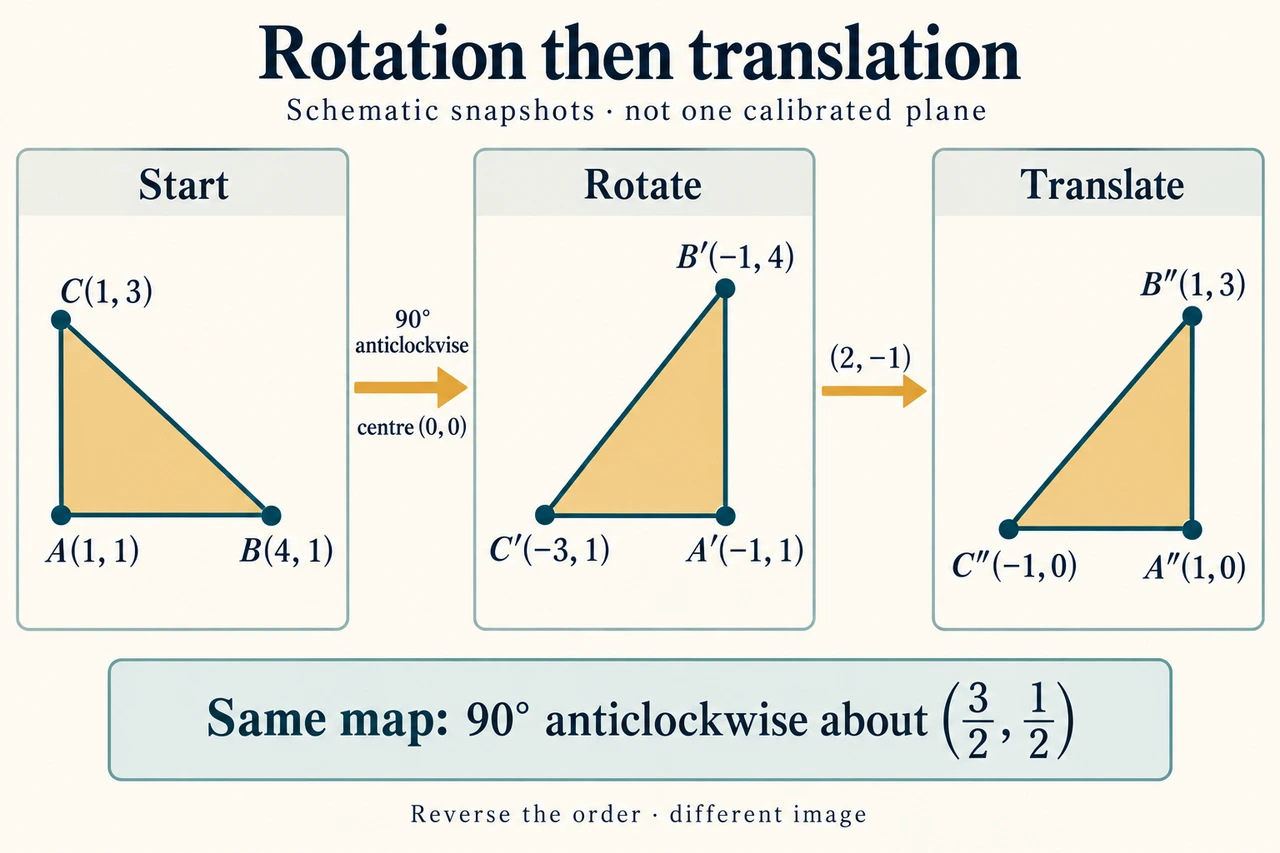
Original myAudience generated teaching illustration; accepted caption limits apply. · Original project artwork; no exam-board figures or textbook illustrations reused.
A turn followed by a translation: order changes the destination
A rotation and a translation are both rigid transformations: they preserve lengths and angles. Combining them still preserves the shape, but the order usually changes its position. A rotation needs a centre, angle and direction; a translation needs a complete signed vector. State those details before calculating. Rotating first and translating afterwards means the translation moves the rotated image in the original coordinate directions. Translating first moves the original before it turns around the fixed centre. Those journeys are different because a rotation changes the direction of displacement vectors. Label every intermediate image and test the actual sequence rather than relying on a sketch that happens to look plausible.
A 90-degree anticlockwise rotation about the origin sends (x,y) to (−y,x). For A (1,1), B (4,1), C (1,3), the first image is (−1,1),(−1,4),(−3,1). Translating this image by (2,−1) gives final vertices (1,0),(1,3),(−1,0). The combined general rule is (x,y)→(2−y,x−1). The translation changes the final coordinates but does not remove the rotation: AB, originally horizontal to the right, is now vertical upwards. Recognising this change of direction is a useful qualitative check, while the exact coordinate rule establishes the complete mapping for every point.
Reverse the operations without changing their stated parameters. Translation (2,−1) first gives (3,0),(6,0),(3,2); rotating those about the origin gives (0,3),(0,6),(−2,3). These are different from the stated final vertices. The reversed general rule is (x,y)→(1−y,x+2), because the translation vector itself has effectively been rotated. A single point may accidentally hide a difference in other transformation pairs, so compare the general rules or several corresponding vertices. Here the two formulas differ by a fixed displacement (−1,3), establishing noncommutation. Unchanged side lengths cannot distinguish them because both are valid rigid images of the same original triangle.
The stated combination can be described as a single 90-degree anticlockwise rotation about a different centre. For centre (h,k), first subtract the centre, rotate and then add it back. The resulting coordinate rule is (h+k−y,k−h+x). Matching it to (2−y,x−1) gives h+k=2 and k−h=−1. Adding these equations gives 2 k=1, so k=1/2 and h=3/2. The complete equivalent description is a 90-degree anticlockwise rotation about (3/2,1/2). This fractional centre is exact, not an approximate point chosen to make a drawing fit. Substituting it in the rule confirms all vertices and every other point.
An equivalent single transformation preserves the endpoint map, not the intermediate route. Our two-stage process turns about the origin and then slides, whereas the equivalent one-stage rotation turns about (3/2,1/2). The fixed point of the combined map is that new centre: solving x=2−y and y=x−1 gives (3/2,1/2). The origin is not fixed by the combination, because it moves to (2,−1). Conversely, a point fixed by the combination can move during the two-stage route and later return. This distinction makes fixed-point reasoning useful without treating an intermediate motion diagram as evidence of the final centre.
For the inverse route, undo the translation first with (−2,1), then rotate 90 degrees clockwise about the origin. The final vertices (1,0),(1,3),(−1,0) become (−1,1),(−1,4),(−3,1), and the clockwise rule (x,y)→(y,−x) returns (1,1),(4,1),(1,3). Alternatively use a 90-degree clockwise rotation about the equivalent centre (3/2,1/2). In a mixed sequence, applying inverse operations in the original order generally fails. Write the route in order and read it backwards, replacing each instruction with its inverse. A clockwise rotation is not obtained by changing only one coordinate sign in an arbitrary off-origin rule.
Off-origin rotations require a local displacement calculation. A 90-degree clockwise rotation about (1,−1) sends (x,y) to (y+2,−x). For the changed example, this gives (3,−1),(3,−4),(5,−1); a later translation (−2,3) gives (1,2),(1,−1),(3,2). The combined rule is (x,y)→(y,3−x), equivalent to a 90-degree clockwise rotation about (3/2,3/2). Reversing the instructions produces (6,1),(6,−2),(8,1), not the same image. The general centre calculation uses subtraction and addition consistently; importing an origin-only rule while leaving the centre untouched is a common error.
Both original and changed combinations preserve squared side lengths 9,13,4, ordinary area 3 and labelled orientation. A quarter-turn can exchange the visual roles of horizontal and vertical sides without stretching them. These invariants help catch sign mistakes or unintended scale changes, but exact correspondences and the centre rule determine the location. The full answers below retain every intermediate image and inverse rather than compressing the task to a final label. This is a bounded Higher-tier rotation/translation composition under the existing G 8 objective. No matrix method, enlargement combination, independent assessed construction or complete qualification coverage is claimed.
Image: illustration, not a documentary photograph. Separate snapshots show (1,1),(4,1),(1,3) rotated 90 degrees anticlockwise about (0,0) to (−1,1),(−1,4),(−3,1), then translated by (2,−1) to (1,0),(1,3),(−1,0). The lower statement identifies the equivalent 90-degree anticlockwise rotation about (3/2,1/2). Centre labels name operations; no centre or common coordinate plane is plotted. Flow arrows indicate sequence. The shapes and panel positions are schematic, not measured scale drawings; exact coordinates and the full centre derivation in prose establish the mapping. Reversed order gives a different final image, worked fully in the text. 160 px is recognition only; inspect the larger illustration and accessible full lesson for notation and proof.
Worked example: Rotate A (1,1), B (4,1), C (1,3) 90 degrees anticlockwise about (0,0), then translate by (2,−1). Give all intermediate and final vertices, compare reversed order, derive the centre of an equivalent single rotation, and undo the stated route.
Subtract the stated centre before rotating and restore it afterwards. Compose general rules to compare order and derive the equivalent centre; do not relocate a centre by eye. Reverse stage order for the inverse. A correct rigid shape can still be in the wrong place, so exact vertex correspondences supplement length/area checks. Fractional centres are retained as exact rational numbers.
Answer: The rotated vertices are A′(−1,1), B′(−1,4), C′(−3,1). The translated final vertices are A″(1,0), B″(1,3), C″(−1,0). Translating first produces (3,0),(6,0),(3,2), then rotating gives (0,3),(0,6),(−2,3), proving the two orders differ. The stated general rule is (2−y,x−1). A 90-degree anticlockwise rotation about (h,k) gives (h+k−y,k−h+x); hence h+k=2 and k−h=−1, so (h,k)=(3/2,1/2). The equivalent mapping is a 90-degree anticlockwise rotation about that centre. Undo translation first with (−2,1) to recover (−1,1),(−1,4),(−3,1), then rotate 90 degrees clockwise about the origin to recover (1,1),(4,1),(1,3). The equivalent inverse turns 90 degrees clockwise about (3/2,1/2). Squared side lengths remain 9,13,4, ordinary area 3 and signed double area 6.
Check your understanding: Instead rotate the same original triangle 90 degrees clockwise about (1,−1), then translate by (−2,3). Calculate both stages and reversed order, derive an equivalent single rotation and give a complete inverse. Explain why an origin-only rotation rule would be wrong.
Answer: Subtracting (1,−1), rotating clockwise and restoring the centre gives the rule (y+2,−x). Thus the first image is (3,−1),(3,−4),(5,−1), and translation gives (1,2),(1,−1),(3,2). Reversed order translates first to (−1,4),(2,4),(−1,6), then rotates to (6,1),(6,−2),(8,1). The stated combined rule is (y,3−x). A clockwise rotation about (h,k) gives (h−k+y,h+k−x), so h−k=0 and h+k=3; the centre is (3/2,3/2). Undo the final translation with (2,−3), recovering (3,−1),(3,−4),(5,−1); then rotate 90 degrees anticlockwise about (1,−1), recovering all original vertices. Equivalently turn anticlockwise about (3/2,3/2). The origin rule (y,−x) would omit the centre-dependent horizontal+2 before translation. Squared sides 9,13,4 and ordinary area 3 remain unchanged, with original orientation retained.
Why: Subtract the stated centre before rotating and restore it afterwards. Compose general rules to compare order and derive the equivalent centre; do not relocate a centre by eye. Reverse stage order for the inverse. A correct rigid shape can still be in the wrong place, so exact vertex correspondences supplement length/area checks. Fractional centres are retained as exact rational numbers.