Three transformations: reverse the route and check what survives
By UK GCSE Mathematics · independent study · myAudience
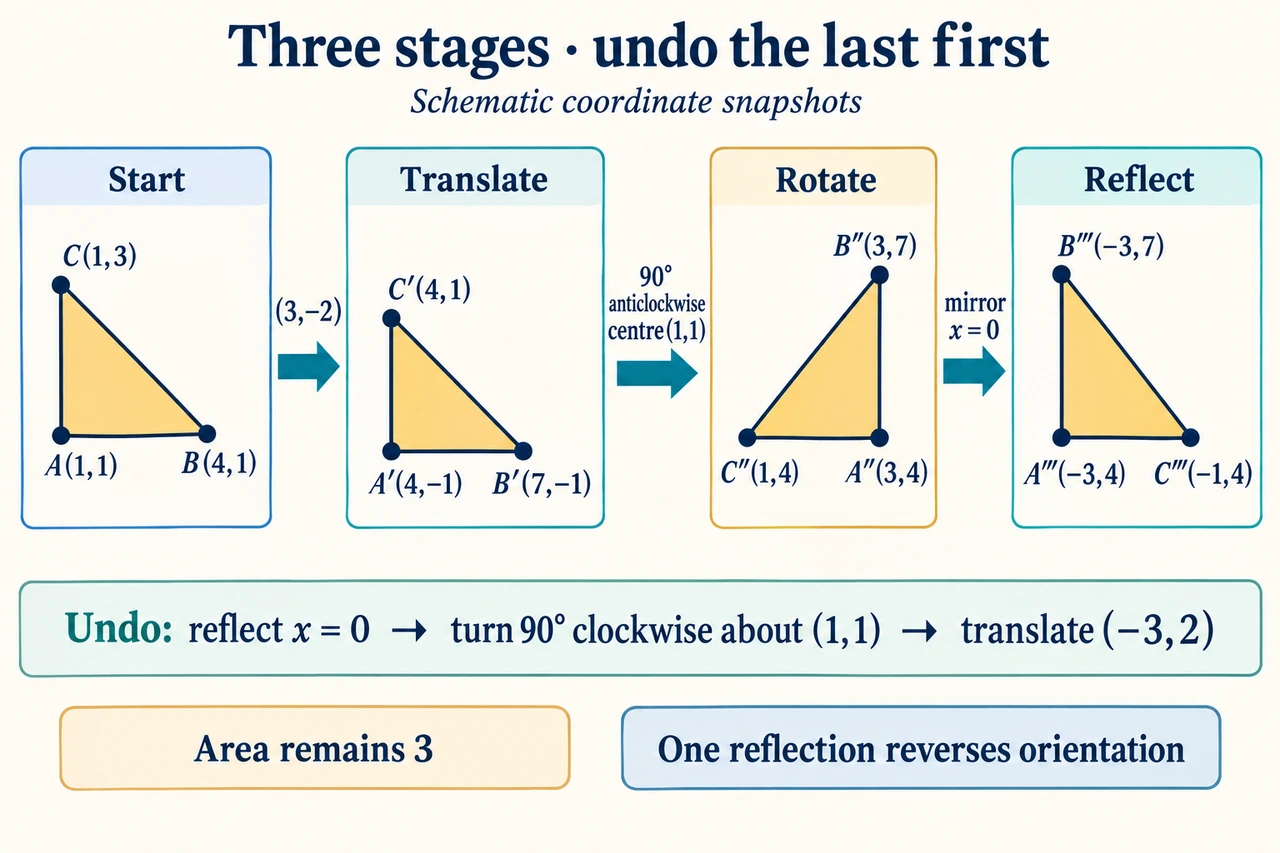
Original myAudience generated teaching illustration; accepted caption limits apply. · Original project artwork; no exam-board figures or textbook illustrations reused.
Three transformations: reverse the route and check what survives
Three transformations require the same disciplined process as two: each instruction acts on the most recent image. Make a table with original vertices and one column for each stage. A useful label sequence is A,A′,A″,A‴, keeping B and C aligned in the same rows. Start by recording complete parameters for every operation. A missing rotation centre or an unspecified mirror line makes the task ambiguous. Working in stages also localises mistakes: if the second column is correct but the third is wrong, there is no need to recalculate the entire route. The final transformation can sometimes be simplified, but a forced single label is less valuable than a correct complete sequence.
Use A (1,1), B (4,1), C (1,3). First translate by (3,−2) to get (4,−1),(7,−1),(4,1). Next rotate 90 degrees anticlockwise about (1,1). Subtract (1,1), apply the quarter-turn and restore the centre; this gives (3,4),(3,7),(1,4). Finally reflect in x=0 to obtain (−3,4),(−3,7),(−1,4). The last operation reverses orientation, but all three are rigid, so the ordinary area and side lengths remain unchanged. Coordinates should be checked at every stage rather than judging whether the final triangle sits in a plausible quadrant.
The stated composition has a general point rule. Translation gives (x+3,y−2). A 90-degree anticlockwise rotation about (1,1) sends a point (u,v) to (2−v,u), so the second stage gives (4−y,x+3). Reflection in x=0 negates the first coordinate and leaves the second unchanged, producing (y−4,x+3). This derives the complete mapping for every point. It is not the reflection in y=x, whose rule is (y,x). A diagram with reversed orientation does not justify identifying a particular reflection line. This lesson retains the complete three-stage description without requiring a new transformation vocabulary or a single equivalent label for the original task.
To undo the route, reflect the final triangle in x=0, rotate 90 degrees clockwise about (1,1), then translate by (−3,2). The first inverse stage recovers (3,4),(3,7),(1,4), the second recovers (4,−1),(7,−1),(4,1), and the third recovers (1,1),(4,1),(1,3). Reflection is its own inverse; the quarter-turn reverses direction; the translation vector changes both signs. Reversing the operation order is essential. The inverse general rule is (x,y)→(y−3,x+4), found by solving the forward relations or by composing these inverse instructions. Substituting either rule into the other returns the original general point.
Reversing the original instructions is a different operation from taking the inverse. Reversed order keeps each instruction unchanged: reflect first in x=0, rotate anticlockwise about (1,1), then translate (3,−2). It gives final vertices (4,−3),(4,−6),(2,−3), which differ from the stated route. An inverse changes instructions as well as reversing their order, so that the original image is recovered. This distinction matters in longer sequences where a learner may correctly reverse the list but forget to reverse a rotation direction or translation vector. Write both lists explicitly and apply them to actual coordinates before comparing their purposes.
Track ordinary area separately from orientation. Our original triangle has signed double area 6 using the labelled order A,B,C; the final stated triangle has signed double area−6. Both have ordinary area 3, the magnitude divided by 2. The single reflection accounts for the orientation reversal. The side displacements change direction, but squared lengths remain 9,13,4. A negative signed area is not a negative physical area, just a record of the labelled clockwise or anticlockwise ordering. Even these combined invariant checks do not identify where the triangle is: an incorrect translated reflection could share them. Vertex and general-point rules remain the authority for the full mapping.
The changed route turns the same original triangle 180 degrees about (−1,2), reflects in y=1, then translates by (−1,2). Its stages are (−3,3),(−6,3),(−3,1); then (−3,−1),(−6,−1),(−3,1); then (−4,1),(−7,1),(−4,3). The general rule reduces to (−3−x,y), which is reflection in x=−3/2. This simplification is justified by algebra and midpoint geometry: each point/image midpoint has x=−3/2 and corresponding y values agree. It does not follow merely from noticing an orientation flip. A half-turn about the wrong centre would produce a different mirror in the combined rule.
Complete answers should show intermediate coordinates, a correctly reversed inverse, and the checks that rule out common errors. The changed task illustrates when a single equivalent reflection can be established; the original task shows why a complete sequence can be retained without forcing a simpler name. Both stay within bounded Higher-tier combinations of rotations, reflections and translations under existing G 8. They do not introduce matrix methods, enlargement combinations, general isometry classification or additional official demands. Independent drawing/construction, assessment and complete qualification coverage remain open. The original mathematical data are exact, and any future illustration must support rather than replace these coordinate arguments.
Image: illustration, not a documentary photograph. Four separate coordinate snapshots show the original triangle; translation (3,−2) gives (4,−1),(7,−1),(4,1); a 90-degree anticlockwise rotation about (1,1) gives (3,4),(3,7),(1,4); reflection in x=0 gives (−3,4),(−3,7),(−1,4). The inverse strip reverses the route: reflect in x=0, turn 90 degrees clockwise about (1,1), then translate (−3,2). The one reflection reverses labelled orientation, while ordinary area remains 3 by the exact coordinate argument. Panels are schematic and separately arranged, not a shared calibrated plane; operator labels are not physically plotted centres or mirrors. Do not measure lengths, centres or area from pixels. No single-reflection simplification is claimed. 160 px is recognition only; the larger image and full accessible prose provide the complete stages and proof.
Worked example: For A (1,1), B (4,1), C (1,3), translate by (3,−2), then rotate 90 degrees anticlockwise about (1,1), then reflect in x=0. Give all stage vertices and a general point rule. Undo the route completely, compare the reversed unchanged instructions, and check lengths, ordinary area and orientation. Do not force a single-transformation name.
A complete stage table distinguishes inverse instructions from reversed unchanged instructions. General-point substitution proves the combined rule and any valid simplification, while exact inverse recovery tests all signs and centres. Use magnitude for ordinary area and sign only for orientation. Unchanged side lengths do not prove correct position, and a reversal of orientation alone does not identify a mirror line.
Answer: Translation gives (4,−1),(7,−1),(4,1). Rotation gives (3,4),(3,7),(1,4). Reflection gives final vertices (−3,4),(−3,7),(−1,4). The general rules compose as (x,y)→(x+3,y−2)→(4−y,x+3)→(y−4,x+3). Undo reflection to recover (3,4),(3,7),(1,4); rotate 90 degrees clockwise about (1,1) to recover (4,−1),(7,−1),(4,1); translate by (−3,2) to recover (1,1),(4,1),(1,3). The inverse rule is (y−3,x+4). Reversing the unchanged forward instructions instead gives (−1,1),(−4,1),(−1,3), then (1,−1),(1,−4),(−1,−1), then (4,−3),(4,−6),(2,−3), a different final image. Original and stated-final squared sides are 9,13,4. Ordinary area is 3 throughout; signed double area changes 6→6→6→−6 because the one reflection reverses orientation. No single reflection is asserted; the staged rule and exact inverse already specify the complete requested mapping.
Check your understanding: Instead rotate the original triangle 180 degrees about (−1,2), reflect in y=1, and translate by (−1,2). Give all stages, prove the equivalent single reflection, calculate the reversed-order final image and show every inverse stage. A student reports area−3 and says any order works: correct both claims.
Answer: The half-turn gives (−3,3),(−6,3),(−3,1). Reflection in y=1 gives (−3,−1),(−6,−1),(−3,1). Translation gives (−4,1),(−7,1),(−4,3). For a general point the half-turn is (−2−x,4−y), reflection gives (−2−x,y−2), and translation gives (−3−x,y). This is reflection in x=−3/2 because 2(−3/2)−x=−3−x and y is unchanged. Reversed unchanged instructions translate to (0,3),(3,3),(0,5), reflect to (0,−1),(3,−1),(0,−3), then turn to (−2,5),(−5,5),(−2,7): a different image. For the inverse translate final vertices by (1,−2) to recover (−3,−1),(−6,−1),(−3,1), reflect in y=1 to recover (−3,3),(−6,3),(−3,1), then use the same 180-degree turn about (−1,2) to recover all originals. Squared sides remain 9,13,4. Signed double area is−6 finally, but ordinary area is its magnitude divided by 2, namely 3; one reflection reverses orientation. The unequal reversed-order coordinates disprove the claim that any order works.
Why: A complete stage table distinguishes inverse instructions from reversed unchanged instructions. General-point substitution proves the combined rule and any valid simplification, while exact inverse recovery tests all signs and centres. Use magnitude for ordinary area and sign only for orientation. Unchanged side lengths do not prove correct position, and a reversal of orientation alone does not identify a mirror line.