Define a circle by its fixed distance, not its appearance
By UK GCSE Mathematics · independent study · myAudience
Original myAudience generated teaching illustration; accepted caption limits apply. · Original project artwork; no exam-board figures or textbook illustrations reused.
Define a circle by its fixed distance, not its appearance
A circle is a set of points in a plane at one fixed distance from a fixed point. The fixed point is the centre, and the fixed distance is the radius. Here the radius is positive: a distance of zero would leave just the centre, not the ordinary circle being discussed. This definition concerns the boundary. The region inside that boundary is a disc, although everyday language often uses “circle” for both. Distinguishing the boundary from the enclosed region matters when a question says that a point lies on a circle. A point near the centre belongs to the disc but is not on the circle.
The word radius can name either a length or a segment. If O is the centre and P lies on the circle, segment OP is a radius and its length is the radius of the circle. Different boundary points give different segments with the same length. The direction of the segment does not change that length: turning a compass with its opening fixed traces precisely this constant-distance boundary. A compass illustration explains the idea, but reading it does not demonstrate that someone has accurately used a compass. Practical drawing still needs a real instrument, a stated opening and a check of the result.
A diameter is a chord through the centre. Its two endpoints are on the circle, and the centre lies between them. The two parts from centre to endpoints are radii, so the whole diameter has length r + r = 2r. This argument establishes why doubling works rather than presenting an isolated formula. A segment from the centre to one boundary point is only half a diameter: its centre endpoint is not on the boundary. A chord that misses the centre is also not a diameter. Correct names therefore require both endpoint conditions and the centre-location condition, not merely a long-looking segment.
Coordinates can locate simple boundary points without using a circle equation. Take centre O = (−2,3) and radius 7. Moving 7 units horizontally left gives (−9,3); moving right gives (5,3). Moving vertically up gives (−2,10); moving down gives (−2,−4). In each case only one coordinate changes because the movement is along a coordinate direction. The horizontal pair forms one diameter and the vertical pair another. This is a small coordinate model based directly on the radius definition. The Higher-tier algebra lesson on x² + y² = r² remains a separate, existing lesson rather than being recreated here.
To decide whether a point is on, inside or outside this circle, compare its distance from O with 7. Equality places it on the boundary; a smaller distance places it inside; a larger distance places it outside. For instance, (−2,3) is distance zero from O, so it is inside rather than on. This classification does not depend on whether a drawing looks round. Unequal horizontal and vertical display scales can make a coordinate circle look like an oval. The mathematical object still comes from distances in an equal-unit plane; a stretched picture cannot supply a new radius or establish that a point lies on the boundary.
Changing the centre and changing the radius are different operations. Keeping radius 7 while moving the centre translates the whole circle. Keeping the centre while halving the radius draws a smaller circle with the same centre. In the changed task the diameter is 7, so the radius is 7/2, not 7. Use that exact fraction in both positive and negative directions from O. The old right-hand boundary point (5,3) does not remain on the new circle: it is still 7 units from O, which is greater than the new radius. A familiar point is not automatically preserved when the defining distance changes.
Information about a diameter should be read as information about two radii. If the diameter is 7 centimetres, the compass opening for the corresponding circle is 3.5 centimetres. Opening the compass to 7 centimetres would instead make a diameter of 14 centimetres. Conversely, two segments with equal length do not automatically belong to the same circle: their starting points may be different centres. To justify one circle, identify the common centre and the common distance. This separates the mathematical definition from a collection of approximately circular objects and prevents a measurement statement from silently turning into a location statement.
A useful check is to write three pieces of evidence beside every proposed diameter: both endpoints are on the circle, the segment passes through the centre, and its length is twice the radius. Beside a radius, write the centre endpoint, the boundary endpoint and the fixed distance. These checks explain the original and changed answers below, including why their numbers differ even though the centre stays fixed. This lesson develops circle language and a bounded coordinate application. Circumference and area formulae, arc length, sector area and observed independent construction remain separate work. Exact statements and calculations carry the reasoning; measurements from a future illustrative picture will not replace them.
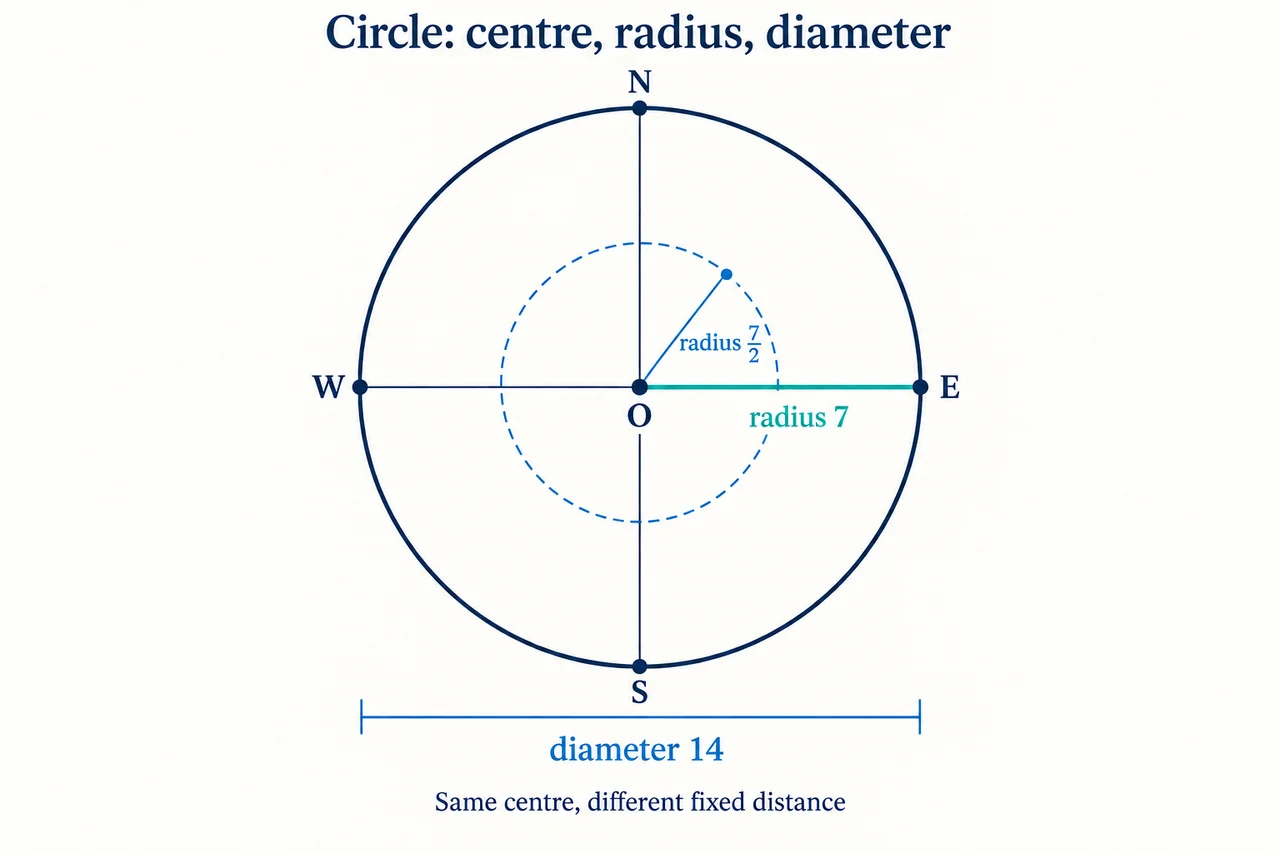
Image: illustration, not a documentary photograph. The outer circle has centre O, radius 7 and diameter WE of length 14. N and S are the other outer axis endpoints. The dashed circle shares O and has radius 7/2; its endpoints do not coincide with the outer endpoints. The illustration explains the radius-to-diameter and changed-radius relationships, not the offset coordinate positions in the worked task. Exact lengths and coordinates come from the complete prose, not pixel measurement. The 160 px image is recognition only; open the larger image and full accessible lesson for labels and reasoning.
Worked example: A circle has centre (−2,3) and radius 7. Give its four axis-aligned boundary points, two diameters and their lengths. A student calls a segment from the centre to (5,3) a diameter. Correct it.
Use the fixed-distance definition and endpoint conditions together. A diameter has two boundary endpoints and passes through the centre; a radius starts at the centre. Recover radius by halving a supplied diameter before locating points. Check each coordinate displacement and the whole diameter independently. A correct-looking drawing cannot compensate for a wrong compass opening or an unstated centre.
Answer: With O = (−2,3), move horizontally or vertically by the radius 7. The boundary points are W(−9,3), E(5,3), N(−2,10) and S(−2,−4). Segment WE passes through O and has length 5 − (−9) = 14; segment NS passes through O and has length 10 − (−4) = 14. Both are diameters and therefore chords. Their halves WO, OE, NO and OS are radii of length 7. Segment OE is not a diameter: one endpoint is the centre rather than a second boundary point. The same endpoint check prevents treating any convenient centre-to-boundary segment as a chord. Each listed point has distance 7 from O along one coordinate direction, so its boundary status is justified directly.
Check your understanding: Keep centre (−2,3) but diameter 7. Recalculate all four axis-aligned boundary points and explain why copying the previous point (5,3) is incorrect.
Answer: The new diameter 7 gives radius 7/2. From the unchanged centre (−2,3), the four boundary points are W(−11/2,3), E(3/2,3), N(−2,13/2) and S(−2,−1/2). Horizontal diameter length is 3/2 − (−11/2) = 14/2 = 7; vertical diameter length is 13/2 − (−1/2) = 14/2 = 7. Each centre-to-boundary segment has length 7/2. The previous point (5,3) is 7 units to the right of the centre, so it is outside the new circle rather than on it. Copying that point would confuse diameter with radius. Keeping fractions exact makes both the boundary coordinates and the length checks agree; rounding to whole coordinates would change the problem.
Why: Use the fixed-distance definition and endpoint conditions together. A diameter has two boundary endpoints and passes through the centre; a radius starts at the centre. Recover radius by halving a supplied diameter before locating points. Check each coordinate displacement and the whole diameter independently. A correct-looking drawing cannot compensate for a wrong compass opening or an unstated centre.