Chord, diameter and tangent: count the boundary contacts
By UK GCSE Mathematics · independent study · myAudience
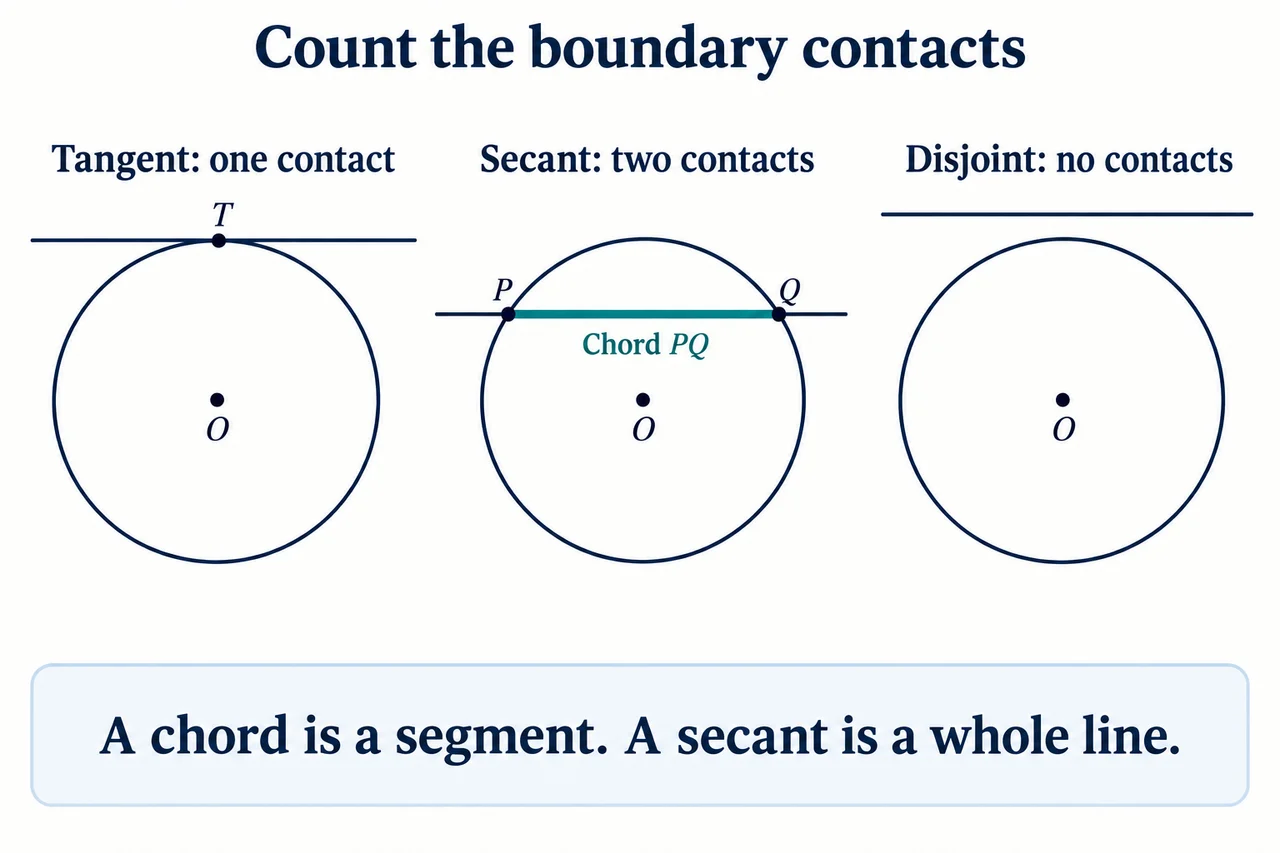
Original myAudience generated teaching illustration; accepted caption limits apply. · Original project artwork; no exam-board figures or textbook illustrations reused.
Chord, diameter and tangent: count the boundary contacts
A circle boundary and a straight line can meet in different ways. A tangent has exactly one boundary contact, a secant has two distinct boundary intersections, and a disjoint line has none. These descriptions concern the whole line, which continues in both directions. A segment is only a finite part of a line. Saying that a drawn line meets one named point of the circle does not establish that it meets no other point. The number of contacts is part of the information needed to classify it, not a fact that can always be read from a crowded sketch.
A chord is a segment whose two endpoints lie on the circle. Its interior usually lies inside the disc, but the endpoint definition is the starting point. A diameter is a particular chord passing through the centre. Every diameter is therefore a chord, whereas not every chord is a diameter. This is an inclusion relationship, not a choice between mutually exclusive labels. A radius is different: one endpoint is the centre, which is not on the boundary of a positive-radius circle. Calling every straight segment in a circle a chord would lose this distinction and make statements about diameters unreliable.
Fix the coordinate reference before using numerical line positions. In our model the centre is explicitly O = (0,0), and the radius is 5. The axis endpoints are W(−5,0), E(5,0), N(0,5) and S(0,−5). WE and NS are diameters because they join opposite boundary points through O. WN joins two boundary points without going through O, so it is a chord but not a diameter. ON is a radius. These conclusions use the positions and endpoint conditions together. If the centre had a different vertical coordinate, the same horizontal line equations would describe different relative positions.
The line y = 5 meets this circle only at N and is tangent there. The line y = 3 crosses the boundary twice and is secant. The line y = 6 lies above the whole circle and is disjoint. The task supplies the contact counts explicitly; the diagram is not being asked to prove them by eye. For y = 3, the finite segment between its two boundary intersections is a chord. The whole infinite secant line extends beyond that segment, so it should not be called a chord. Keeping the word line distinct from segment avoids naming an unbounded object as though it had the two required endpoints.
A line through a boundary point can still be secant. Suppose P and Q are distinct points on the same circle and the straight line passes through both. It has at least those two contacts and is the secant through them; the segment PQ is its chord. Saying that it “touches P” is too vague to identify a tangent. In ordinary geometry a tangent has only one boundary contact, not simply one contact that the speaker happens to mention. A diagram with a small gap between labelled points does not license merging them or deleting the second intersection.
Nearness is also different from equality. If a second boundary intersection lies extremely close to P, the points can still be distinct. A low-resolution picture may hide that separation. Conversely, two printed labels placed near one another do not prove that there are two geometrically different points. Use the statement of the problem, a justified construction or a mathematical argument to settle the relationship. The limiting idea of a secant approaching a tangent can be useful later, but it does not let a learner reclassify an actual two-point intersection merely because its drawing looks nearly tangent.
Rotating a valid circle-and-line configuration preserves the contact type: tangent, secant and disjoint are not synonyms for horizontal, slanted and vertical. The tangent can have any direction depending on where it meets the circle. Stretching an illustration unequally can distort angle appearance, so do not use its pixels to prove a right angle. The Higher-tier circle-theorem unit will explain why the radius at a contact point is perpendicular to the tangent. This definitions lesson does not borrow that theorem without its conditions, and it does not repeat the existing Higher algebra lesson that calculates a tangent equation from an origin-circle model.
For a classification answer, name the object first, list its endpoints or full boundary-contact count, and then apply the appropriate definition. Multiple labels can be correct: a diameter is also a chord. Some labels are incompatible: a positive-radius centre-to-boundary segment is not a chord, and a two-contact line is not a tangent. The original and changed questions below test those distinctions with a stated origin and exact conditions. They do not assess independent drawing or compass accuracy. A future illustration must clearly distinguish finite segments from extended lines; its appearance remains a teaching aid rather than evidence that an unspecified contact has occurred.
Image: illustration, not a documentary photograph. Three separate circle-and-line examples show one boundary contact for a tangent, two distinct contacts P and Q for a secant, and a visible gap for a disjoint line. Only the finite segment PQ between secant contacts is highlighted as a chord; it misses the centre and is not a diameter. These diagrams explain contact types rather than plotting the specific y = 5, y = 3 and y = 6 coordinate lines. Full endpoint and contact conditions in the prose establish the classifications. The 160 px version is recognition only; use the larger image and accessible full teaching for detail.
Worked example: Radius 5 circle centred at O = (0,0) has axis points W, E, N, S. Classify WE, NS, WN, ON. The horizontal lines y = 5, y = 3, y = 6 have respectively 1, 2, 0 boundary contacts. Name their types and identify which are chords versus whole lines.
Classify from complete endpoint and contact conditions. Record the centre before interpreting line coordinates. Distinguish finite chord segments from infinite secant lines and distinguish one named contact from exactly one total contact. Preserve distinctness in near-coincident examples; low-resolution appearance never establishes equality or a tangent theorem.
Answer: The centre is O = (0,0), radius 5, so W(−5,0), E(5,0), N(0,5) and S(0,−5) are the four axis endpoints. WE and NS each join opposite boundary points through O: both are diameters and chords. WN joins two boundary points but misses O, so it is a chord and not a diameter. ON runs from centre to boundary, so it is a radius, not a chord. Using the supplied total contact counts, y = 5 is a tangent, y = 3 is a secant and y = 6 is disjoint. The secant line itself is infinite; only its segment between the two circle intersections is a chord. These classifications depend on the explicit origin and endpoint/contact information, not on the line seeming horizontal.
Check your understanding: A line passes through boundary point P and another boundary point Q distinct from P. A learner calls it tangent because it touches P. Correct the statement. If Q tends towards P in a drawing, may the drawn line alone establish a tangent?
Answer: Because P and Q are distinct boundary points on the line, it has two boundary intersections and is a secant. Segment PQ is a chord. The learner has confused “passes through P” with “has exactly one circle contact”. If Q remains distinct from P, however close it looks in a drawing, the two-point condition remains and the classification does not become tangent. A drawing alone cannot establish that Q has become P or that no second boundary intersection exists. A tangent conclusion requires a valid one-contact statement or an argument establishing that condition. Contact counts refer to the whole line, so cropping the picture near P cannot remove the second contact from the geometry.
Why: Classify from complete endpoint and contact conditions. Record the centre before interpreting line coordinates. Distinguish finite chord segments from infinite secant lines and distinguish one named contact from exactly one total contact. Preserve distinctness in near-coincident examples; low-resolution appearance never establishes equality or a tangent theorem.