An arc is a boundary; a sector and segment are regions
By UK GCSE Mathematics · independent study · myAudience
Original myAudience generated teaching illustration; accepted caption limits apply. · Original project artwork; no exam-board figures or textbook illustrations reused.
An arc is a boundary; a sector and segment are regions
An arc is part of the circumference, so it is curved boundary rather than a straight segment or a filled region. A chord joins its two boundary endpoints along a straight segment. For two distinct non-antipodal endpoints, there are two possible connecting arcs: a minor arc and a major arc. Naming just the endpoints can therefore be ambiguous. Specify minor or major, identify a third point on the intended arc, or describe the direction around the circle. This is a matter of selecting the intended boundary, not calculating its length.
A sector is a region bounded by two radii and their selected connecting arc. Begin at the centre, travel along one radius to its boundary endpoint, follow the chosen arc, and return along the other radius. A minor sector usually uses the shorter arc, while the complementary major sector uses the longer arc. The choice must be stated. Sector does not mean triangle: one part of its boundary is curved. Nor is a sector the arc itself, because an arc is a boundary path and a sector includes the points enclosed by its three boundary parts.
A segment is the region bounded by a chord and a selected arc with the same endpoints. Its straight boundary is the chord, not two radii. This produces the cap-shaped region often shown near the edge of a circle. There are complementary minor and major segments when the chord is not a diameter. A word such as “segment” also has a general straight-line meaning in geometry, so say circular segment when the context needs clarity. The chord is a line segment; the circular segment is a two-dimensional region. Confusing these two objects loses both their boundary conditions and their dimensional meaning.
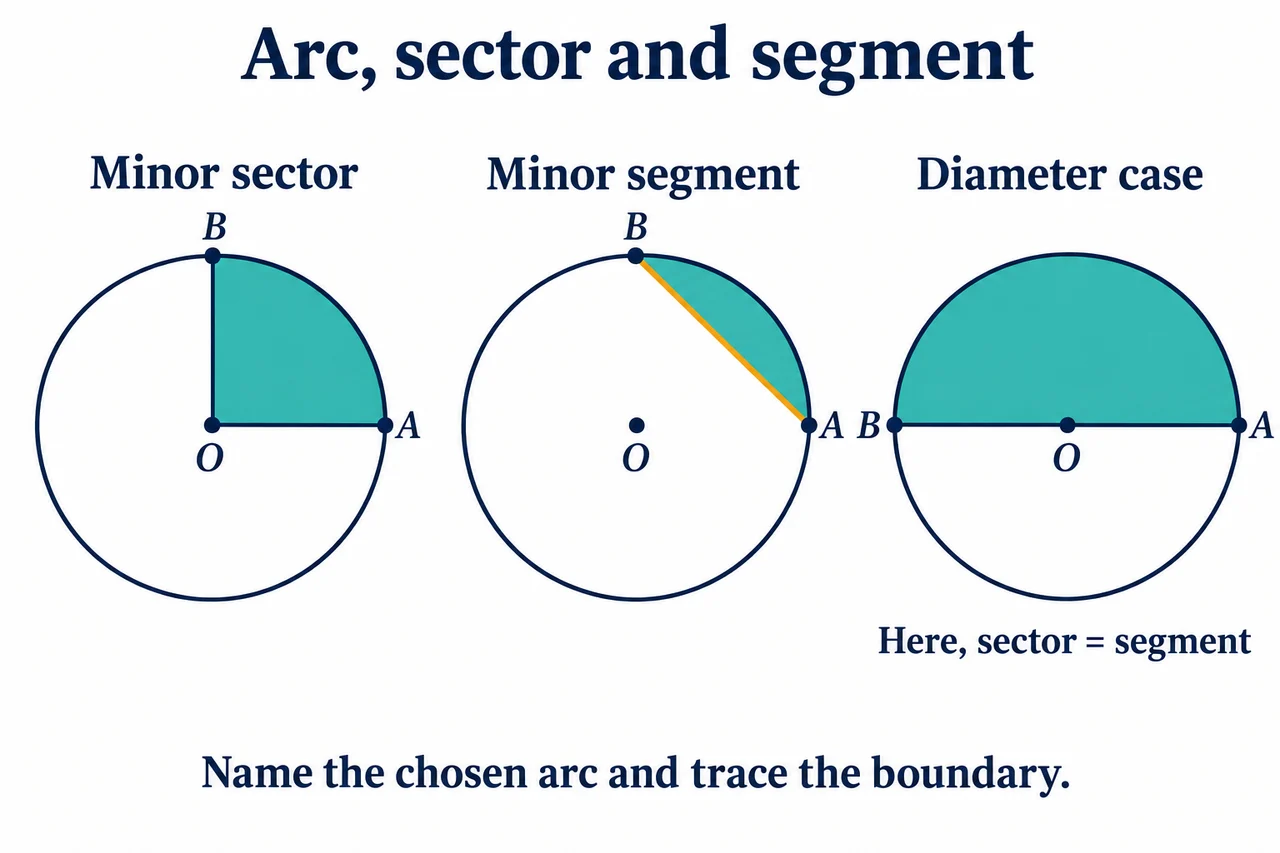
For a concrete comparison, let A be the east endpoint and B the north endpoint of a circle with centre O. The minor arc runs through the northeast quarter. The major arc goes the other way round through the remaining three quarters. The minor sector is bounded by OA, OB and the northeast arc. The minor circular segment is bounded by straight chord AB and that same arc. They are different regions. The sector contains triangle OAB as well as the circular segment, whereas the segment excludes the triangle interior. This relationship identifies the regions without introducing an area formula.
Complementary regions should not be assigned by vague shading. For this same chord, the major segment is everything on the other side of chord AB within the disc, including the centre. The major sector instead follows the major arc between the two radii. These are not generally the same region, even though both are larger than their minor partners in this example. Trace each boundary with a finger or a written list before accepting a label. A coloured patch can hide whether its straight boundary consists of a chord or two radii; the written conditions settle the distinction.
The diameter case is an important exception to an overgeneral rule. Move B to the west endpoint opposite A. Radii OA and OB now lie on one straight line and together form diameter AB. Choose the upper semicircle. The upper sector has the diameter and the upper arc as boundary; the corresponding upper circular segment has exactly that same diameter and arc as boundary. The regions coincide. Thus the statement “a sector and a segment are always different” is false. The earlier quarter-circle example demonstrated a typical difference, not a theorem that survives every allowed endpoint position.
For opposite endpoints neither semicircle is shorter, so minor and major are not useful labels. Say upper or lower in a fixed diagram, specify another point, or give an unambiguous route. With east and north endpoints, the short route from east to north is anticlockwise in the usual coordinate orientation, while the clockwise route is the longer one. With different endpoints or a different starting point, the direction must be reconsidered rather than memorised. Clockwise and anticlockwise describe movement around the circle; they do not by themselves choose a region unless the start and endpoint are also fixed.
A complete identification explains the boundary and, where necessary, the chosen side of it. The worked and changed answers below compare a quarter-circle configuration with the diameter boundary case. Neither requires circumference, arc-length or sector-area calculation, which belong to later requirements. A future image should use separate uncluttered regions and visible radius/chord labels, with no invented area numbers. Reading such an image does not assess independent circle drawing. Keep this lesson’s claim bounded: it teaches how to distinguish and name arcs, sectors and circular segments, including a counterexample to a tempting universal statement.
Image: illustration, not a documentary photograph. With A east and B north, the first circle shades the minor sector bounded by radii OA and OB and the northeast arc. The second shades only the minor segment bounded by chord AB and that same arc; the centre and triangle OAB are excluded. The third uses opposite diameter endpoints and shades an upper semicircle, where the corresponding sector and segment have the same boundary and coincide. No area or arc-length formula is depicted. Exact definitions and the selected arc, not approximate shading or pixel measurement, carry the reasoning. The 160 px image is recognition only; open the larger picture and complete accessible prose.
Worked example: A and B are east and north endpoints of a circle. Identify the minor arc,major arc,minor sector and minor segment. Are the sector and segment the same region? Give their boundaries.
Identify objects by their complete boundaries and state which arc is selected. Separate curved boundary from straight chord and two-dimensional region. Check exceptional endpoint arrangements before claiming a universal difference. The diameter case is a counterexample with matching boundaries, not a claim that all sectors and segments coincide.
Answer: With A east and B north, the minor arc AB follows the northeast quarter of the circumference. The other route is the major arc and covers the remaining three quarters. The minor sector is enclosed by radii OA and OB and the minor arc. The minor circular segment is enclosed by chord AB and the minor arc. They are not the same region: the minor sector includes triangle OAB together with that segment, while the segment is the cap beyond the chord and excludes the triangle interior. The distinction is established by the straight boundary components, not by approximate shading. No arc-length or area formula is needed. Choosing the major arc instead would select different complementary regions and must be stated explicitly.
Check your understanding: Move B to the west endpoint, keeping A east. Can a semicircular sector and a semicircular segment now be the same region? Specify which half; explain why endpoints alone do not choose it.
Answer: Yes: choose, for example, the upper semicircle with A east and B west. The two radii OA and OB are opposite halves of one diameter, so the upper sector boundary is diameter AB together with the upper semicircular arc. The upper circular segment has that same chord, which is now a diameter, and the same arc. The two regions therefore coincide. The lower half supplies another matching pair. Endpoints A and B alone do not select upper rather than lower, and the arcs have equal lengths, so neither is the uniquely minor arc. Specify a side, another boundary point or a route. This valid diameter configuration disproves the claim that a sector and its corresponding segment must always differ.
Why: Identify objects by their complete boundaries and state which arc is selected. Separate curved boundary from straight chord and two-dimensional region. Check exceptional endpoint arrangements before claiming a universal difference. The diameter case is a counterexample with matching boundaries, not a claim that all sectors and segments coincide.