Central and circumference angles: prove the relationship with the right arc
By UK GCSE Mathematics · independent study · myAudience
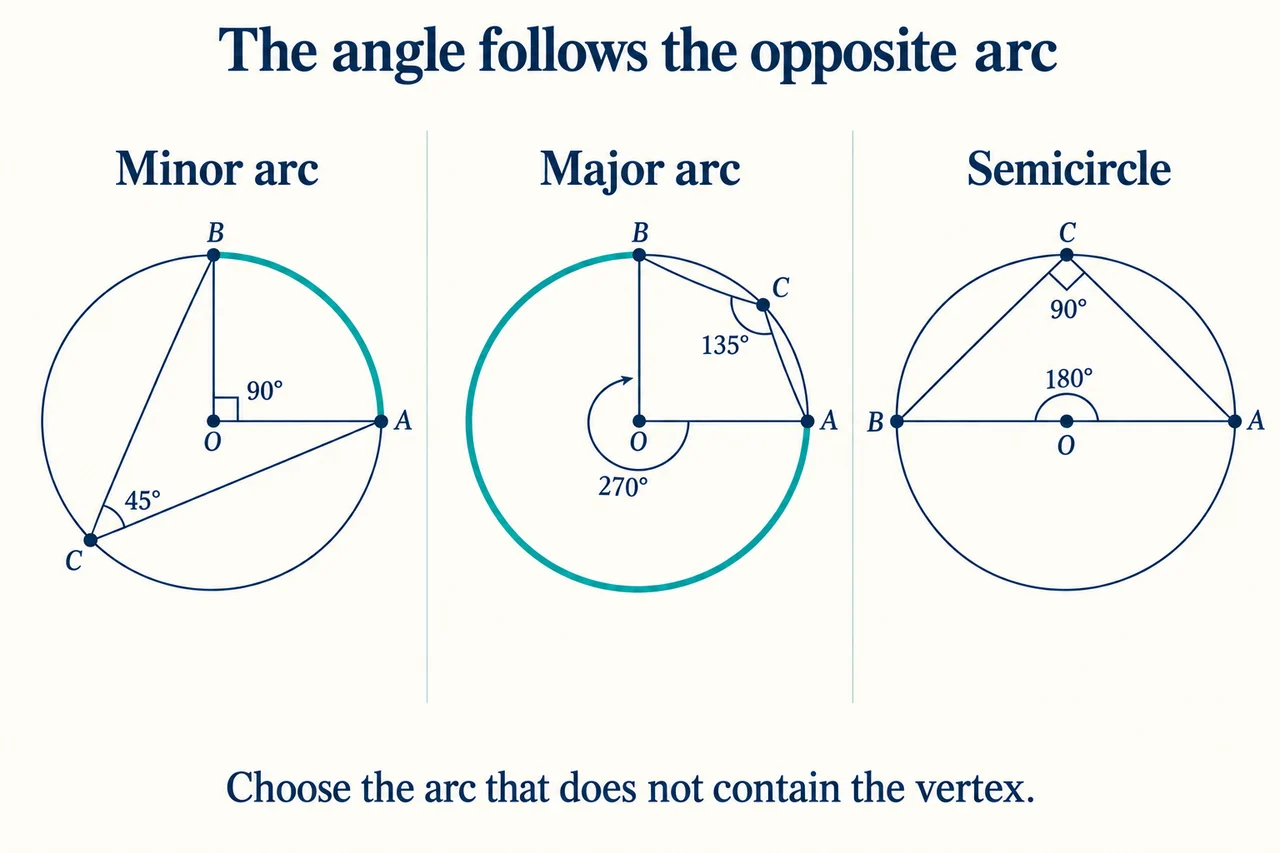
Original myAudience generated teaching illustration; accepted caption limits apply. · Original project artwork; no exam-board figures or textbook illustrations reused.
Central and circumference angles: prove the relationship with the right arc
A circumference angle is formed by chords joining a boundary vertex C to two other distinct boundary points A and B. The central angle to compare with it must subtend the same arc AB that does not contain C. This arc choice is part of the theorem. It is not always the minor central angle printed nearest the chord. The relevant central angle can be reflex when C lies on the minor arc. Exclude collapsed cases with repeated endpoints: a zero-length chord or a vertex equal to A or B does not provide the ordinary triangle and angle used in the proof.
Join the centre O to A, B and C. The three segments OA, OB and OC are radii and therefore have equal length. Triangles OAC and OBC are consequently isosceles, so each has equal base angles. Write α for angle ACO and β for angle OCB when the ray CO lies inside angle ACB. The angles at the centre of those two triangles are 180° − 2α and 180° − 2β. This step uses a triangle angle sum and equal radii, not the central-angle theorem being proved. Establishing the smaller triangle facts first avoids a circular argument.
In that inside-ray configuration, angle ACB is α + β. The two central angles just calculated occupy the route from A through the side containing C to B. The remaining central angle, along the arc AB that excludes C, is 360° − (180° − 2α) − (180° − 2β) = 2α + 2β. It is therefore twice angle ACB. The remaining angle may be smaller than 180° or larger than 180°, depending on where C lies. Keeping the actual arc route in the argument handles the reflex case instead of silently replacing it with the minor angle.
If ray CO lies outside angle ACB, define α and β as the ordinary angles between CO and CA, and between CO and CB. The circumference angle is now the difference |α − β|, not their sum. The corresponding isosceles-triangle central angles differ by |(180° − 2α) − (180° − 2β)| = 2|α − β|. That difference follows the arc AB excluding C and again gives twice the circumference angle. If CO coincides with CA or CB, the three points on that ray form a diameter situation; avoid pretending that a flattened triangle is an ordinary isosceles triangle. Use the other radius triangle and the straight 180° angle to obtain the same result.
When AB is a diameter, either arc AB is a semicircle with central angle 180°. A boundary vertex C different from A and B lies on one of those semicircles and subtends the other. The theorem gives angle ACB = 90°. This is the angle-in-a-semicircle result, with its endpoint and boundary hypotheses intact. A right-looking angle drawn near a circle is not enough: its two rays must end at the ends of a diameter, and its vertex must be on the circle. Likewise, moving C inside the disc would remove the circumference-vertex condition and would not preserve this conclusion.
Two boundary vertices on the same side of chord AB lie in the same segment and subtend the same opposite arc. Applying the central-angle relation to each gives the same circumference angle. This derives the same-segment result from a shared arc rather than from the apparent similarity of two triangles. Vertices on opposite sides of the chord subtend different complementary arcs, so their angles need not be equal. In the changed task the two values are 58° and 122°. Their supplementary sum can be checked, but the reasoning here is still the explicit selected-arc argument; a complete cyclic-quadrilateral treatment remains further work.
In the original algebraic task, the central angle is (5x + 6)° and the circumference angle on the opposite arc is (2x + 11)°. Use the stated relationship to write 5x + 6 = 2(2x + 11), giving x = 16. Substitution produces 86° and 43°. Check the geometry as well as the algebra: both are positive, the stated central angle is minor, and doubling 43° gives 86°. An equation can have a numerical solution that violates the described angle domain in another task. Reject such a configuration rather than accepting every solved value automatically.
The changed model fixes a minor central angle of 116°. A vertex on the major arc sees that minor arc, so its angle is 58°. A vertex on the minor arc instead sees the major arc, whose central angle is 360° − 116° = 244°; its angle is 122°. This comparison exposes the error in halving the same printed number for every boundary vertex. Draw or describe the chosen arc before calculating. This Higher-tier lesson develops selected circle proofs and complete original transfers, not assessed mastery of every circle theorem. Alternate-segment reasoning and a complete cyclic-quadrilateral proof remain explicit next work.
Image: illustration, not a documentary photograph. Three distinct circle examples show a 90-degree central angle with a 45-degree circumference angle on the opposite arc; a reflex 270-degree central angle with a 135-degree circumference angle whose vertex lies on the minor arc; and a diameter giving 180 degrees at the centre and 90 degrees at the boundary. Highlighted arcs exclude the circumference vertex. These are separate illustrative values, not the 86/43 or 116/58/122 worked models. The full prose explains inside-ray, difference and diameter cases and selects the appropriate arc. The 160 px version is recognition only; exact proof and legible detail are available in the larger image and accessible lesson.
Worked example: A chord subtends central angle(5x + 6)° and circumference angle(2x + 11)° at a vertex on the opposite arc. Find x and both angles; check the stated minor central-angle domain.
State the boundary vertex and the arc excluding it before applying an angle theorem. Prove the sum, difference or diameter case from equal radii and elementary angle facts. Keep the selected central angle reflex when necessary. Algebraic substitution must pass positive-angle and minor/reflex domain checks. The same-segment conclusion requires vertices on the same side of the chord, not merely two vertices somewhere on the circle.
Answer: The circumference vertex is on the opposite arc, so both given expressions refer to the same subtended minor arc. Therefore 5x + 6 = 2(2x + 11) = 4x + 22. Subtracting 4x and 6 gives x = 16. The central angle is 5(16) + 6 = 86°, while the circumference angle is 2(16) + 11 = 43°. Both are positive; 86° lies between 0° and 180° as required for the stated minor central angle; and 2 × 43° = 86°. The proof relationship comes from equal-radius isosceles triangles and the appropriate sum or difference of their angles, not from guessing the picture. Without the vertex’s arc-location condition the same minor-angle expression could not simply be used.
Check your understanding: A chord has minor central angle 116°. One circumference vertex lies on the major arc and another on the minor arc. Find both angles and explain why simply halving116° for both is wrong.
Answer: For the vertex on the major arc, the opposite arc is the minor one with central angle 116°, giving circumference angle 116°/2 = 58°. For the vertex on the minor arc, the opposite arc is the major one with central angle 360° − 116° = 244°, giving circumference angle 244°/2 = 122°. These angles sum to 180°, which independently checks the complementary-arc calculation. Halving 116° twice would assign the wrong arc to the second vertex. Both vertices must remain distinct from the chord endpoints and on the circle; a point inside the disc does not satisfy the theorem’s circumference-vertex condition. The difference in angles follows from arc selection, even if a rough sketch makes the two angles appear similar.
Why: State the boundary vertex and the arc excluding it before applying an angle theorem. Prove the sum, difference or diameter case from equal radii and elementary angle facts. Keep the selected central angle reflex when necessary. Algebraic substitution must pass positive-angle and minor/reflex domain checks. The same-segment conclusion requires vertices on the same side of the chord, not merely two vertices somewhere on the circle.