Chord bisection and tangent lengths: identify the congruent triangles
By UK GCSE Mathematics · independent study · myAudience
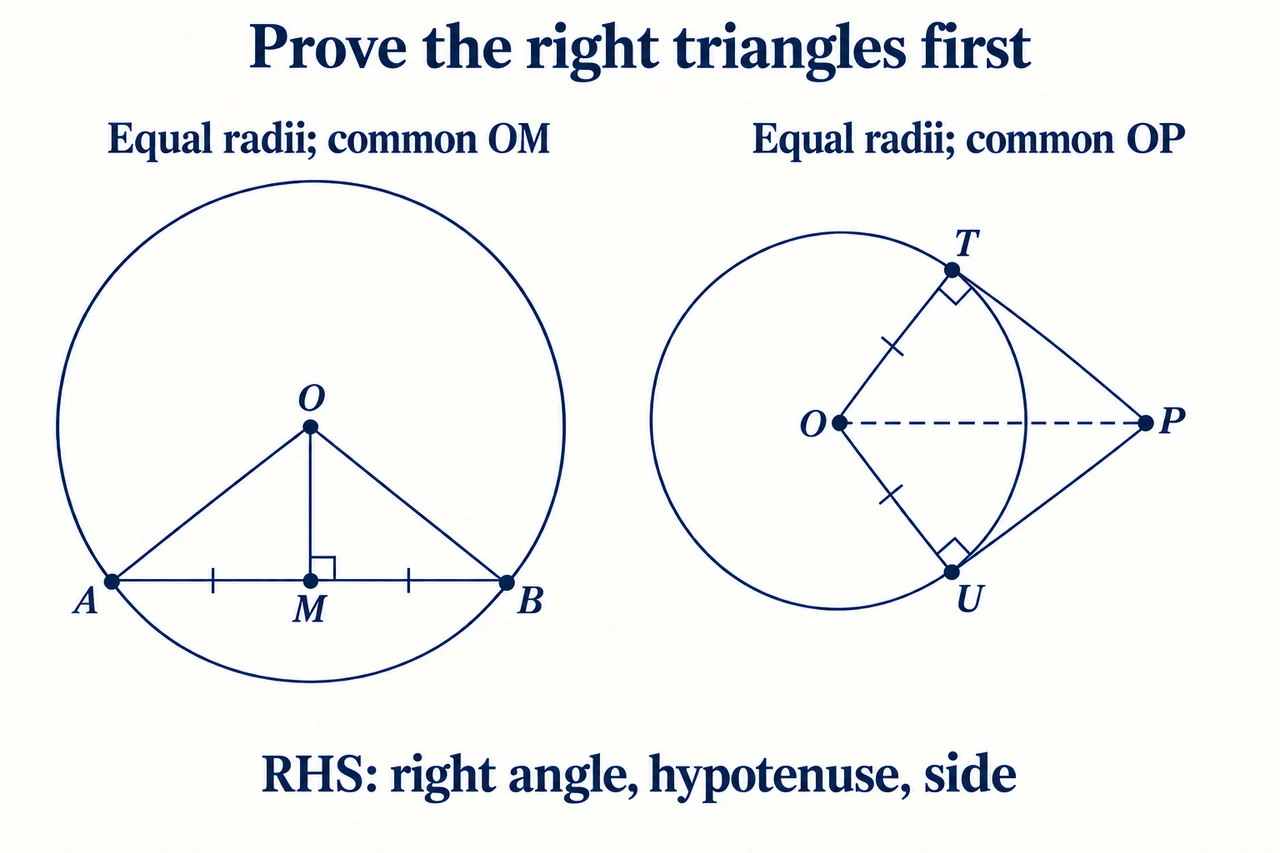
Original myAudience generated teaching illustration; accepted caption limits apply. · Original project artwork; no exam-board figures or textbook illustrations reused.
Chord bisection and tangent lengths: identify the congruent triangles
Circle proofs often compare two triangles, but the correspondence and the right-angle premises must be established before naming a congruence criterion. Let AB be a genuine chord of a circle with centre O, and let OM be perpendicular to the line AB at M. For a chord that is not a diameter, O is outside that line, so OAM and OBM are ordinary right triangles. Their hypotenuses OA and OB are equal radii, and OM is common. Those stated facts prepare a valid RHS comparison. Equal-looking halves of a chord are not a substitute for the right angle, radius equality and common leg.
RHS proves triangles OAM and OBM congruent, with A corresponding to B and M to M. Hence AM = BM, so the centre perpendicular bisects the chord. The foot M lies within AB: if it lay beyond an endpoint, the two equal-radius right triangles would still give equal endpoint distances from M, contradicting that one endpoint lies strictly between M and the other. For a diameter, the centre already lies between the endpoints and the two radii directly show bisection. In that special case OM has zero length, so do not call OAM an ordinary right triangle or apply RHS to a collapsed figure.
The converse also needs careful bookkeeping. Suppose M is the midpoint of a non-diameter chord AB. Then OA = OB by the radius definition, AM = BM by the midpoint hypothesis, and OM is common. SSS, not a guessed right angle, proves triangles OAM and OBM congruent. Their angles at M are equal and fill a straight angle because A, M and B are collinear. Each is therefore 90°, showing OM perpendicular to AB. If the chord is a diameter, M = O and the zero-length segment OM has no direction. The midpoint statement stays true, but this particular converse cannot assign a perpendicular direction to that zero segment.
Why is a tangent perpendicular to the radius at contact? Let a line touch the circle only at T. If OT were not perpendicular to the line, the perpendicular foot N from O to that line would be closer to O than T is. Since OT is the radius, N would be inside the disc. A complete line through an interior point exits the circle boundary on both sides, giving two boundary contacts rather than one. That contradicts tangency. The radius must therefore meet the tangent at 90°. Conversely, if a line through T is perpendicular to OT, every other point P on it has OP² = OT² + TP² greater than the radius squared, so it has no second boundary contact.
Now let P be outside a circle, and suppose its two tangents meet the circle at T and U. The established radius-tangent fact supplies right angles at T and U. Triangles OTP and OUP have equal hypotenuse OP and equal radius legs OT and OU. RHS proves their congruence and then PT = PU. Do not put the desired tangent equality into the criterion as a premise: it is the consequence. This is an equality of lengths, not a claim that the two tangent segments overlap or point in the same direction. A point inside the circle cannot supply this external-tangent configuration.
For the first original calculation, a radius-13-centimetre circle has chord AB of length 24 centimetres. The perpendicular-bisection result gives AM = BM = 12 centimetres. Pythagoras in OAM then gives OM² = 13² − 12² = 25 square centimetres, so OM = 5 centimetres. Choose the positive root because OM is a length. The theorem justifies the half-chord before the numerical calculation; using 24 as the triangle leg would make the expression negative and would ignore the actual triangle. The earlier area proof established the Pythagoras relationship, while broader applied trigonometry remains separate curriculum work.
In the separate tangent model, the circle radius is 5 centimetres and OP = 13 centimetres. At either contact the radius and tangent are perpendicular, so PT² = 13² − 5² = 144 square centimetres and PT = 12 centimetres. The other tangent has the same length by the RHS argument. The changed data exchange the known legs: a chord of length 10 in a radius-13 circle has half-chord 5 and centre-distance 12; a radius-12 circle with OP = 13 has tangent length 5. Similar familiar numbers must not be copied into the same roles when the givens have changed.
Check the geometry before taking a square root. An exterior point must have OP greater than the radius for a nonzero tangent segment; OP equal to the radius puts the point on the circle, and OP smaller than the radius makes it interior. A negative value for OP² − r² therefore signals an invalid exterior-point premise, not a mysterious negative length. This Higher-tier lesson develops selected chord and tangent proofs plus two changed numerical models. It does not claim that a learner has constructed tangents, proved every circle result or mastered all Pythagoras and trigonometry applications. Future illustrations must show genuine chord endpoints, contact points and right-angle locations; those geometric facts cannot be repaired merely by a caption.
Image: illustration, not a documentary photograph. The left circle shows a centre perpendicular OM to chord AB, equal radius hypotenuses OA and OB and a common right-triangle leg OM. The right shows two tangents from external P, equal radii OT and OU, a common hypotenuse OP and right angles at the genuine contact points T and U. These are proof-structure illustrations without numerical length labels; they do not depict the exact 13/12/5 worked scales. The complete prose establishes each RHS premise before deriving chord bisection or equal tangent lengths, and handles diameter and interior-point exceptions. The 160 px version is recognition only; use the larger diagram and accessible full explanation for detail.
Worked example: Circle radius 13 cm has chord 24 cm and perpendicular from centre to chord. Find its distance. Separately a radius 5 cm circle has external point distance 13 cm from centre; find both tangent lengths and prove equality.
Before RHS, identify both right angles, the hypotenuse pair and the matching other side. Prove chord halves or tangent equality only after congruence. Use SSS for the midpoint converse rather than assuming perpendicularity. Separate diameter and zero-segment degeneracies. Check exterior-point and positive-length conditions, choose the positive root and preserve square-versus-length units. Equal numbers in a new task do not retain their earlier geometric roles.
Answer: For the chord, OA = OB = 13 cm and the centre perpendicular OM is common to right triangles OAM and OBM. RHS establishes AM = BM, so each is 12 cm. Pythagoras gives OM² = 13² − 12² = 169 − 144 = 25 cm², hence OM = 5 cm. The separate tangent circle has radius 5 cm and external-centre distance OP = 13 cm. The radius-tangent result makes both contact triangles right-angled. They have common hypotenuse OP and equal radius legs, so RHS establishes equal tangent lengths. Each satisfies PT² = 13² − 5² = 144 cm², giving PT = PU = 12 cm. Equality of tangents is deduced after congruence, not inserted as a premise. In each model the positive root and units agree with the requested length.
Check your understanding: Change the first chord to 10 cm in radius 13 cm; then use external-centre distance 13 cm with circle radius 12 cm. Find both new distances and diagnose a claim that the old 5 cm and 12 cm outputs remain in the same roles.
Answer: The new chord is 10 cm, so each half is 5 cm once perpendicular bisection has been justified. Its distance from the centre satisfies OM² = 13² − 5² = 144 cm², giving OM = 12 cm. In the new tangent circle the radius is 12 cm and OP is 13 cm; each tangent satisfies PT² = 13² − 12² = 25 cm², giving length 5 cm. RHS again proves the two tangent lengths equal from the common hypotenuse and equal radius legs. The old outputs do not remain in the same roles: the changed known leg changes the unknown leg. If OP were less than the circle radius, OP² − r² would be negative and the claimed exterior-point tangent configuration would be impossible. This is a failed hypothesis, not permission to report a negative or imaginary physical length.
Why: Before RHS, identify both right angles, the hypotenuse pair and the matching other side. Prove chord halves or tangent equality only after congruence. Use SSS for the midpoint converse rather than assuming perpendicularity. Separate diameter and zero-segment degeneracies. Check exterior-point and positive-length conditions, choose the positive root and preserve square-versus-length units. Equal numbers in a new task do not retain their earlier geometric roles.