Recover a missing vertex from geometry, not the outline of the sketch
By UK GCSE Mathematics · independent study · myAudience
Original myAudience generated teaching illustration; accepted caption limits apply. · Original project artwork; no exam-board figures or textbook illustrations reused.
Recover a missing vertex from geometry, not the outline of the sketch
Coordinates locate points, while geometric conditions connect them. To recover a missing vertex, use both kinds of information rather than extending whichever outline a sketch seems to suggest. This lesson stays in two dimensions and can use all four quadrants. In a quadrilateral named ABCD, the letters ordinarily run around its boundary; A to C and B to D are diagonals, not adjacent sides. Changing that order changes which coordinates must be joined. Record the consecutive-vertex statement before choosing a formula or constructing the fourth point.
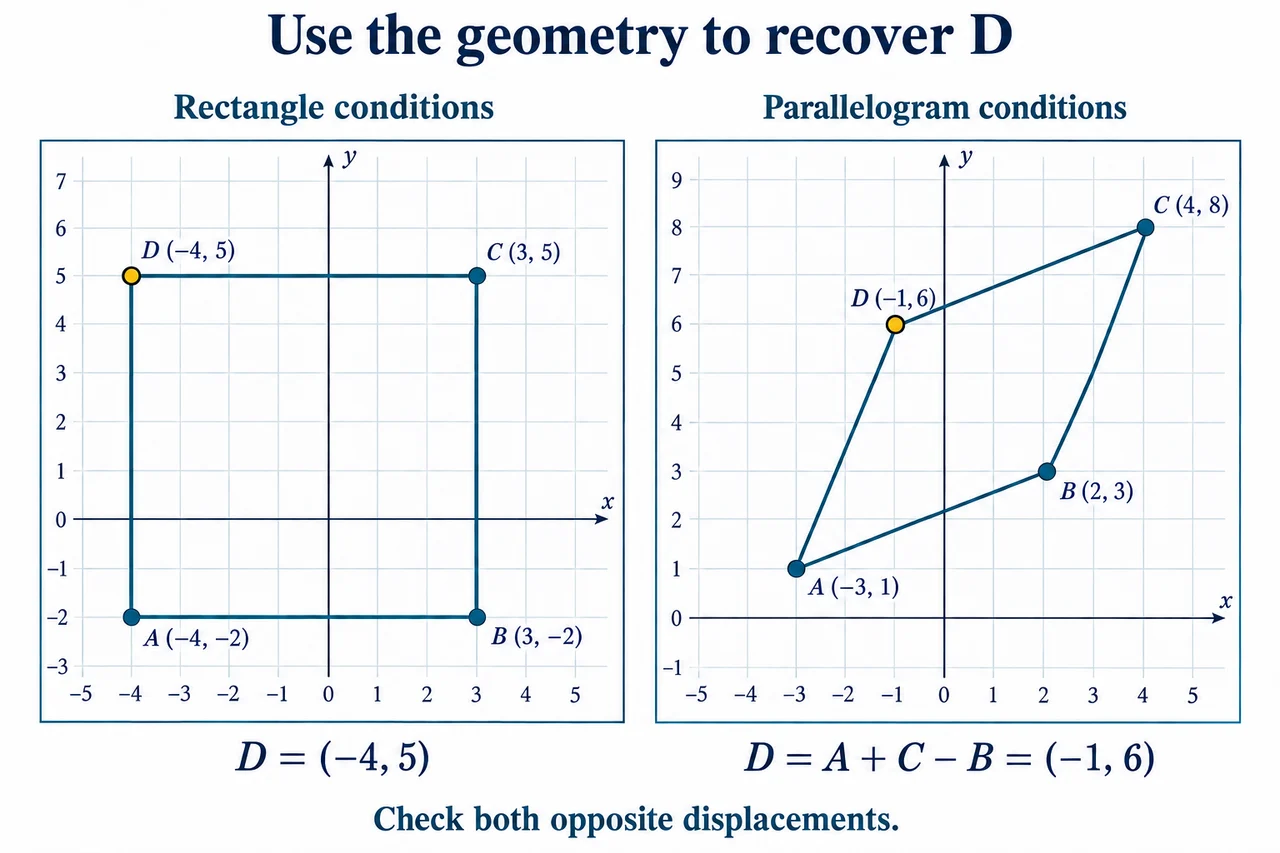
For an axis-aligned rectangle, horizontal edges share a vertical coordinate and vertical edges share a horizontal coordinate. Let A = (−4,−2), B = (3,−2) and C = (3,5) be consecutive vertices. AB is horizontal and BC vertical. The missing D shares A’s horizontal coordinate −4 and C’s vertical coordinate 5, so D = (−4,5). This choice closes the rectangle with CD horizontal and DA vertical. It is justified by the axis alignment and boundary order, not by a rule to mix coordinates indiscriminately in every shape.
Check more than one condition. AB has displacement (7,0) and DC also has displacement (7,0); BC and AD both have displacement (0,7). Opposite sides are therefore parallel with equal lengths, and adjacent sides are horizontal and vertical, giving right angles in an equal-unit Cartesian plane. Here both side lengths happen to be 7 units, so this rectangle is also a square. Rectangle did not automatically mean square: if the vertical extent had been 6, the rectangle conditions would still hold but the equal-side condition would fail. State the extra length comparison that establishes the stronger classification.
A midpoint averages the two endpoint coordinates because moving halfway along a straight segment halves each component of its displacement. The diagonal AC has midpoint ((−4 + 3)/2,(−2 + 5)/2) = (−1/2,3/2). Diagonal BD gives the same midpoint. This agrees with the proved parallelogram property that the diagonals bisect each other. Neither midpoint has to be a labelled edge vertex or an integer grid point. Rounding a half-coordinate to a nearby integer would move the point and break the bisection check. Keep exact fractions when the data demand them.
For a general parallelogram with consecutive vertices A, B and C, the move from A to D is the same as the move from B to C. Thus D = A + (C − B), component by component. This is a coordinate expression of equal, parallel opposite sides, not an arbitrary addition trick. Also D to C has the same displacement as A to B. Both checks help detect a sign or vertex-order error. The rule assumes that the named points are the stated consecutive vertices of an ordinary nondegenerate parallelogram. If B were instead the opposite vertex, that correspondence would be wrong.
Apply the rule to A = (−3,1), B = (2,3), C = (4,8). The B-to-C displacement is (2,5), so adding it to A gives D = (−1,6). AB and DC both have displacement (5,2), while BC and AD both have displacement (2,5). The diagonal midpoint is (1/2,9/2) for both AC and BD. Choosing D = (−1,3) by copying the vertical coordinate from B would give AD = (2,2), which is not the required B-to-C move. The failed displacement identifies the exact condition violated by the proposed answer.
Parallel opposite sides do not, by themselves, prove a rectangle. The changed configuration is a parallelogram, but the given parallelism does not supply a right angle. In contrast, the original axis-aligned configuration had a separate horizontal-versus-vertical reason for right angles. Keep these two arguments distinct. Equal diagonal midpoints prove the bisection relationship here, not that every adjacent angle is 90°. More advanced coordinate tests involving gradients can support further classification when their conditions are taught and stated, but they are not silently assumed in this bounded both-tier reconstruction task.
A reliable answer records the vertex order, derives the missing displacement or shared coordinate, checks both opposite side pairs and then checks the two diagonal midpoints. If a stronger name such as square or rectangle is requested, supply the extra right-angle or equal-side evidence it needs. The original and changed questions below show why a familiar sketch can conceal a wrong coordinate. This lesson supports selected 2D coordinate geometry under existing G11. Richer Higher-tier algebraic compound-shape proofs, independent accurate drawing and assessed transfer remain further work. A future plotted illustration must put every labelled vertex in its stated location with equal-unit axes where angle appearance is meaningful.
Image: illustration, not a documentary photograph. The first equal-unit coordinate plot joins A(−4,−2), B(3,−2), C(3,5) and D(−4,5); horizontal and vertical sides give a rectangle, and their equal lengths make this example a square. The second joins A(−3,1), B(2,3), C(4,8), D(−1,6) as a parallelogram; no right-angle conclusion follows merely from opposite parallel sides. The recovered D values and complete displacement/midpoint checks are explained in prose. Labelled coordinates, not estimates from a small image, establish the exact positions. The 160 px version is recognition only; open the larger plot and accessible lesson for labels and full proof.
Worked example: A(−4,−2), B(3,−2), C(3,5) are consecutive vertices of an axis-aligned rectangle. Find D and diagonal midpoint; check opposite side displacements and decide whether it is also a square.
Respect consecutive vertex order before applying D = A + C − B. Use both opposite displacement comparisons and both midpoint calculations to catch a wrong sign or copied coordinate. Keep fractions exact. Distinguish parallelogram evidence from a separate right-angle condition and rectangle evidence from a separate equal-adjacent-side condition. A correct-looking outline is not a coordinate proof.
Answer: Because AB is horizontal and BC vertical, the fourth vertex shares A’s x coordinate and C’s y coordinate: D = (−4,5). The AC midpoint is ((−4 + 3)/2,(−2 + 5)/2) = (−1/2,3/2), and BD gives the same result. AB = (7,0) as a displacement, matching DC; BC = (0,7), matching AD. Horizontal and vertical adjacent sides meet at right angles, and both side lengths are 7 units. Hence this particular rectangle is also a square. The square conclusion needs the equality of the side lengths in addition to the rectangle conditions; it does not follow merely from the word rectangle. Both exact midpoint computations independently check the diagonal bisection.
Check your understanding: A(−3,1), B(2,3), C(4,8) are consecutive vertices of a parallelogram. Find D and diagonal midpoint. A learner chooses (−1,3) by copying y from B. Correct it and state whether supplied parallelism alone proves a rectangle.
Answer: Consecutive vertices require AD to equal the B-to-C displacement (4 − 2,8 − 3) = (2,5). Adding that to A = (−3,1) gives D = (−1,6). The AC midpoint is (1/2,9/2), and the BD midpoint is ((2 − 1)/2,(3 + 6)/2) = (1/2,9/2). AB and DC both have displacement (5,2), and BC and AD both have displacement (2,5). The proposed D = (−1,3) gives AD = (2,2), failing the required opposite-side correspondence. The corrected data establish a parallelogram. Parallelism alone does not prove a rectangle; unlike the original axis-aligned task, there is no supplied horizontal-versus-vertical right-angle condition. Each stronger classification needs its own additional justified evidence.
Why: Respect consecutive vertex order before applying D = A + C − B. Use both opposite displacement comparisons and both midpoint calculations to catch a wrong sign or copied coordinate. Keep fractions exact. Distinguish parallelogram evidence from a separate right-angle condition and rectangle evidence from a separate equal-adjacent-side condition. A correct-looking outline is not a coordinate proof.