Stave 1: narrator, isolation and a business that forgets people
By UK GCSE English Literature · independent study · myAudience
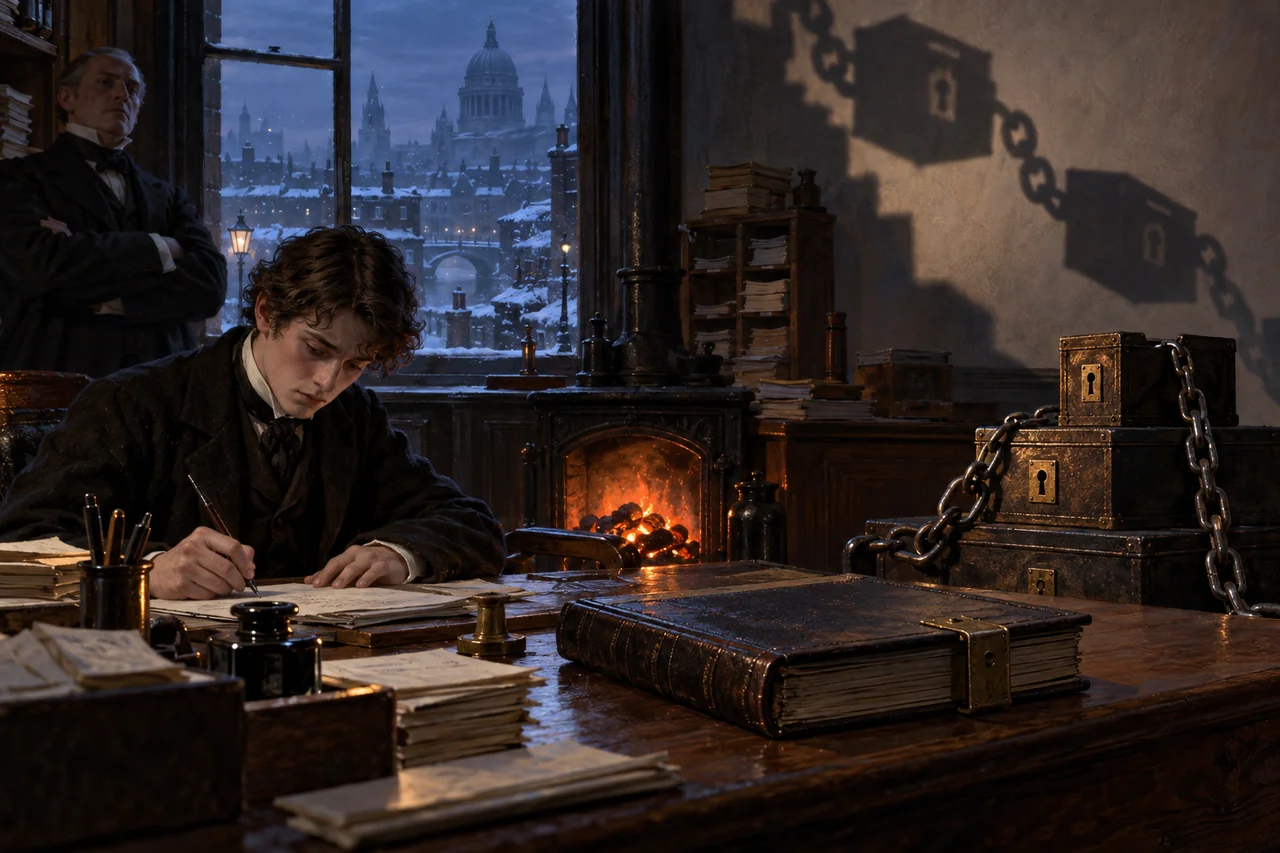
Image: illustration, not a documentary photograph. · Original generated conceptual literature illustration; independently reviewed original artwork.
Stave 1: narrator, isolation and a business that forgets people
The opening does two things that appear to pull in different directions. It insists that Marley is dead, supplying the language of registers, signatures and official witnesses; then the narrator interrupts himself to discuss the absurdity of calling a door-nail dead. The factual insistence prepares the supernatural event, while the digression establishes a companionable voice that is willing to joke with a reader. Neither effect should be reduced to a device label. If Marley might simply be alive, the later apparition would lose its significance. If the opening were only a legal certificate, it would lack the storyteller’s warmth. Dickens makes an apparently cold fact the beginning of a relationship between narrator and reader, before showing how little Scrooge values such relationships.
Scrooge enters through accounts of conduct as well as through description. He makes a bargain on the day of Marley’s funeral, retains their shared business name and accepts either name when people address him. These details connect his identity to a commercial partnership, but they do not prove that all trading is wicked. The problem is the narrowing of value: even a death becomes an occasion on which a profitable transaction remains possible. The narrator’s accumulation of grasping actions makes that judgement energetic rather than neutral. A careful response distinguishes the narrator’s moral presentation from a photograph of a real merchant. Scrooge is being constructed for a story whose judgement will later change, and the exaggerated introduction supplies a starting point against which that change can be measured.
The cold imagery reaches beyond weather. Scrooge carries his own temperature and fails to thaw even at Christmas. His inward disposition seems to govern his surroundings, so a setting that might ordinarily explain discomfort instead reflects a character’s resistance to other people. The narrator’s comparison with an oyster is worth treating as an interpretive problem. An oyster can suggest a shut, inaccessible interior; readers may also associate it with a valuable thing concealed inside. The first inference is strongly supported by the nearby descriptions of secrecy and isolation. The second is a possible forward-looking reading, strengthened by the eventual transformation, but it should not be asserted as a certainty about Dickens’s intention. Analysis becomes more persuasive when it ranks evidence rather than treating every association as equally established.
The counting-house turns that inward cold into a relationship of power. Bob works beside a very small fire, and Scrooge controls access to the coal. This is not merely a decorative contrast between gloomy and cheerful rooms: the employer’s decisions regulate another person’s comfort. Fred’s arrival supplies a different response to Christmas, founded on goodwill rather than calculation of profit. Scrooge’s refusal allows the reader to hear competing values in dialogue. An answer that says only that Fred is happy and Scrooge is sad misses the argument. Fred can acknowledge that Christmas has not made him richer while still defending its worth. Dickens therefore separates financial return from a different kind of human value without suggesting that material resources do not matter.
The charitable collectors test what Scrooge includes within his responsibilities. He asks about prisons and workhouses, and treats the existence of institutions as grounds for withholding assistance. His claim that he pays for them is an attempted justification, not a statement the narrator endorses. The collectors’ reply that some people cannot go and others would rather die exposes the gap between provision on paper and a person’s experience. Historical information about nineteenth-century relief can clarify the terms, but the literary argument begins with this exchange. Do not replace the scene with an unsupported claim that every poor person in 1843 faced an identical choice. Scrooge’s language makes the suffering of others seem distant and administratively settled; the narrative will bring individual consequences back into view.
Marley’s arrival initially meets a defensive explanation. Scrooge associates the ghost with something he might have eaten, reducing a disturbing encounter to digestion. This comic scepticism keeps the supernatural from becoming an unexamined instruction delivered to a perfectly obedient pupil. The sound, appearance and distress of the apparition gradually disrupt that defence. A ghost story can give visible form to what ordinary social conversation has failed to make Scrooge recognise. That does not mean ghosts should be treated as documentary proof of an afterlife. Within the novella’s invented world, the encounter creates a moral test: will a person who insists on narrow explanations hear a claim about wider obligations? The genre matters because it makes evaded consequences return as a presence that cannot easily be dismissed.
The chain turns responsibility into an image that can be inspected. Marley says that he forged it in life, link by link, through his own will. Its association with business objects makes it more specific than a general symbol of punishment. The habits that seemed to establish successful ownership become a burden he carries. The emphasis on gradual making is crucial: the chain represents accumulated choices, rather than a single accidental error. Scrooge is invited to recognise a similar pattern in himself, but the warning is delivered while he is still alive. This difference prevents the lesson from becoming simply a verdict that he is beyond repair. Marley cannot undo his own history; Scrooge can potentially alter the conduct through which his future is being formed.
The scene finally challenges the meaning of business itself. Marley’s lament enlarges responsibility beyond the counting-house towards human beings and their welfare. Dickens has first made commercial language familiar, then shown its limits and redirected it. This creates a useful whole-text argument: the opening does not merely present a bad man for readers to reject; it establishes values that later scenes will put under pressure. In a close response, move from an exact detail to an explanation of its effect, then test that explanation elsewhere. The cold office can be connected to the increased coal and changed employment relationship at the end. Such a link shows structural development, while leaving room for the counterargument that the narrator’s early caricature also seeks immediate moral judgement.
Image: illustration, not a documentary photograph. Imagined counting-house and symbolic business chain. The scene connects controlled warmth with accumulated responsibility; it does not establish the appearance of Dickens’s characters or a real office. This original conceptual rendering is an interpretation; use the primary text and lesson prose as evidence.
Worked example: How does the opening prepare a judgement of Scrooge that can later be revised? Develop a complete analytical response using the counting-house and Marley’s chain.
Start with a claim that explains movement, rather than listing characteristics: Dickens presents isolation as a pattern of choices whose consequences can become visible. This gives the response something to test across the opening. It does not claim that Scrooge is secretly generous already or that the ending is inevitable. The chain and the controlled coal supply will be connected through responsibility, while their differences remain important: one is a supernatural representation of accumulated conduct, the other an everyday exercise of power over an employee.
Locate the small fire and Scrooge’s control of coal before naming a method. Bob’s discomfort establishes an effect on another person, so the cold has an ethical dimension as well as an atmospheric one. Explain how an employer’s refusal narrows the use of his resources. Do not infer an exact wage, temperature or medical injury: the text supplies enough to discuss controlled comfort without invented measurements. This detail also prevents a response from treating isolation as a wholly private matter that harms only Scrooge himself.
Select the chain’s making, not just its existence. Marley’s assertion that he forged it through repeated actions gives the image a temporal structure: a present burden has been assembled over a life. Explain the connection between business objects and the habits they represent. A metaphor label alone would not show why that particular chain matters. The image reverses the idea that possessions necessarily give freedom, since items associated with ownership now constrain the owner. Keep that as an interpretation of the story’s arrangement, not a universal rule about wealth.
Compare the two scenes without flattening them into the same event. Scrooge can still choose what happens in the office, whereas Marley speaks from an irreversible condition. The encounter therefore creates both warning and opportunity. A reader can condemn Scrooge’s conduct and still recognise that the narrative is opening a possibility of change. This is why a thesis about revision is stronger than simply saying the opening makes him evil: it accounts for the timing of the ghost’s intervention while also preserving the force of the initial judgement.
Test the argument against a difficult detail. The narrator’s grasping verbs and exaggerated cold plainly encourage dislike; a response should not pretend that the opening is morally undecided. Instead qualify the claim: the opening begins with severe judgement, but translates it into habits and choices that can be interrupted. The ending’s changes to the office provide a structural check, rather than proof that every opening image has one secret meaning. Refer to the increased coal and altered care of Bob to show a concrete reversal of the employer’s earlier practice.
Finish by joining judgement to narrative purpose. The paragraph should explain why Dickens uses both ordinary workplace detail and supernatural warning: each makes responsibility visible at a different scale. Read the response aloud and remove any sentence that merely repeats a method name or asserts that all readers must feel an identical emotion. Retain the distinction between evidence and interpretation, and make the whole-text connection earn its place by showing an actual change. A conclusion can sharpen this judgement without adding a new unsupported contextual fact.
Answer: Dickens initially makes Scrooge’s coldness a practice that affects others, rather than merely a dislikeable mood. In the counting-house he controls the coal that could warm Bob, turning personal reluctance into an employer’s decision. Marley’s chain then gives a visible form to a lifetime of similarly narrowed responsibility: its repeated making suggests consequences assembled through choices. The scenes differ because Scrooge still has time to act, while Marley cannot recover the life he has spent. The opening therefore encourages condemnation without making reform meaningless. Its workplace detail also prepares a concrete measure of change: increased coal and a different relationship with Bob at the end reverse an earlier exercise of power. The narrator’s caricature remains severe, but the warning turns that judgement towards conduct that might be interrupted.
Check your understanding: Changed task: explain how the opening’s humour affects its moral seriousness. Use the narrator’s door-nail discussion and Scrooge’s explanation of the ghost through digestion. Is the judgement weakened?
Answer: Humour creates distance from solemn certainty without removing the judgement. The narrator’s door-nail digression makes the insistence on Marley’s death entertaining and establishes an accessible storyteller. Scrooge’s digestive explanation has a different purpose: it displays his attempt to reduce a moral disturbance to an ordinary bodily cause. The reader can enjoy the wit while noticing that this explanation becomes inadequate as Marley’s distress continues. These comic moments therefore need not cancel the seriousness of the warning. They make the encounter a contest between ways of understanding it, rather than a command instantly accepted by Scrooge. A competing reading could emphasise how comedy delays fear; that is persuasive if it also explains why the delay leads into, rather than replaces, the ghost’s account of responsibility.
Why: Worked-method rationale: the response links a concrete workplace action with an image of accumulated consequences and tests the link against the severe caricature. It avoids confusing explanation with excuse or treating business objects as proof that all commerce is condemned. Changed-method rationale: the second response gives two kinds of humour different roles, separating the narrator’s welcome from Scrooge’s defence. It allows an alternative account of comic delay but asks it to explain the passage’s continuing seriousness. Neither task has an official assigned mark; the strength lies in supported distinctions.