Stave 2: remembered exclusion without automatic absolution
By UK GCSE English Literature · independent study · myAudience
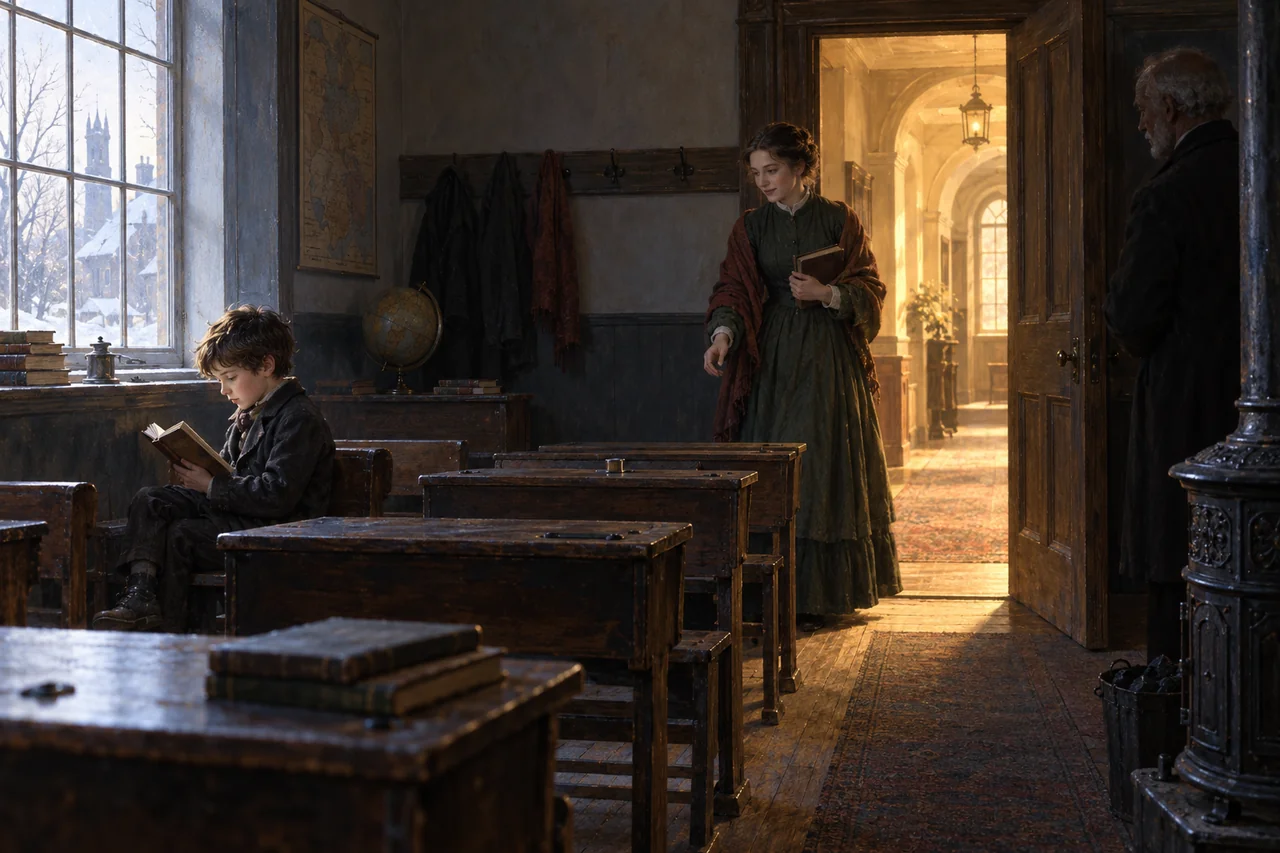
Image: illustration, not a documentary photograph. · Original generated conceptual literature illustration; independently reviewed original artwork.
Stave 2: remembered exclusion without automatic absolution
The Ghost of Christmas Past does not simply deliver a list of facts about Scrooge’s childhood. It places the adult beside scenes that he remembers and makes him watch his younger self. That arrangement creates two responses at once: the reader encounters a neglected boy, and sees the older man affected by recognising him. A statement about plot would say that Scrooge returns to his school. An analytical statement explains why the return matters now. Memory brings a suffering person close enough to disturb the adult’s habitual detachment. The past is not presented as an excuse that cancels everything that follows, but as evidence with which his present behaviour must enter a relationship. The reader therefore has to hold sympathy and responsibility together.
The school’s emptiness is more important than a general claim that it is frightening. Large, cold and poorly used spaces make the child’s abandonment visible, while other children have gone home for the holidays. The repeated negatives and small sounds intensify the absence of ordinary company. It would be easy to import a modern diagnosis and turn this into an explanation of every later choice, but that would go beyond the text. The scene shows loneliness and the adult’s tears; it does not provide a clinical account of personality. Its literary force lies in changing scale. A character first introduced through a hostile public description is now encountered as a particular child, within a setting whose neglect the reader can imagine.
Books give that child imagined companions. Scrooge recalls figures from stories with an excitement unlike the controlled manner his business acquaintances know. This does not mean that reading is a complete solution to abandonment. The contrast shows both the resource available to him and the absence that makes it necessary. The adult alternates between delight at fictional companions and pity for the boy himself, so the passage refuses a simple account of an entirely happy refuge. Notice how the narrator records a voice and face changed by recognition. Analysis should connect these outward signs to the movement of the scene: a person formerly presented as closed begins to respond, but his response is still emotional rather than proof of sustained reform.
The remembered child leads Scrooge to think of the carol singer whom he rejected the previous evening. This is a small but significant transfer. The past does not remain a sentimental spectacle about himself; it suggests that another young person deserved a different response. The wish to have given something is limited, since the opportunity has already passed and the child is not present to receive it. That limit makes the scene useful for an argument about regret. Feeling can reveal a missed duty without repairing it. A careful answer therefore distinguishes an emerging recognition from a completed act. Later parts of the novella will test whether such wishes become conduct, rather than asking the reader to accept tears as sufficient evidence of a changed life.
Fan’s arrival changes the emotional pattern. She brings the prospect of home and repeatedly addresses Scrooge as her brother. The welcome counters the earlier separation, while her report that their father has grown kinder suggests that family relationships themselves can change. This is not a complete biography of the father or a licence to invent scenes of his earlier conduct. We know what Fan says within a remembered episode, and should keep the source of that information clear. Her small stature beside her eagerness gives the scene energy: she acts, persuades and leads her brother out. She is not merely a symbol of kindness without a role in the action. The welcome allows the adult to recover an experience of belonging that he now tends to refuse.
The later exchange about Fan’s child makes memory a test of present responsibility. Scrooge identifies her one child as his nephew, Fred. The Spirit does not need to provide a long moral lecture here: the juxtaposition exposes an inconsistency between affection for the remembered sister and rejection of her living son. Fred is not simply Fan reborn, and his invitation has value even without this family connection. Nevertheless, the connection makes Scrooge’s refusal harder to separate from his own emotional history. A strong response follows the narrative transition instead of collecting the school and Fan as isolated sad and happy scenes. What the adult recognises about the past changes what his present relationships can mean.
Sympathy should not be mistaken for acquittal. The novella can make a neglected child moving while showing that the grown man exercises power over others. A claim that his upbringing made every later choice unavoidable would remove the significance of the story’s interventions and final actions. Equally, a claim that the past is irrelevant would fail to account for the carefully constructed recognition. The more defensible position is that memory supplies reasons for understanding his isolation and opportunities to question its continuation. This keeps an interpretation open to awkward evidence. Scrooge can feel for the child he was before he learns to respond adequately to people who are not versions of himself.
When writing about this stave, organise by the movement from self-recognition towards another person, rather than by a catalogue of memories. Select the lonely child, the wish concerning the carol singer and the reminder of Fred, and explain what changes between them. A context paragraph about childhood in general would be less useful than analysis of these particular links. The scene’s emotional appeal is created through narrative arrangement, setting, remembered speech and the adult’s reactions. Those methods give an answer its evidence, while a whole-text reference to accepting Fred’s invitation later supplies a test of its consequence. The ending is not needed to erase the scene’s limits: it lets the reader ask whether the earlier recognition eventually becomes an altered relationship.
Image: illustration, not a documentary photograph. Imagined schoolroom, reader and remembered visitor. Adult observation and offered companionship suggest how memory can alter responsibility; hardship does not automatically excuse later conduct. This original conceptual rendering is an interpretation; use the primary text and lesson prose as evidence.
Worked example: Explain how Dickens moves from sympathy for the lonely child towards responsibility to the rejected carol singer. Why are Scrooge’s tears not enough to complete this movement?
Define the movement in the task before gathering evidence. The problem is not simply whether childhood was unhappy, but how recognition of an earlier self begins to affect a response to somebody else. Start with a thesis that holds two claims together: the scene makes isolation understandable and makes its repetition questionable. This prevents an answer from becoming either a defence of every later choice or a refusal to consider the past at all. The lonely school scene and the later wish belong to one developing sequence.
Locate the child within the nearly deserted school and explain the effect of particular absences. The setting should not be reduced to a label such as pathetic fallacy without examining what is missing: company, welcome and ordinary holiday belonging. The adult’s tears show that he recognises the experience, while the remembered literary companions reveal both imaginative comfort and continuing need. Keep the explanation rooted in what the narrator shows; do not infer a diagnosis or fill gaps with a fictional history of abuse.
Follow the change of focus to the singer rejected the previous night. Scrooge’s wish establishes a connection between his own remembered vulnerability and a child beyond that memory. The temporal detail matters because the missed opportunity cannot now be repeated exactly. Explain why this makes the wish a recognition of loss rather than a completed charitable act. A reader sees a possibility of care emerging, but the story has not yet shown him consistently practising it.
Use the distinction between emotion and action to refine the claim. Tears can demonstrate that the past is affecting him, but they cannot warm Bob’s workplace or provide the singer with anything. This is not an argument that emotion is useless. It is a claim that the novella’s sequence requires emotional recognition to develop into conduct. The answer should say what the evidence establishes now and what remains to be tested later, rather than giving the whole transformation to one moment of sorrow.
Introduce a counterclaim: perhaps the scene principally asks readers to forgive Scrooge because he once suffered. Acknowledge that the reader’s view becomes more sympathetic, then explain why the wish about another child moves the passage beyond self-pity. The scene does not withdraw the earlier evidence of his treatment of people. It adds a perspective through which that conduct can be questioned and possibly changed. This qualification makes the thesis stronger than a blanket statement that his past explains everything.
End with the narrative sequence, not an unsupported life lesson. Dickens places remembered exclusion before the thought of a present missed duty, making the past an active challenge to current habits. The answer should be coherent enough for a reader to follow each stage without a list of device names. Check that every assertion has an identified source in the scene and that terms such as sympathy, regret and responsibility are not being used as synonyms. A later act of generosity may confirm a development, but it cannot make the earlier missed opportunity vanish.
Answer: Dickens first makes Scrooge encounter loneliness as an individual experience rather than as a distant category. The nearly deserted school and the adult’s tears give the reader a view absent from the hostile opening portrait. The thought of the rejected carol singer then transfers that recognition beyond Scrooge’s own past: he wishes that he had given the child something. The wish is significant because it admits a missed duty, but it remains a wish. Tears neither provide the singer with help nor establish a durable change in conduct. The sequence therefore makes sympathy a starting point for responsibility, rather than an excuse that settles it. Although the scene encourages a more forgiving view of Scrooge, its move towards another child prevents the past from functioning only as an occasion for self-pity.
Check your understanding: Changed task: explain why the reminder that Fred is Fan’s child matters. Does it make the nephew’s invitation valuable only because of the family connection?
Answer: Fan’s remembered welcome gives Scrooge an experience of belonging that contrasts with his current refusal of Fred. Identifying her child as his nephew makes the reader see those episodes together: affection for the sister sits uneasily beside rejection of her son. The connection does not make Fred valuable only as a substitute for Fan. His invitation and goodwill have already offered a different account of Christmas in their own right. Rather, the family reminder exposes an additional inconsistency in Scrooge’s relationships. A response can therefore argue that memory renews an obligation without reducing Fred to a device. His later welcome of Scrooge also tests whether recognition has become conduct, while leaving the nephew’s generosity as an independent part of the story.
Why: Worked-method rationale: the first answer separates remembered suffering, present regret and completed assistance, so it avoids mistaking tears for total reform. It also tests the forgiveness reading against the transfer to another child. Changed-method rationale: the second answer follows a different relationship and preserves Fred’s own agency. It treats the family connection as additional evidence, not as the sole reason that an invitation deserves care. Both answers explain narrative links rather than inventing causes or diagnoses, and remain open to alternatives that account for the same details.