Stave 3: the Cratchits, pathos and the return of Scrooge’s words
By UK GCSE English Literature · independent study · myAudience
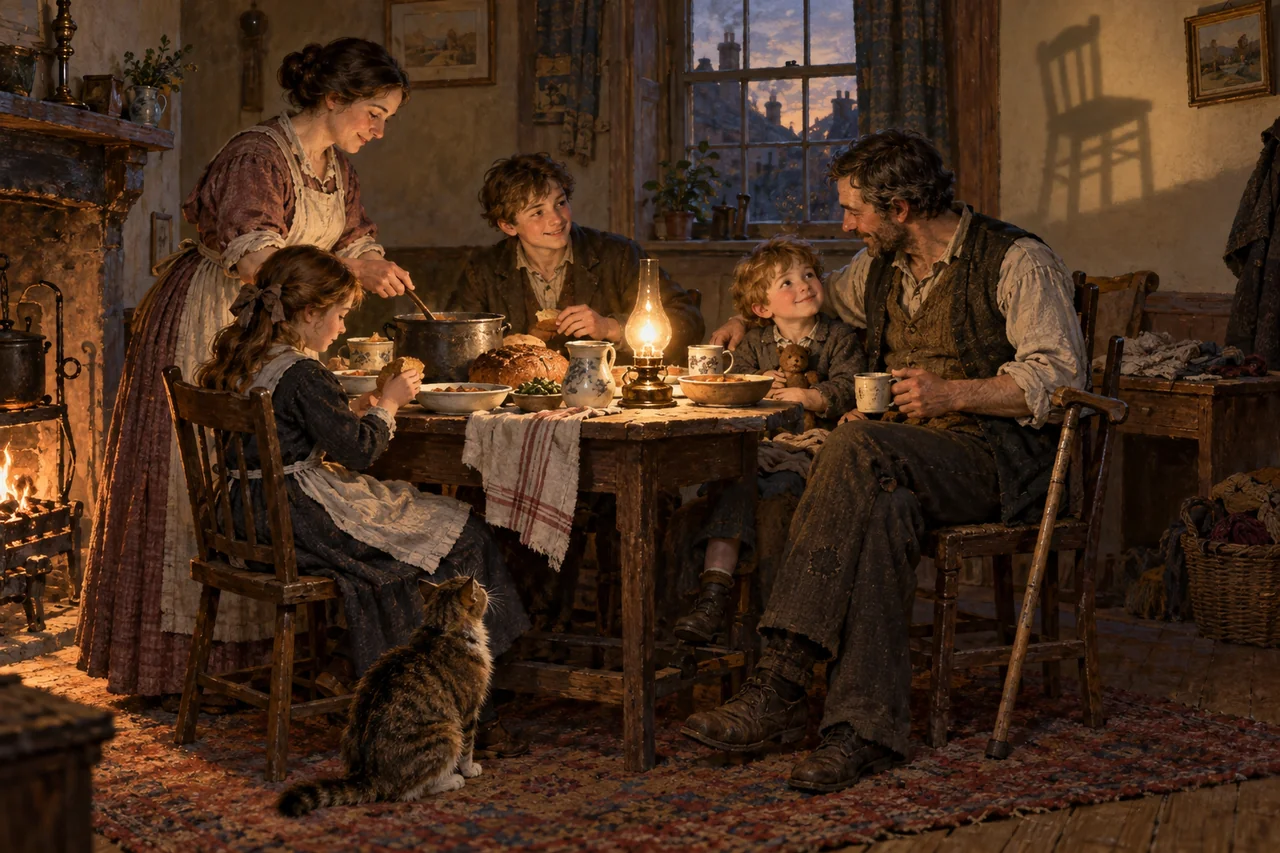
Image: illustration, not a documentary photograph. · Original generated conceptual literature illustration; independently reviewed original artwork.
Stave 3: the Cratchits, pathos and the return of Scrooge’s words
The Cratchits enter the story through work, preparation, movement and conversation. Martha has been delayed by labour; other children help bring the meal together; Bob carries Tiny Tim home. These details give the household individual roles before it becomes part of Scrooge’s education. A weak response may describe the family as simply poor but happy, allowing a general moral to replace the scene. A stronger response asks how happiness is constructed under limited conditions and whose effort sustains it. The meal does not arrive by magic. Its preparation connects pleasure to labour, and Martha’s late arrival reminds us that the celebration occupies time carved out of an unequal working life. Dickens lets company matter without making scarcity disappear.
The meal’s presentation enlarges ordinary things into an event. Repeated admiration of the goose and pudding expresses the family’s pleasure, while anxious possibilities about the pudding introduce comedy and suspense on a domestic scale. Their praise should not be taken as an objective statement that the meal is lavish by every standard. The narration makes a modest provision feel abundant through anticipation, shared attention and language. That is why a response should examine both the small material quantity and the large imaginative celebration. Either fact alone gives an incomplete account. The episode’s warmth contrasts with Scrooge’s office, but the contrast concerns ways of valuing and sharing resources as well as their amount.
Bob and Mrs Cratchit do not give the same judgement of Scrooge. Bob’s toast names him as the provider of the feast, while she objects to the employer’s conduct before agreeing to drink for Bob and the day. This disagreement is important evidence against treating the family as a single sentimental voice. Gratitude, dependence and anger can coexist within a household. A reader may interpret Bob’s response as generous or conciliatory, and his wife’s as a clearer statement of injustice, but each reading should account for the situation. Bob depends on the employer for income; Mrs Cratchit’s protest names the harm that a festive courtesy might seem to overlook. Dickens stages a tension rather than removing it with a universal instruction to be thankful.
Tiny Tim’s place in the family is not exhausted by the possibility of his death. He joins the celebration and his blessing follows those of others, placing him within a shared act of speech. Bob reports his thought about being seen at church, which connects his physical condition with a Christian account of care and healing. Keep the reporting clear: we hear Bob convey what the child told him, not an independent medical assessment. The scene invites affection and concern, but modern readers can also ask how the use of a vulnerable child makes an argument persuasive. A respectful reading preserves his participation and voice while examining the pathos through which the narrative confronts Scrooge. Do not assign a diagnosis or treat disability itself as evidence of moral purity.
The Spirit’s image of a vacant seat and an ownerless crutch gives absence a concrete form. It projects a possible loss through objects already associated with a person, making the threat more particular than a statistic. Its conditional phrasing matters: the child will die if the future remains unaltered. A response that says the Spirit proves an inevitable fate would miss the opportunity for intervention that runs through the story. Equally, do not turn the warning into a clinical prediction based on identified symptoms. Within the fictional encounter, it reveals a consequence that Scrooge must confront. The child’s survival in the ending will test whether the warning has prompted altered conduct, rather than establishing a universal claim about what generosity can cure.
The return of Scrooge’s population language changes its force. In the opening he used a general category to distance himself from suffering; the Spirit repeats the idea when he has become anxious about an individual child. The words are therefore not merely quoted twice for emphasis. Their second situation exposes what the first use refused to imagine. Scrooge’s grief and penitence show that he now hears the moral implications differently. Analysis can connect repetition to this altered context instead of treating it as an isolated technique. The Spirit’s challenge also contests his assumed authority to decide whose life is surplus. That is a judgement within the novella’s dialogue, not a demographic model whose terms should be reproduced as neutral descriptions of people.
Historical context can sharpen the reading if it remains attached to an exact problem. Parliament’s account of the 1834 relief reforms describes deterrent aims and harsh workhouse conditions, while also noting variations in support and treatment. This helps explain why Scrooge’s earlier appeal to institutions is not automatically adequate care. It does not establish that every family had the same experience or that the Cratchits are a documentary case. Avoid an unrelated block of facts about all Victorians. The more useful question is how a literary household challenges language that reduces need to an institutional provision or population category. Dickens constructs an encounter in which the speaker must recognise particular people, but the individual story does not itself resolve every structural cause of poverty.
An analytical response should preserve the scene’s tensions: pleasure with scarcity, gratitude with protest, a child’s participation with threatened loss, and general words with individual consequences. These are not flaws to be tidied away. They make the household more than an illustration of one easy slogan. For a whole-text argument, compare the office’s restricted coal with the family’s shared resources, then examine the ending’s changes to pay, warmth and support. The contrast shows reform in an employment relationship, not only a new emotion. A reasoned alternative could question how strongly the novella depends on an exceptional generous employer; it becomes persuasive when it still accounts for the narrative’s attention to material needs and the family’s distinct voices.
Image: illustration, not a documentary photograph. Imagined family meal with a faint symbolic empty-seat shadow. Warmth and mutual care coexist with limited resources; the shadow refers to a conditional warning, not a diagnosis or proof that deprivation is harmless. This original conceptual rendering is an interpretation; use the primary text and lesson prose as evidence.
Worked example: Explain how the Cratchit Christmas scene combines warmth with a criticism of Scrooge’s treatment of other people. Use both the household’s disagreement and the Spirit’s warning.
Set up the tension rather than erasing one side of it. The family’s pleasure is genuine within the scene, but limited food, Martha’s work and Bob’s dependence remain visible. Begin with an argument that warmth reveals ways of sharing, not that happiness proves hardship harmless. This allows the response to connect domestic narration with the wider question of responsibility. It also prevents a patronising assumption that poor people are uniformly content with deprivation.
Read Bob’s toast and Mrs Cratchit’s protest as different judgements made within one household. The disagreement interrupts an easy story of collective gratitude. Explain how dependence on an employer can coexist with resentment of his behaviour, while keeping interpretation qualified: Bob does not deliver a full explanation of his motive. Her concession is made for Bob and Christmas, rather than as a withdrawal of the objection. The exact conversational sequence is stronger evidence than describing the family as one moral symbol.
Move to Tiny Tim’s participation before discussing his possible death. His reported thought and blessing give him a place in the scene; the warning concerns a person the reader has encountered, not an anonymous example. Analyse the vacant seat and crutch as signs of an imagined absence. Do not infer a diagnosis from them. The emotional effect arises from continuity between the living household and what could be missing from it.
Preserve the condition in the Spirit’s warning. A future left unaltered threatens loss, so the scene creates a reason for change rather than proving that intervention is useless. This distinction will matter when the ending states that Tim survives. It should not become a claim that charity guarantees medical outcomes. The fictional warning tests Scrooge’s response to consequences he had refused to consider at the opening.
Explain how the repeated population words expose that refusal. Their first use dismisses suffering at a distance; their return accompanies concern for a named child. The changed situation makes Scrooge hear the moral weight of his own language. A label such as repetition is only the start of analysis. The response needs to show what the later use reveals and how Scrooge’s reaction differs from his earlier certainty.
Finish with a concrete whole-text test. The ending’s pay, fuel and support change the employment relationship that helped produce the earlier difficulty. This does not mean one reformed employer supplies a complete solution to poverty. It does show why warmth in the family scene and criticism of Scrooge belong together: the family’s human value demands a more adequate material response. Check that the conclusion preserves both the domestic celebration and the conditions it cannot by itself overcome.
Answer: The Cratchits’ warmth does not cancel Dickens’s criticism of Scrooge. The shared meal is created through effort and limited resources, while Bob’s toast and Mrs Cratchit’s protest make gratitude and anger coexist. Their disagreement prevents the household from becoming one uncomplicated voice. The Spirit then connects threatened loss to a child already participating in that household, making the vacant seat and crutch signs of a particular absence. By repeating Scrooge’s population language in this situation, it exposes what his earlier general dismissal excluded. The conditional warning creates a reason for changed conduct, not a medically guaranteed rescue. Pay, warmth and support at the ending give that conduct a material test, although one employer’s reform cannot be taken as a complete answer to poverty.
Check your understanding: Changed task: respond to the claim that the Cratchits’ happiness shows that material hardship does not matter. Include an alternative reading of the narration, and explain its limits.
Answer: The narration can be read as showing that company and shared attention create pleasures which wealth alone cannot provide. The family’s admiration of the meal and involvement in its preparation support that interpretation. It does not follow that material hardship is irrelevant. Martha’s labour, the small provision and the threat to Tiny Tim remain part of the scene, while Mrs Cratchit’s protest challenges the employer whose income the family depends upon. An answer should therefore separate the value of relationships from the claim that deprivation needs no remedy. The ending strengthens this distinction by changing pay, fuel and support rather than offering pleasant words alone. One may question the sentimental emphasis on family harmony, but a persuasive challenge must account for the disagreement and vulnerability Dickens includes within the celebration.
Why: Worked-method rationale: the argument keeps distinct voices and conditional warnings visible, preventing a generic poor-but-happy summary. It analyses repeated language through its changed situation and avoids medical or demographic claims. Changed-method rationale: the second response grants the value of shared pleasure but tests the inference that hardship therefore does not matter. It also allows criticism of sentimental narration without ignoring counterevidence. Contextual support is limited to the documented relief arrangements, not presented as a complete causal history of the fictional household.