Stave 3: widening community and a warning that interrupts abundance
By UK GCSE English Literature · independent study · myAudience
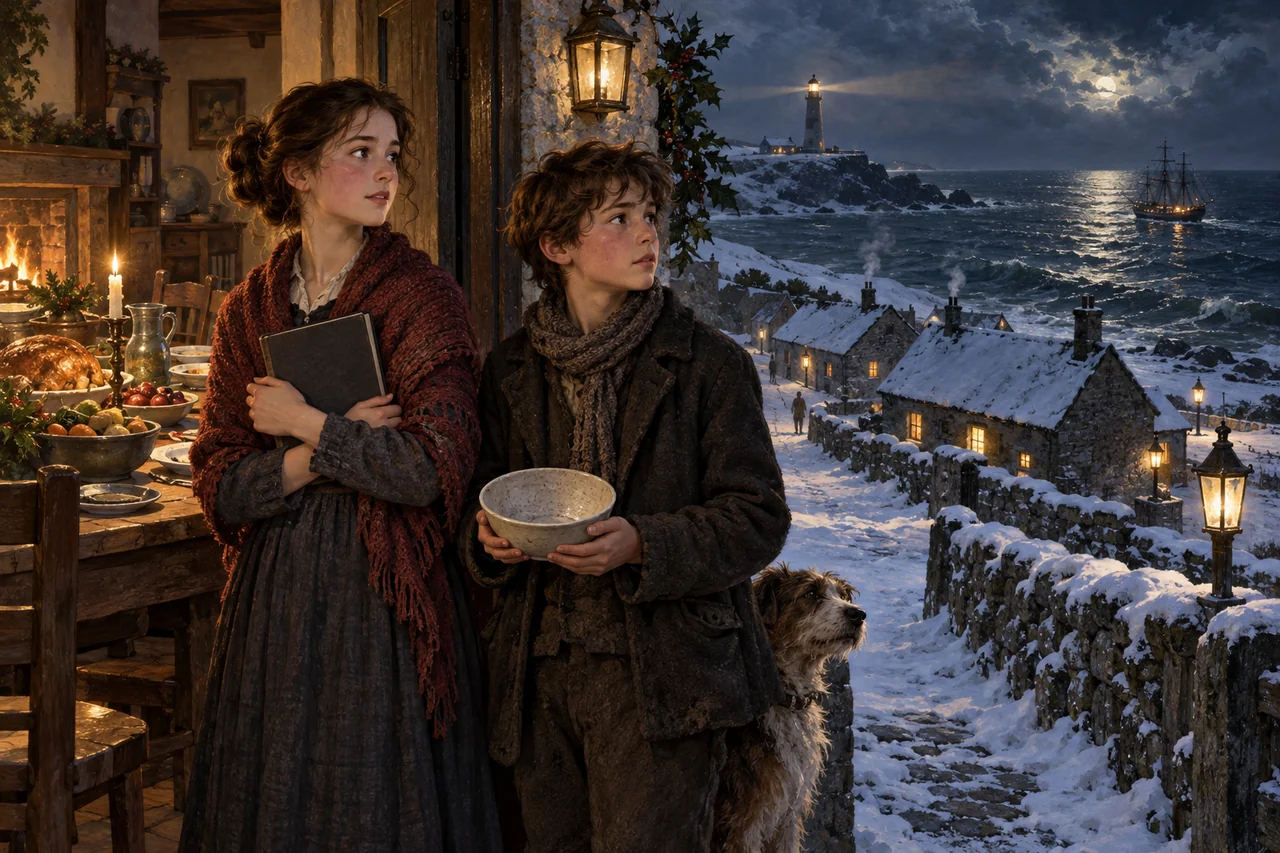
Image: illustration, not a documentary photograph. · Original generated conceptual literature illustration; independently reviewed original artwork.
Stave 3: widening community and a warning that interrupts abundance
The Ghost of Christmas Present begins with apparent abundance, but the stave does not remain inside one comfortable room. Its movement takes Scrooge through the Cratchit household, other celebrations and eventually the disturbing figures of Ignorance and Want. This expansion matters to an argument about responsibility. Scrooge has treated other people’s lives as outside his business; the Spirit repeatedly places those lives before him. The journey is not a statistical survey of Christmas across Britain, nor evidence that every household shares the same beliefs. It is a sequence of selected fictional scenes through which the reader can test the narrowness of his earlier view. Attention moves from one individual’s refusal towards different forms of connection and neglect.
The miners, lighthouse keepers and people aboard a ship extend the reach of the celebration beyond familiar domestic settings. Distance, difficult weather and work do not prevent these groups from remembering relationships or sharing a moment with others. The contrast should not become a claim that danger or deprivation is picturesque. A reader can notice that the conditions remain difficult while the scene gives meaning to acts of connection within them. The ship is especially useful for analysing the difference between physical proximity and remembered belonging. People can be far from home yet think of those associated with it. Scrooge, by contrast, has living opportunities nearby and deliberately keeps them at a distance.
Fred’s gathering gives that deliberate distance another perspective. The nephew recognises his uncle’s disagreeable behaviour but does not treat it as a reason to abandon every invitation. His account suggests that Scrooge deprives himself as well as refusing others. This is not the same as saying that all harm falls on the person who behaves badly: Bob’s workplace has already shown otherwise. The gathering can also make Scrooge an object of amusement, which means its goodwill is not an entirely solemn ideal. Analyse how laughter, judgement and continued welcome coexist. Fred’s refusal to give up is significant because it opens a relationship that Scrooge has closed, while the reader still sees the uncle through the group’s critical and comic responses.
The different settings build an interpretation of Christmas as a practice of attention rather than simply a luxurious possession. The people shown do not all have the same resources, and the journey does not erase distinctions in comfort or power. An answer should therefore avoid treating celebration as proof of universal equality. Dickens can place shared customs across social and geographical differences while leaving the differences visible. This helps explain why the stave’s ending is so disruptive. If the reader accepts abundance and goodwill as a complete account of the world, the neglected children force a revision. The Spirit’s journey has trained Scrooge to look outward, but looking outward must include suffering that a pleasing celebration might otherwise leave outside its frame.
The children emerge from beneath the Spirit’s robe near the end of its life. Their placement links neglect to a scene that has seemed generous and plentiful, rather than locating it in a wholly separate world. The description is disturbing and exaggerated, so it should be read as allegorical construction rather than as a neutral portrait of actual children. When the Spirit identifies them as Ignorance and Want, it turns social problems into vulnerable figures that require recognition. A respectful response can examine the narrative’s use of bodily distress without repeating its description as a judgement of poor children themselves. The warning asks who has allowed these conditions to develop; it does not establish that deprivation makes a person less human.
Ignorance and Want are related but not interchangeable. Want names deprivation and unmet need, while ignorance points towards a lack of understanding, education or recognition that the warning associates with future danger. The Spirit gives the boy particular emphasis and says that the threatened outcome may be changed. Keep this as a textual distinction, not a universal ranking that education always matters more than material support. The gendered allocation belongs to the novella’s allegory and does not describe qualities naturally belonging to boys or girls. A strong answer explains how the two figures work together and why the warning remains conditional. It should not invent a detailed policy programme that the scene never supplies.
The Spirit calls the children humanity’s rather than accepting them as its own private responsibility. This redirects Scrooge’s question towards a collective failure. The return of his prison and workhouse language then connects the warning to his earlier confidence in institutions. A quotation repeated in a new situation can expose the assumptions of its first speaker. The questions no longer sound like a sufficient answer to need when the need is embodied before him. Historical context about relief arrangements may illuminate that inadequacy, but it is not necessary to claim that Dickens condemns every possible institution. The scene challenges the refusal to look further once an institutional name has been supplied, while leaving the reader to consider what a more adequate response would require.
An argument about this stave should follow its change of scale and tone. Begin with the outward journey, explain one contrast between connection and deliberate exclusion, and then show why the allegorical ending interrupts an easy celebration. The structure gives the warning its force: a reader has been invited to recognise shared humanity before encountering evidence of its neglect. A competing response might argue that the cheerful scenes soften the criticism or make it sentimental. That is worth testing against the harshness of the ending and the conditional threat attached to ignorance. Avoid announcing that all readers must agree with one moral. The stronger conclusion explains what the arrangement makes difficult to ignore, while preserving both the comfort and the unease that the stave creates.
Image: illustration, not a documentary photograph. Imagined distant communities and two dignified symbolic young figures. The contrast between shared celebration and unmet learning/material needs evokes the novella’s warning; these invented objects are explanatory symbols, not details claimed to be Dickens’s text. This original conceptual rendering is an interpretation; use the primary text and lesson prose as evidence.
Worked example: How does the ending with Ignorance and Want change the meaning of the wider Christmas journey? Develop a complete response that connects one distant celebration with the final warning.
Construct a thesis about structure rather than simply naming the children as symbols. The stave extends belonging across distance and different circumstances, then exposes conditions that such belonging has failed to remedy. That movement means the final warning revises the reader’s experience of abundance. It does not erase the earlier pleasures or prove they were fraudulent. It requires an account of why shared attention cannot stop at attractive scenes.
Choose one distant setting and identify what remains difficult there. The ship or lighthouse can show people connected with others despite physical separation, but neither proves that labour or danger has disappeared. Explain the contrast with Scrooge’s self-imposed separation from nearby people. This gives the journey an analytical function: it challenges the idea that company depends only on convenience or wealth. Do not combine the selected scenes into an unsupported historical description of everyone’s Christmas.
Locate the children beneath the Spirit’s robe and explain the change in tone. Their emergence places neglect within a figure associated with abundance, making it harder to treat suffering as wholly outside the celebration. The personification gives abstract problems a vulnerable form, but the response should not equate real poor children with monsters. The descriptive violence belongs to the warning’s rhetorical construction and needs to be analysed as such.
Distinguish the figures and the condition attached to the threat. Ignorance and Want point towards different but connected failures. The emphasis on ignorance does not establish a universal formula that education alone will solve deprivation. The possibility of altering the threatened outcome keeps responsibility active. An answer should explain these distinctions rather than treating both children as one interchangeable emblem of sadness.
Connect the warning to Scrooge’s earlier questions about institutional relief. Repeating those questions now exposes the inadequacy of using their existence to close discussion. The changed situation gives the same words a different force. If using context, introduce only what helps explain this problem of distance and provision; avoid a detached list of facts about the whole century. The argument should remain rooted in the scene’s language and arrangement.
Conclude by weighing the celebratory and disturbing elements together. The wider journey suggests the value of connection, while the ending demands attention to people whose need has not been met. A qualified judgement is stronger than saying either that Christmas fixes everything or that the happy scenes mean nothing. Check that the response explains the movement through the stave and includes a genuine alternative reading, rather than attaching a formulaic counterargument unrelated to the evidence.
Answer: The wider journey makes connection seem possible across distance, as people aboard a ship remember others despite separation from home. Scrooge’s deliberate exclusion from nearby relationships is therefore challenged. The emergence of Ignorance and Want then interrupts any idea that shared celebration is enough. Beneath a Spirit associated with abundance, the vulnerable figures expose needs that remain unaddressed. Their identification directs attention towards different failures, and the conditional warning makes change necessary rather than impossible. The return of Scrooge’s institutional questions also reveals how easily names of provision can substitute for attention to actual people. The ending consequently deepens, rather than simply cancels, the journey’s goodwill: connection must include recognition of neglected lives, not only enjoyment of cheerful scenes.
Check your understanding: Changed task: explain why Ignorance and Want should not be treated as interchangeable, and evaluate the claim that the scene says education alone can solve poverty.
Answer: The two figures connect different failures. Want directs attention towards deprivation, while Ignorance raises questions about understanding, education and the danger of refusing to recognise need. The Spirit’s stronger warning about the boy makes the distinction significant, but it does not present a complete policy or say that material support is unnecessary. Both children appear together and require attention. The conditional threat also implies that the future depends on responses still to be made. An interpretation centred on education can be supported by the emphasis on ignorance, provided it does not erase want or turn a symbolic warning into a universal social formula. Their gendered presentation belongs to the allegory rather than describing natural differences between real children.
Why: Worked-method rationale: the response follows the stave’s structural expansion and interruption instead of extracting one symbol from its setting. It retains the difficulty of the distant scenes and analyses personification without endorsing dehumanising descriptions. Changed-method rationale: the second answer identifies a genuine difference but resists exaggerating it into an exclusive solution. It treats context as support for an interpretation, not as a substitute for reading the paired figures. Formal assessment remains open, and other supported readings are possible if they account for the conditional warning.